
Alabama Author Wants People to Take a “Fresh Look at Roadkill”
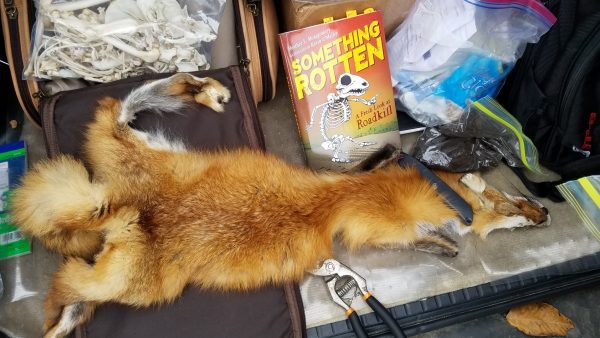
"Something Rotten, A Fresh Look at Roadkill" explores what we can learn from studying roadkill.
When North Alabama author Heather L. Montgomery sets her mind to something, she commits. Trekking through the woods on the side of Highway 65 near Cullman, she points to a spot a few yards away.
“This is kind of the environment that I was in when, ok I was driving down the road and I saw a turtle and it was just coming on to the pavement,” Montgomery says.
She thought to herself, ‘this turtle needs help.’ So she pulled off on the side of the road to move it to safety. More often, by the time she arrives, it is too late for that. The animals have become roadkill. But Montgomery, a naturalist and biologist, still stops, because she says their bodies have a story to tell.
“And then when I realized that there are other people that, like, paid attention to roadkill, it blew my mind,” Montgomery says.
Mary Scott Hodgin
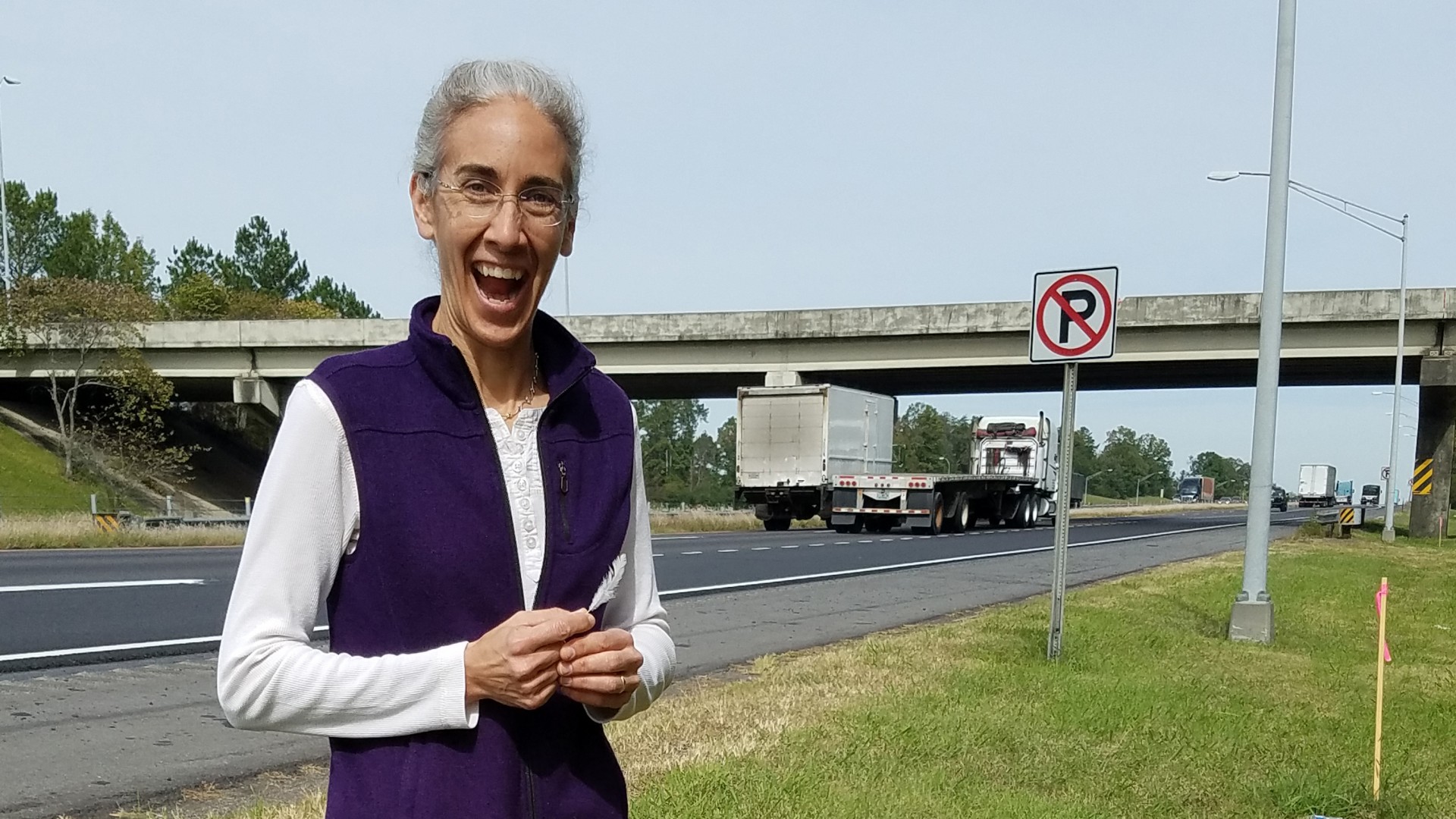
North Alabama author Heather L Montgomery is an educator and a trained biologist.
In her new book, Something Rotten, A Fresh Look at Roadkill, Montgomery shares her journey to find these people. She interviews a biologist in Australia who studies cancer in dead Tasmanian devils, and herpetologists who collect run-over snakes, classified as D-O-R, “Dead on the Road.” Sometimes these roadkill-obsessed scientists discover new species. Others study roadkill to prevent it. There are engineers who find “hot spots” where animals often get hit, then build tunnels for them to cross underground or set-up barriers to restrict access.
“How do we know where animals live? Well, roadkill. How do we know when they mate? Well, roadkill.” Montgomery says. “These are answers that we can find, that are sitting there by the road. We just have to ask the questions.”
Montgomery has published more than a dozen books, exploring topics like insect parenting and bugs with rude behavior. She writes for kids, but really for anyone who is not afraid of a little gross.
“Adults are fascinated by this material too,” she says, “but we’ve kind of trained ourselves to not look at things, and kids aren’t limited. They’re not inhibited yet.”
In Something Rotten, Montgomery describes beetle larvae that eat away at flesh and parasites that feed off of dead animals. She says the gore serves a purpose, showing what we can learn from what she calls the tragedy of roadkill. Armed with plastic gloves, hand sanitizer and a knife, she is always prepared to pull over on a busy road or highway.
“So this is what I carry with me, so that when I find an animal, either if it’s an animal that needs to be submitted to the natural history museum, or if I need to collect parts for scientists or if I’m going to use that body for educational materials, this is what I have,” Montgomery says.
She does not advise people to go out and collect dead animals themselves, not without training. But Montgomery hopes Something Rotten will reshape how readers look at roadkill.

Park Fire in California could continue growing exponentially, Cal Fire officer says
Cal Fire has confirmed that over a hundred structures have been damaged in the Park Fire, which grew overnight near Chico, Calif. Difficult firefighting conditions are forecast through Friday night.
Checking in with Black voters in Georgia about the election, now that Biden is out
Some voters who could be key to deciding who wins Georgia. What do they think about Vice President Harris becoming the frontrunner in the race to be the Democratic nominee?
Tahiti’s waves are a matter of ‘life and death’ for surfing Olympics
Tahiti's Teahupo'o wave has a slew of riders for the Paris 2024 Olympics. NPR finds out why it's called one of the most dangerous waves.
Researchers are revising botanical names to address troubling connotations
Since the mid-1700s, researchers have classified life with scientific names. But some of them have problematic histories and connotations. The botanical community is trying to tackle this issue.
A spectacular opening ceremony wowed a global audience despite Paris’ on-and-off rain
The Paris Olympics opening ceremony wowed Parisians, fans and most everyone who was able to catch a glimpse of thousands of athletes floating down the Seine to officially begin the Games.
Kamala Harris faces racism and sexism as she moves closer to presidential nomination
As Vice President Kamala Harris ramps up her campaign for president, Republicans are trying out new — and old — attacks focused on her race and gender, including calling her a "DEI candidate."