
19 states sue over Trump’s voting executive order, arguing it’s unconstitutional
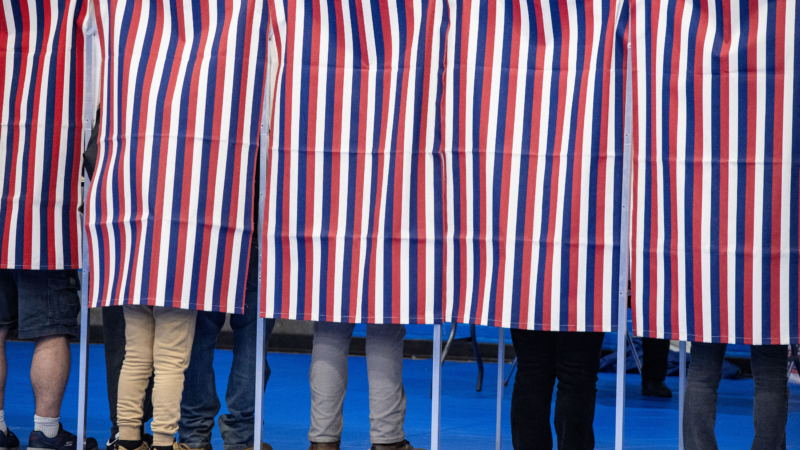
Nineteen states are suing over President Donald Trump’s sweeping executive order on voting that he signed last week, saying it is “an unconstitutional attempt to seize control of elections” that will create barriers to voting that could disenfranchise millions.
The lawsuit, which is the fourth legal challenge so far against the executive order, calls on a federal district court in Massachusetts to block several provisions of the executive order, which the attorneys general argue “usurps the States’ constitutional power and seeks to amend election law by fiat.”
The lawsuit is filed by Democratic attorneys general from Arizona, California, Connecticut, Colorado, Delaware, Hawaii, Illinois, Maryland, Maine, Massachusetts, Michigan, Minnesota, Nevada, New Mexico, New Jersey, New York, Rhode Island, Vermont, and Wisconsin.
“We are a democracy — not a monarchy — and this Executive Order is an authoritarian power grab,” said New York Attorney General Letitia James in a statement. “With this Order, this President is prioritizing his own quest for unchecked power above the rights and will of the public.”
Trump’s March 25 order seeks to make dramatic changes to voting and election administration and threatens that if states do not comply they could lose federal funds and face potential action from the U.S. attorney general.
Among the changes, the executive order directs the Election Assistance Commission – an independent, bipartisan body — to rewrite the federal voter registration form to include a requirement that Americans must show a copy of a proof of citizenship document to register to vote in federal races. It also aims to prevent states from counting mailed ballots that are postmarked by Election Day but arrive after the election, which 18 states currently allow.
The lawsuit argues that these changes cannot be ordered by a president, since it is up to states and Congress to decide how elections should be run. It also argues the president cannot direct the Election Assistance Commission to take actions since it is an independent body, and that adding a proof of citizenship requirement on the federal registration form conflicts with existing federal law.
The suit says the executive order “sows confusion and sets the stage for chaos” since states will have to divert staff and resources toward implementing new training, testing, voter education and coordination “at breakneck pace” to comply with the order – or risk losing needed funds if they don’t comply.
Three other federal lawsuits have already been filed this week against the executive order. All are assigned to U.S. District Court Judge Colleen Kollar-Kotelly in Washington, D.C. who ordered Thursday that the three suits will be consolidated and will proceed together.
Two of those lawsuits were brought by voting rights groups on behalf of organizations that assist voters with registration. The other was brought by Democratic election attorney Marc Elias’ law firm on behalf of Democrats.
Trump has said his executive order is necessary to stop fraud and “straighten out our elections.”
False claims about election fraud have become part of Trump’s brand, the most notable example being his denial of his 2020 election loss.
In the leadup to the 2024 election, Trump promoted the bogus theory that Democrats would attempt to steal the election by helping noncitizens vote in large numbers. There is no evidence of such a plot.
In fact, past audits have shown that cases of noncitizens voting are rare. Under current federal law, voters must attest, under penalty of perjury, that they are U.S. citizens when they register to vote, and some states take additional steps to verify citizenship. Those who try to vote illegally can face prison time and deportation.
Still, in response to the lawsuit filed by Democrats challenging the executive order, U.S. Senator Mike Lee, R-Utah, posted to X, “Why are top Democrats suing to allow non-citizens to vote in American elections? You know why.” Billionaire Elon Musk, who owns X and is a top adviser to Trump, shared Lee’s post with one word, “Fraud.”
The lawsuits challenging the executive order argue that requiring voters to show a copy of a proof of citizenship document to register to vote would create an unlawful burden on voters, and conflicts with the 1993 federal law, the National Voter Registration Act, that spells out registration requirements.
More than 21 million American adults do not have a proof of citizenship document like a birth certificate or passport, or do not have easy access to one, according to a survey commissioned by voting rights advocates. Furthermore, Trump’s executive order only names a limited number of documents that can be used to prove citizenship: a U.S. passport, military ID cards that state citizenship, or a government-issued photo ID that lists citizenship, though most states do not offer IDs that list citizenship. It remains unclear if birth certificates are a valid way to prove citizenship under the executive order. Only half of Americans have a passport.
Meanwhile, Republican lawmakers are backing federal legislation that will change federal law to require proof of citizenship to register to vote. Republican House leaders said in a statement on Monday that the Safeguard American Voter Eligibility Act, known as the SAVE Act, “cements into law President Trump’s executive action to secure our voter registration process and protect the voices of American voters.”

Opinion: Remembering Ai, a remarkably intelligent chimpanzee
We remember Ai, a highly intelligent chimpanzee who lived at the Primate Research Institute of Kyoto University for most of her life, except the time she escaped and walked around campus.
The near death — and last-minute reprieve — of a trial for an HIV vaccine
A trial was about to launch for a vaccine that would ward off the HIV virus. It would be an incredible breakthrough. Then it looked as if it would be over before it started.

Bessemer data center developer to request rezoning for additional 900 acres
The city’s attorney informed council members of the request on Tuesday, warning that there may be media scrutiny.
Is RFK Jr.’s Administration for a Healthy America — AHA — in the works or not?
The Administration for a Healthy America is RFK Jr.'s plan to tackle chronic disease, addiction and other persistent problems. But so far it's not being set up like previous new agencies.
Major plumbing headache haunts $13 billion U.S. carrier off the coast of Venezuela
The crew of USS Ford is struggling to handle sewage problems on board the Navy's newest carrier.
Events in Minneapolis show how immigration enforcement has changed. What’s the impact?
Minneapolis is at the center of sweeping, evolving federal immigration push. It demonstrates how different immigration enforcement is under Trump's second administration - and raises questions about the lingering effects on local communities and law enforcement.
