Court filings provide additional details of the US’ first nitrogen gas execution
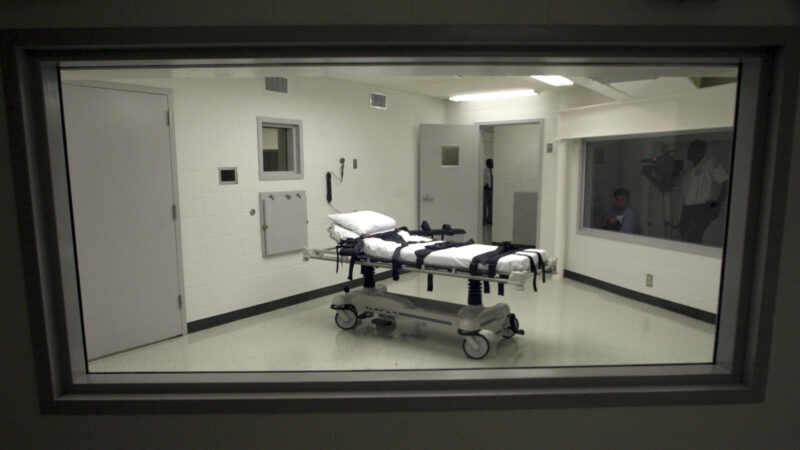
Alabama's lethal injection chamber is shown Oct. 7, 2002, at Holman Correctional Facility in Atmore, Ala. Court filings are providing new details of what happened in the nation's first execution using nitrogen gas on Jan. 25, 2024.
MONTGOMERY, Ala. (AP) — A corrections officer who helped carry out the nation’s first nitrogen gas execution said in a court document that the inmate had normal blood oxygen levels for longer than he expected before the numbers suddenly plummeted.
Another court document indicated that the nitrogen gas was flowing for at least 10 minutes during the execution. The documents filed last month in ongoing litigation provided additional details of the execution of Kenneth Smith, who was the first person put to death using nitrogen gas.
Alabama Attorney General Steve Marshall’s office maintains the high oxygen readings indicate that Smith held his breath as the nitrogen gas flowed, causing the execution to take longer than expected. But attorneys for another inmate said the state has no proof to back up that claim and is trying to “explain away” an execution that went horribly awry.
As the state of Alabama plans additional nitrogen gas executions, questions and disagreements continue over what happened at the first one. A federal judge on Tuesday will hear arguments in a request to block the state from executing Alan Miller by nitrogen gas in September in what would be the nation’s second nitrogen execution.
Media witnesses to Smith’s execution, including The Associated Press, said that Smith shook on the gurney for several minutes before taking a series of gasping breaths. Alabama had assured a federal judge before the execution that the new execution method would quickly cause unconsciousness and death.
A pulse oximeter showed that Smith had oxygen levels of 97% to 98% for a “period of time that was longer than I had expected,” the corrections captain said in a sworn statement. The corrections captain said he did not observe Smith make any violent or convulsive movements, but he did tense up and raise his body off the gurney. After “he released a deep breath,” the oxygen levels began dropping, the corrections captain said.
“The best explanation of the testimony is that Smith held his breath and lost consciousness when he breathed nitrogen gas — not that the mask did not fit or that the nitrogen was impure,” the Alabama attorney general’s office wrote in a court filing.
Attorneys for Miller responded that the state has no evidence to back up that claim and said it would be impossible for someone to hold their breath for as long as the execution took. Instead, they suggested other problems with the mask accounted for the delay.
“It should therefore not be surprising that Mr. Smith did not lose consciousness after a few breaths — as the State repeatedly promised this Court. Instead, Mr. Smith’s entire body — including his head — convulsed and jerked violently, heaving against the straps with enough force to move the gurney,” attorneys for Miller wrote.
Dr. Philip E. Bickler, an expert hired by Miller’s defense, wrote in a court document that most people can hold their breath only a minute or less.
The court filing, which was later placed under seal, indicated that the nitrogen gas was flowing for at least 10 minutes. Bickler wrote that he that he understands that Alabama’s “execution log states that 10 minutes passed in between the initiation of the flow of nitrogen gas to Mr. Smith” and when the corrections’ officer performed a consciousness check on Smith.
Unless stopped by the court, Alabama plans to execute Miller with nitrogen gas on Sept. 26. Miller, a delivery truck driver, was convicted of killing three men — Terry Jarvis, Lee Holdbrooks and Scott Yancy — during back-to-back workplace shootings in 1999.
Alabama had previously attempted to execute Miller by lethal injection. But the state called off the execution after being unable to connect an IV line to the 351-pound inmate. The state and Miller agreed that any other execution attempt would be done with nitrogen gas.
Miller said in a deposition, however, that he did not trust the state to properly fit the gas mask. “And these guys can’t even open a cell door sometimes. They’re keystone cops is basically what they are,” he said.
The attorney general’s office is also seeking an nitrogen gas execution date for Carey Dale Grayson, who was convicted in the 1994 killing of Vickie Deblieux in Jefferson County.
An attorney for Grayson said the descriptions of Smith’s execution show there needs to be more scrutiny of the new execution method.
“Even after the first execution, we have more questions than answers. We need to slow down, not speed up,” John Palombi, an attorney with the Federal Defenders Program, said.

DHS ends Temporary Protected Status for thousands from Nicaragua and Honduras
Some 76,000 people from Nicaragua and Honduras were covered by TPS, which provides protection from deportation and grants work permits to people from certain nations affected by war or natural disasters.
DOJ says no evidence Jeffrey Epstein had a ‘client list’ or blackmailed associates
The two-page memo outlines the "exhaustive review" the department conducted of the Epstein files in its possession, and also reiterates that Epstein died by suicide, contrary to some conspiracy theories.

Floods are getting more dangerous around the country, not just in Texas
The deadly floods in Central Texas were caused by extremely heavy rain. Climate change is causing even more rain to fall during the heaviest storms.

Near old Montana mine, special clinic for asbestos-related illness fights to survive
The Center for Asbestos Related Disease in Libby, Montana, closed in May after a court judgment. The clinic's federal funding is also threatened. Patients with scarred lungs worry about what's next.
4 things to know about the deadly Texas floods and ongoing search efforts
Search efforts continue for the dozens of people still missing after Friday's floods, as questions swirl over what went wrong. Here's what we know so far.

In Peru, criminal gangs are targeting schools in poor neighborhoods for extortion
The president of one of Lima's largest parent-teacher associations says at least 1,000 schools in the Peruvian capital are being extorted and that most are caving into the demands of the gangs.