Racist wording is still in the Alabama Constitution. Voters can erase it
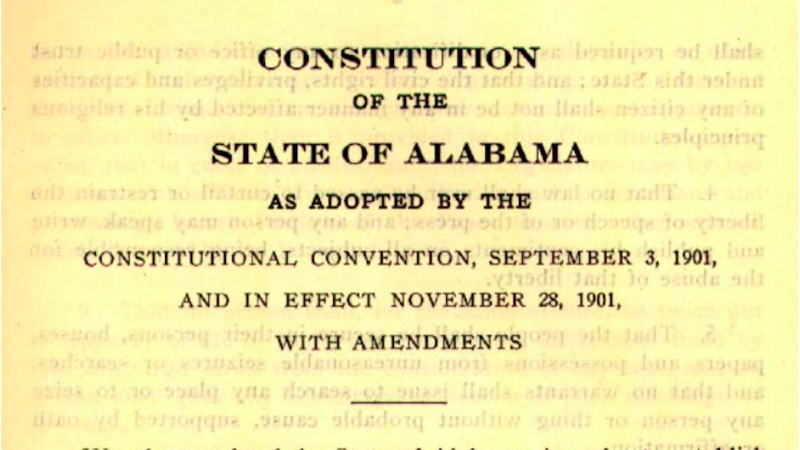
Alabama voters this year have the opportunity to reorganize the state’s Constitution, as well as remove racist language from the document.
Alabama voters this year have the opportunity to remove racist language from the state’s constitution. Portions of the document include language that allows slavery “for the punishment of crime,” poll taxes designed to keep Blacks and poor whites from voting and the segregation of schools.
Since the constitution was written in 1901, federal laws and court decisions have rendered much of this racist verbiage void, as well as some of the related schemes designed to protect the economic interests of the state’s elite. Still, the language remains in the state’s governing document.
The proposal is officially listed on the ballot as a question, “Shall the following Recompilation of the Constitution of Alabama of 1901 be ratified?”
It’s presented as a “recompilation” because, in addition to removing the racist language, the measure would also reorganize the document, which would then be titled “Constitution of Alabama of 2022.” If passed, it would group together amendments related to economic development and by county of application.
History of the recompilation
Having the recompilation on the ballot is actually the third step in a multi-year process. Two-thirds of voters approved an amendment in 2020 that allowed the Alabama Legislature to make specific changes in the constitution. Lawmakers then did the actual work of removing the racist bile and reorganizing the document, all of which was approved unanimously in both chambers of the Legislature.
Rep. Merika Coleman, a Democrat who represents House District 57 near Birmingham, sponsored the initiative. However, the measure was bipartisan from the start.
Reasons for the recompilation
There were multiple reasons for the recompilation according to Coleman.
“The way that our Alabama state constitution is devised right now, it is the longest operational constitution in the world,” Coleman said. “The recompilation will make that document user friendly now for the larger public.”
Improved accessibility, as well as the removal of racist language, will together, Coleman contends, improve the state’s economy.
“We want to make sure that folks know we’re open for business, have it easy for them to find [what they need] in our Alabama state constitution,” Coleman said. “But [the initiative] will also let them know, by removing the racist language, that we are open for business and that everyone is welcome here.”
What’s at stake
Ryan Hankins is the executive director of the Public Affairs Research Council of Alabama, an independent, non-partisan research organization. As it typically does for each election, PARCA has studied this year’s ballot measures to better explain their meaning and effect for the electorate.
“If voters approve the recompilation, there will be no changes to state law,” Hankins said. “If voters reject recompilation, there’ll be no changes to state law.”
Voters are only being asked to approve the reorganization of the constitution and removal of language that has already been nullified by other laws and court actions. However, he believes, if the measure is rejected, there will be serious consequences.
“What we can feel confident about is a rash of national media stories of how Alabama has again chosen to retain racist language, including separate, but equal schools; prohibitions on interracial marriage, and things of that sort,” he said. “If we are concerned about the reputation of Alabama at a national and international level, then the recompilation is a way to, if not improve our reputation, certainly to mitigate the worst effects of additional negative press.”
Fun facts
• According to PARCA, the Alabama Constitution of 1901 is currently 420,000 words—that makes it the longest document of its kind, not just in the U.S., but the world.
• The new version of the constitution — titled “Constitution of Alabama of 2022” — will be shorter, because redundant text has been deleted in the reorganization. Even so, the new document has a word count of 373,274 words. That’s still three times more words than the next-longest state constitution, and Hankins believes it will still be the longest document of its kind in the world.
• Alabama’s original constitution was written in 1901. It has been amended 977 times, including approximately 750 local amendments, specific to one county or municipality.


Poland’s Iga Świątek thrashes American Amanda Anisimova in Wimbledon women’s final
The Polish player emerged victorious after less than an hour of gameplay.

Israeli settlers beat U.S. citizen to death in West Bank
A 21-year-old Florida man was beaten to death by Israeli settlers while visiting family in the West Bank.
FEMA removed dozens of Camp Mystic buildings from 100-year flood map before expansion, records show
Federal regulators repeatedly granted appeals to remove Camp Mystic's buildings from their 100-year flood map, loosening oversight as the camp operated and expanded in a dangerous flood plain.

In Myanmar, a rush for rare earth metals is causing a regional environmental disaster
A drastic increase in unregulated production of rare earth minerals in Myanmar is causing serious environmental concerns downriver in Thailand, as China's influence in the sector looms large.
No playing Spanish-language music: Many immigrants say they have new rules for driving
As the Trump administration's crackdown continues, traffic stops have become increasingly important tools of enforcement. It has led many immigrants to take alternate modes of transportation.

In the Texas flood zone, volunteers help reunite lost pets with their owners
Hundreds of pets have been reported missing after the devastating floods in central Texas. Volunteers have been combing through debris to help reunite them with their owners.