
Police found a missing woman 60 years after she disappeared. She wants to stay hidden
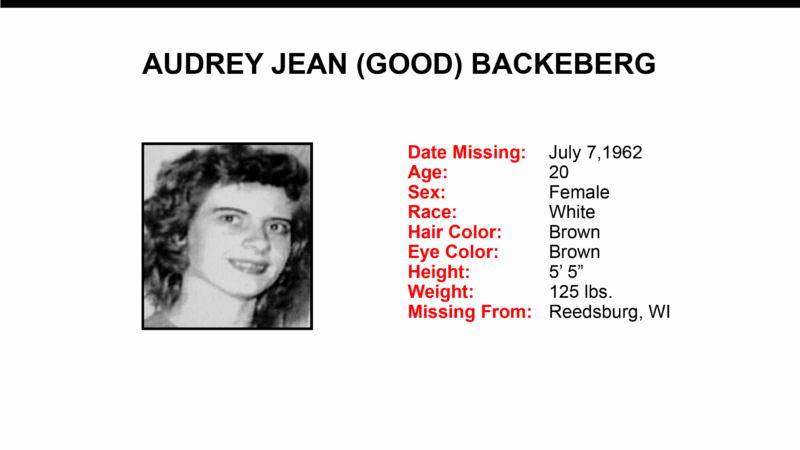
Six decades after a young mother vanished from her small city in south-central Wisconsin, authorities have found her alive and well living in another state.
Audrey Backeberg was 20 years old when she disappeared from Reedsburg in July 1962, according to a bulletin from the Wisconsin Department of Justice.
It says the family’s babysitter claimed that the two of them hitchhiked to Madison — about 55 miles away — and then took a Greyhound bus to Indianapolis, Ind.
“She said she last saw Audrey walking around the corner away from the bus stop,” it reads. “Audrey never returned home and has not been heard from again.”
That is, until now. The Sauk County Sheriff’s Office announced last week that it had resolved Backeberg’s long-cold missing persons case, saying she is “alive and well and currently resides out of State.”
“Further investigation has revealed that Ms. Backeberg’s disappearance was by her own choice and not the result of any criminal activity or foul play,” Sheriff Chip Meister said.
How was the case solved?
Meister said the case was assigned to a sheriff’s office detective earlier this year “for a comprehensive review as part of an ongoing examination of cold case files.”
That process included a “thorough re-evaluation of all case files and evidence, combined with re-interviewing witnesses and uncovering new insights,” Meister said.
The detective, Isaac Hanson, told local ABC affiliate WISN that he discovered Backeberg’s sister had an Ancestry.com account, which led him to new data including a possible address.
“So I called the local sheriff’s department, said, ‘Hey, there’s this lady living at this address. Do you guys have somebody who can just go pop in?'” Hanson recalled. “Ten minutes later, she called me, and we talked for 45 minutes.”
Hanson said he promised Backeberg that he would keep their conversation — and her whereabouts — private, but said “she had her reasons for leaving.”
“I think she just was removed and moved on from things and kind of did her own thing and led her life,” he added. “She sounded happy, confident in her decision. No regrets.”
NPR has reached out to the Sauk County Sheriff’s Office for more information.
What is known about her disappearance?
A Baraboo News Republic article published in 2002, on the 40th anniversary of Backeberg’s disappearance, holds some clues about what might have happened.
According to the article, of which NPR obtained a copy, Backeberg was last seen on July 7, 1962, picking up her paycheck from the woolen mill where she worked. Three days earlier, police received a report that her husband had abused her.
“(She reported) her husband had loaded a couple of guns and put them into the trunk of his car and threatened to kill her,” then-sheriff Randy Stammen told the newspaper.
By that point, Backeberg’s family believed she had long been murdered but was still hoping to find her body. In fact, the article says investigators had recently gotten a tip — from a confidential informant — that her body was allegedly buried on a rural Sauk County property, which they planned to search with a forensic dog.
Stammen, however, says his officers had spoken with investigators who were on the original case 40 years earlier, and “don’t feel comfortable that she’s simply a missing person.”
“We don’t know if she’s simply a missing person living a life somewhere else,” he said. “We do know there has been no activity on her social security number.”
The sheriff’s office said last week that while investigators “pursued numerous leads,” the case eventually went cold. Citing newspaper records, USA Today reports that Backeberg’s husband was granted a divorce in 1963, the year after she disappeared.
What happens now?
Backeberg had two young children at the time of her disappearance, according to the Baraboo News Republic and the National Missing and Unidentified Persons System.
Hanson told the Associated Press that it is still important to Backeberg, now in her 80s, that she not be found. But he said she still has family members living in the area — and has contact information in case she wants to get in touch with any of them.
“Ultimately she kind of holds the cards for that,” he said.
A new Nepali party, led by an ex-rapper, is set for a landslide win in parliamentary election
A Nepali political party led by an ex-rapper is set for a landslide victory in the country's first parliamentary election since Gen Z protests ousted the old leadership that has ruled the Himalayan nation for decades.

U.S. Judge says Kari Lake broke law in overseeing Voice of America
He declared all of Lake's actions over the past year to be null and void, including the layoffs of more than 1,000 journalists and staffers.

Trump vows to ‘take care of Cuba,’ praises Venezuela cooperation at summit
Trump made the promise in front of an assembled meeting of Latin American leaders.
British Columbia to make daylight saving time permanent
The Canadian province is permanently ending the biannual time shifts for more light at the day's end. But research shows daylight saving increases health risks.
Jan. 6 plaque honoring police officers is now displayed at the Capitol after a 3-year delay
Visitors to the Capitol in Washington now have a visible reminder of the siege there on Jan. 6, 2021, and the officers who fought and were injured that day.
Authorities searching debris after suspected tornadoes kill 6 in Michigan, Oklahoma
A 12-year-old boy is reported to be among the dead following powerful storms that stretched across the middle of the country.
