
Government says – for now – it will restore international students’ status
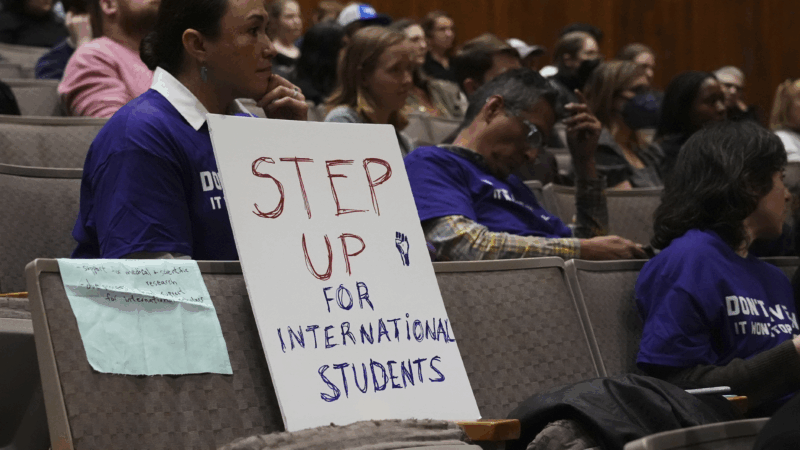
In a major reversal, the federal government is restoring the records of hundreds, and possibly thousands, of international students whose entries in a crucial database the government had abruptly terminated in recent weeks, a move that had complicated their ability to stay in the country.
Even before Friday’s announcement, dozens of judges across the U.S. had already issued temporary orders directing the government to restore students’ records in a database that Immigration and Customs Enforcement, or ICE, uses to monitor international students while they’re in the U.S. The database, known as the Student and Exchange Visitor Information System, tracks whether they are complying with the requirements to maintain their legal status. The SEVIS database also tracks schools’ disciplinary action against students or any criminal charges filed against them.
ICE had begun suddenly terminating thousands of students’ SEVIS records in recent weeks, in many cases over what lawyers say were minor disciplinary records that the government uncovered after running background checks. Without an entry in the SEVIS database, international students cannot easily adjust or extend their legal status, meaning many of those whose records were terminated would likely soon be forced to leave the country.
The database terminations were just one of many steps the Trump administration has taken to ramp up efforts to expel noncitizens – including those with and without legal status. Secretary of State Marco Rubio has also said he has revoked hundreds of visas, many for students who participated in pro-Palestinian campus protests last year.
International students whose SEVIS records were cancelled have filed nearly a hundred federal lawsuits across the country, a government lawyer said in a court hearing Friday.
At the start of that hearing before a federal judge in Washington, D.C., the lawyer read a statement announcing that students’ terminated SEVIS records would be restored, at least temporarily, while the government adopts a formal policy for revoking records in the database.
Brian Green, the attorney representing the plaintiff in that case, provided NPR with a copy of the statement that he said the government lawyer, Joseph Carilli, emailed him.
Green represents an American University student whose SEVIS record was canceled over an arrest that resulted in no charges, he said. He called the government’s announcement reversing course on its blanket revocations “a sigh of relief” for international students across the country. He said immigration attorneys have documented close to 5,000 students whose SEVIS records have been terminated in recent weeks. It’s unclear whether the government will restore all of them, or only those of students who have sued.
“The SEVIS records for plaintiff(s) in this case (and other similarly situated plaintiffs) will remain Active or shall be re-activated,” the government’s courtroom statement read.
The Departments of Justice and Homeland Security did not immediately reply to requests for comment.

Alabama GOP dismisses challenge to Tuberville candidacy
The Alabama Republican Party Candidate Committee dismissed the challenge filed by Ken McFeeters accusing Tuberville of not meeting the seven-year residency requirement to run for governor.
5 papers from the Super Bowl of Economics
Planet Money went to the annual meeting of the American Economics Association, and we saw some fascinating papers presented there.

I thought I’d heard my dad’s voice for the last time. A movie helped me find it again
A period drama, a Supreme Court case and voice our film critic hadn't heard in decades.

19 Winter Olympic storylines we’re watching (they’re not just about sports)
The Winter Olympics promise plenty of high adrenaline, fierce competition, historic firsts and emotional moments over 2 1/2 weeks. Here are some of the names and narratives to keep an eye on.

Kilmar Abrego Garcia becomes symbol of mistaken deportations
Immigration lawyers said Kilmar Abrego Garcia's landmark case highlights the pitfalls with the speed and scale of the Trump administration's goal of mass deportations.
Privatizing Fannie Mae is risky. Would it be a win for taxpayers or Trump’s donors?
The idea has alarmed critics, who warn it could rattle financial markets and drive up mortgage rates, while potentially generating large profits for key Trump supporters.
