
MLK Day is Monday. In Alabama and Mississippi, it’s also Robert E. Lee Day.
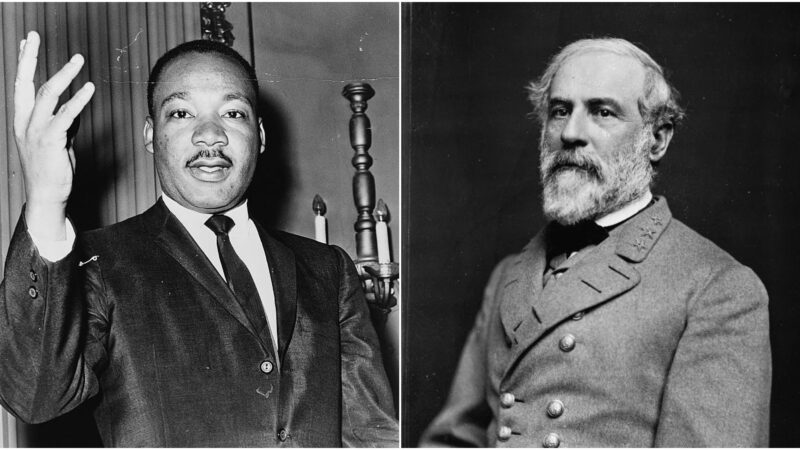
Archive photos of Martin Luther King, Jr. (left) and Robert E. Lee.
Editor’s note: This story was originally published on Jan. 13, 2023. It has been updated to include recent efforts in Alabama and Mississippi to separate the two holidays in each state.
Monday is Martin Luther King Jr. Day — a federally-recognized holiday to honor the life of the civil rights movement icon around his birthday, January 15.
In Alabama and Mississippi, it’s also Robert E. Lee Day, honoring the famed Civil War general of the Confederacy whose birthday falls just days later on January 19.
As a 2017 Smithsonian Magazine article put it, the two men were born 122 years, four days and an ideological world apart. So, how did this joint celebration come to be? Here are five things to know:
Lee-King Day’s origins
Robert E. Lee Day was first celebrated in Virginia, Lee’s home state, in 1889. This day was changed to Lee-Jackson Day in 1904 to also honor another Confederate general — Thomas “Stonewall” Jackson.
However, after President Ronald Reagan declared Martin Luther King Jr. a national holiday in 1983, the state started celebrating Lee-Jackson-King Day in 1985.
Virginia no longer celebrates Lee, Jackson
The celebration of Lee and Jackson wasn’t separated from King’s until 2000. According to the Washington Post, former Virginia governor Jim Gilmore felt that “the separate holidays were needed to give each of the men appropriate recognition.” MLK Day would remain on the third Monday in January, while Lee-Jackson Day would move to the preceding Friday.
Twenty years later, Virginia got rid of Lee-Jackson Day altogether and replaced it with a state holiday on Election Day — one of Gov. Ralph Northam’s legislative proposals in 2020. Northam promoted ending the holiday for the Confederate generals by saying, “It commemorates a lost cause. It’s time to move on.”
Recognition in the Gulf South
Like Virginia, Lee Day has been celebrated in Alabama since the late 1800s. Mississippi adopted Lee Day as a state holiday in 1910, and Louisiana officially recognized the holiday in 1925 — though it could have been celebrated as early as the 1870s.
When MLK Day became a federal holiday in 1983, all three states combined their celebrations for the two men. One reason lawmakers gave for the decision was to avoid having two holidays in January. In other words, lawmakers said they wanted to save money.
North Carolina and Arkansas were the only other southern states that combined the two holidays, but as of 2017, neither state no longer holds a joint celebration.
Unsuccessful attempts to separate the two
Celebrating the two men together has not been popular in recent years in either state.
In Mississippi, Rep. Kabir Karriem, D-Columbus, introduced a bill in 2018 to designate separate days for MLK Day and Lee Day — moving Lee’s Day to the fourth Monday of January.
“Both men had impacts on our history, and I think it’s time to separate the holiday so that King can be observed for the Cvil Rights icon he is,” Karriem said in a statement to the Columbus Commercial Dispatch. “I think this change is long overdue.”
The bill, however, died in committee.
Karriem restarted efforts to give King a separate holiday in 2023 with House Bill 825, which would recognize King’s birthday on the third Monday of January and remove Robert E. Lee’s birthday and Confederate Memorial Day — celebrated on the last Monday in April — as legal state holidays. That bill also died in committee.
Efforts in Alabama have suffered the same fate.
In 2020, a bill sponsored by Sen. Vivian Figures, D-Mobile, wanted to separate the two holidays by moving Lee Day to commemorate the day of his death — Oct. 12, 1870. The bill had bipartisan support, but it died in committee.
In 2023, House Bill 360 looked to remove Lee’s holiday from the Alabama calendar completely. The bill was pre-filed by Rep. Chris England, D-Tuscaloosa — a former chair of the Alabama Democratic Party — amid a wave of bills trying to alter the Alabama holiday calendar.
Democratic Rep. Kenyatté Hassell introduced the bill on April 20, but it died in committee on the same day.
A first in Louisiana this year
Unlike Alabama and Mississippi, Louisiana has successfully separated the two holidays.
Lee Day is no longer celebrated in the Pelican State after legislators removed it from the state holiday calendar during the 2022 legislative session.
The bill, which was signed into law in June 2022, also removed Confederate Memorial Day from the calendar.
State Sen. Jay Luneau, D-Alexandria, called it “an important step in the right direction,” and is proof that Louisiana is “ready to do the right thing,” when it comes to reversing centuries of racism in the state.
This story was produced by the Gulf States Newsroom, a collaboration among Mississippi Public Broadcasting, WBHM in Alabama and WWNO and WRKF in Louisiana and NPR.

Newly discovered dinosaur species was a fish-eater with a huge horn
The semi-aquatic dinosaur, Spinosaurus mirabilis, was discovered by an international team of scientists working in Niger.

Reporters’ notebook: The Olympics closing ceremony is way more fun than you’d think
Olympics opening ceremonies tend to get more love than their closing counterparts. But a pair of NPR reporters who watched both in Italy left with a newfound appreciation for the latter.

Northeast readies for a major winter storm, with blizzard warnings in effect
New Jersey through Massachusetts could see 2 feet of snow. New York City's mayor said the city had not "seen a storm like this in a decade."

Mexican army kills leader of Jalisco New Generation Cartel, official says
The Mexican army killed the leader of the powerful Jalisco New Generation Cartel, Nemesio Rubén Oseguera Cervantes, "El Mencho," in an operation Sunday, a federal official said.

Ukraine’s combat amputees cling to hope as a weapon of war
Along with a growing number of war-wounded amputees, Mykhailo Varvarych and Iryna Botvynska are navigating an altered destiny after Varvarych lost both his legs during the Russian invasion.
University students hold new protests in Iran around memorials for those killed
Iran's state news agency said students protested at five universities in the capital, Tehran, and one in the city of Mashhad on Sunday.
