Alabama fertility care in limbo as lawmakers discuss legislation
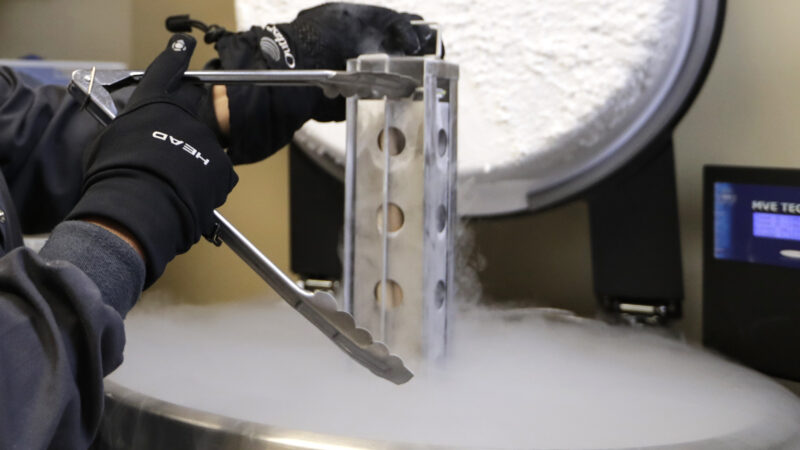
A container with frozen embryos and sperm stored in liquid nitrogen is removed at a fertility clinic in Fort Myers, Fla., Tuesday, Oct. 2, 2018. The Alabama Supreme Court ruled, Friday, Feb. 16, 2024, that frozen embryos can be considered children under state law, a ruling critics said could have sweeping implications for fertility treatments. The decision was issued in a pair of wrongful death cases brought by three couples who had frozen embryos destroyed in an accident at a fertility clinic.
About a decade ago, Kristia Rumbley and her husband tried to get pregnant, but after two years of trying with no success, they turned to in vitro fertilization (IVF).
“It is probably the most hellacious time you can ever go through,” Rumbley said. “We knew we only had one shot at it. However many embryos we could get, we couldn’t afford to do IVF again.”
The procedure yielded several embryos, two of which were transferred to Rumbley’s uterus and successfully implanted, resulting in a pregnancy with twins.
Her doctors in Birmingham froze the remaining embryos. Years later, they transferred another one, which resulted in another pregnancy.
Rumbley and her husband have two frozen embryos left. They aren’t sure if they want to try for another pregnancy, donate the embryos or discard them. But they don’t feel safe keeping them in Alabama anymore.
“We don’t know yet what we’re going to do. We just know that we’re not ready for somebody else to tell us what to do with them,” Rumbley said.
The couple wants to move their embryos out of state because of a recent ruling from Alabama’s Supreme Court.
On Feb. 16, the court declared that people can file wrongful death lawsuits over the destruction of frozen embryos. Justices said a state civil law from 1872 protects all children, including “extrauterine children.”
The ruling sparked national outcry from fertility providers and patients, and it prompted at least three Alabama clinics to pause IVF procedures. In response to the pushback, both Republican and Democratic lawmakers have pledged to pass legislation to protect access to fertility treatments.
But as they discuss taking action, patients are losing access to care.
“This feels very much like the door just got blown wide open, and we have no idea what’s on the other side of it,” said Dr. Beth Malizia, a reproductive endocrinologist and part owner of Alabama Fertility, a private clinic with offices across the state.
The practice announced last week it was stopping all new IVF procedures due to legal risk.
“We are working as hard as we can to alert our legislators as to the far reaching negative impact of this ruling on the women of Alabama,” the clinic posted on Facebook last week. “At a time when we feel so powerless, advocacy and awareness is our strongest tools.”
Malizia said the situation has added unnecessary anxiety to a process that is already fraught with emotion.
“Especially from a patient perspective, (it’s) just so devastating,” she said. “I have patients who have been calling and we are offering the best guidance we can, day by day. But that is a constant evolving process.”
Providers at the Center for Reproductive Medicine in Mobile and at the University of Alabama at Birmingham have also paused IVF procedures due to legal concern.
“We are saddened that this will impact our patients’ attempt to have a baby through IVF,” UAB officials wrote in a statement. “But we must evaluate the potential that our patients and our physicians could be prosecuted criminally or face punitive damages for following the standard of care for IVF treatments.”
Some fertility providers are continuing without much interruption.
At the Fertility Institute of North Alabama, Dr. Brett Davenport said their practice is “going to perform IVF as we always have.”
Davenport said he doesn’t think state laws were meant to be applied to frozen embryos and he is hopeful state legislators will act quickly to protect fertility care.
“We are considered a pro-life state,” Davenport said. “What’s so ironic about that is there’s not anything a lot more pro-life than a fertility practice trying to help couples who can’t conceive, conceive a baby.”
Last week, Democratic state lawmakers introduced legislation to clarify that a human embryo outside of the uterus does not equal an unborn child. Republican legislators are expected to introduce separate legislation this week, which they say will also protect access to IVF.
In anticipation of a possible public hearing on the bills, fertility providers and patients are organizing an advocacy event Wednesday in Montgomery to express their support for fertility care.

An escalation in Yemen threatens to reignite civil war and widen tensions in the Gulf
Saudi Arabia bombed Yemen's port city of Mukalla, targeting a shipment of weapons from the United Arab Emirates for separatist forces. The UAE later said it would withdraw its forces from Yemen.

Cecilia Giménez, the artist who ‘restored’ the face of Jesus, has died at 94
Giménez international attention after she attempted to restore an old fresco. While it was immediately ridiculed at the time, the piece eventually turned into a tourist attraction.

What being around death taught this hospital chaplain about life
J.S. Park helps patients and their families cope with death every day as a hospital chaplain. He explains what to expect as a person is dying, and how to reckon with uncomfortable feelings about death.

Israel says it will bar aid groups, including Doctors Without Borders, from Gaza
Israel accused Doctors Without Borders, one of the largest health organizations operating in Gaza, of failing to clarify the roles of some staff that Israel accused of cooperation with militants.

China flexes blockade capabilities near Taiwan on second day of military drills
China's People's Liberation Army is staging a second day of large-scale military drills around Taiwan. It's unleashing live-fire exercises as part of what it calls "Justice Mission 2025."
Policy relief for family caregivers seems stalled out. But there are signs of change
Family members carry the burden and costs of caring for America's aging population. Federal policy change is slow to come but a new movement and state actions are building momentum.