
UAB Medical School Renamed After $95 Million Donation

The UAB School of Medicine has been renamed the UAB Marnix E. Heersink School of Medicine after a Dothan eye surgeon donated a record-breaking $95 million to the school.
UAB also will establish the Marnix E. Heersink Institute of Biomedical Innovation, which will focus on entrepreneurial health care innovation initiatives. The primary location of the institute will be at UAB, with a prominent physical presence in Dothan.
The gift also will fund the Mary Heersink Institute for Global Health, named for Heersink’s wife.
Heersink is an eye surgeon, innovator and entrepreneur. He co-owns Eye Center South, which he and Dr. John Fortin established in Dothan. It now has 12 offices in Alabama, Florida and Georgia.
Mary Heersink serves on the UAB School of Medicine board of visitors and the advisory board of the Master of Global Health Program, a joint initiative among McMaster University in Canada, Maastricht University in the Netherlands, Manipal University in India and Thomassat University in Thailand. She wrote the book “E. coli 0157: The True Story of a Mother’s Battle with a Killer Microbe” after one of her sons nearly died from an E. coli infection.
According to a statement from UAB, Heersink wants his donation to inspire more contributions. UAB stepped up with a $5 million donation from Triton Health Systems, bringing the total support for the school to $100 million.
“On behalf of the School of Medicine and all the people we serve across Alabama, the nation and the world … I sincerely thank Dr. Heersink,” said Dr. Selwyn Vickers, UAB Senior Vice President of Medicine and Dean of the School of Medicine.
Vickers said that, among other things, Heersink wanted to invest in a school with growing opportunities for transformative change in scientific discovery, training and clinical care, as well as attract the brightest scientists and physicians to the hospital.
“This gift will build on the school’s tremendous momentum and enhance its ability to innovate and deliver on the three E’s (excellence, expansive, encompassing) in a very strategic way,” Heersink said.
UAB President Ray L. Watts said: “Having the Heersink name on the school is a powerful testament to its competitiveness among the very best academic medical centers in the world … Dr. Heersink’s transformative support is critical to building on our global prominence and impact, and his humility and commitment to making the world a better place are inspiring.”
This is not the first donation the Heersink family has made to UAB. It also has donated to renovate the atrium in Volker Hall and to establish the Heersink Family Active Learning Resource Center there, and to the Heersink Family Endowed Glaucoma Fellowship and the Heersink Family Foundation Scholarship Endowment in Optometry, among others.
UAB holds WBHM’s broadcast license, but our news and business departments operate independently. This story was written by our media parter Birmingham Watch.

Some Middle East flights resume, but thousands of travelers are still stranded by war
Limited flights out of the Middle East resumed on Monday. But hundreds of thousands of travelers are still stranded in the region after attacks on Iran by the U.S. and Israel.

‘Hamnet’ star Jessie Buckley looks for the ‘shadowy bits’ of her characters
Buckley has been nominated for a best actress Oscar for her portrayal of William Shakespeare's wife in Hamnet. The film "brought me into this next chapter of my life as a mother," Buckley says.

How, who, and why: NPR flips its famous letters to defend the right to be curious
NPR is standing up for the public's right to ask hard questions in a national campaign dubbed "For your right to be curious." At NPR's headquarters, on billboards in New York City, Chicago, and Washington, D.C., and across social media, NPR's three iconic letters transform into "how," "who," and "why" — a bold declaration of its commitment to fight for Americans' right to ask questions both big and small.
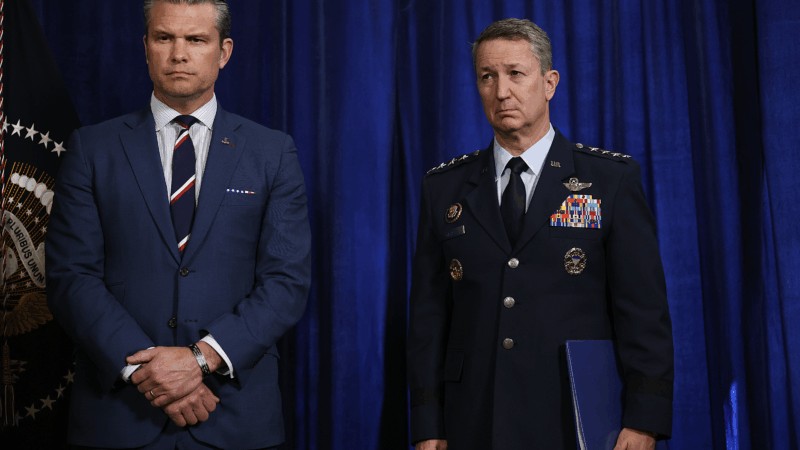
Hegseth: ‘We didn’t start this war but under President Trump we’re finishing it’
The remarks are the first to reporters since the U.S.-Israeli military operations against Iran began Saturday despite weeks of talks designed to stave off a conflict.
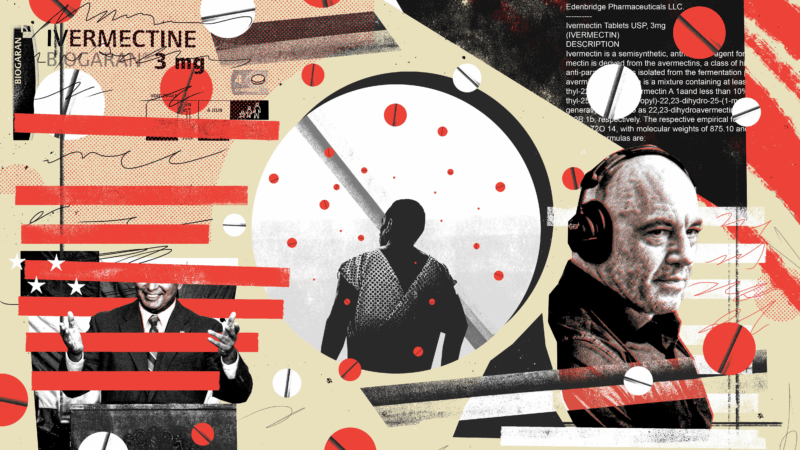
Ivermectin is making a post-pandemic comeback, among cancer patients
The anti-parasitic drug became a household name during the COVID-19 pandemic, and it is now being embraced as an alternative treatment for cancer. It is as politically polarizing as ever.
Rep. Adam Smith on the U.S. strikes on Iran and the debate over Trump’s war powers
NPR's Leila Fadel asks Democratic Rep. Adam Smith of Washington, the ranking member on the House Armed Services Committee, about President Trump's unilateral authorization to strike Iran.
