
Protesters Rally Against Bill Blocking Local Minimum Wage
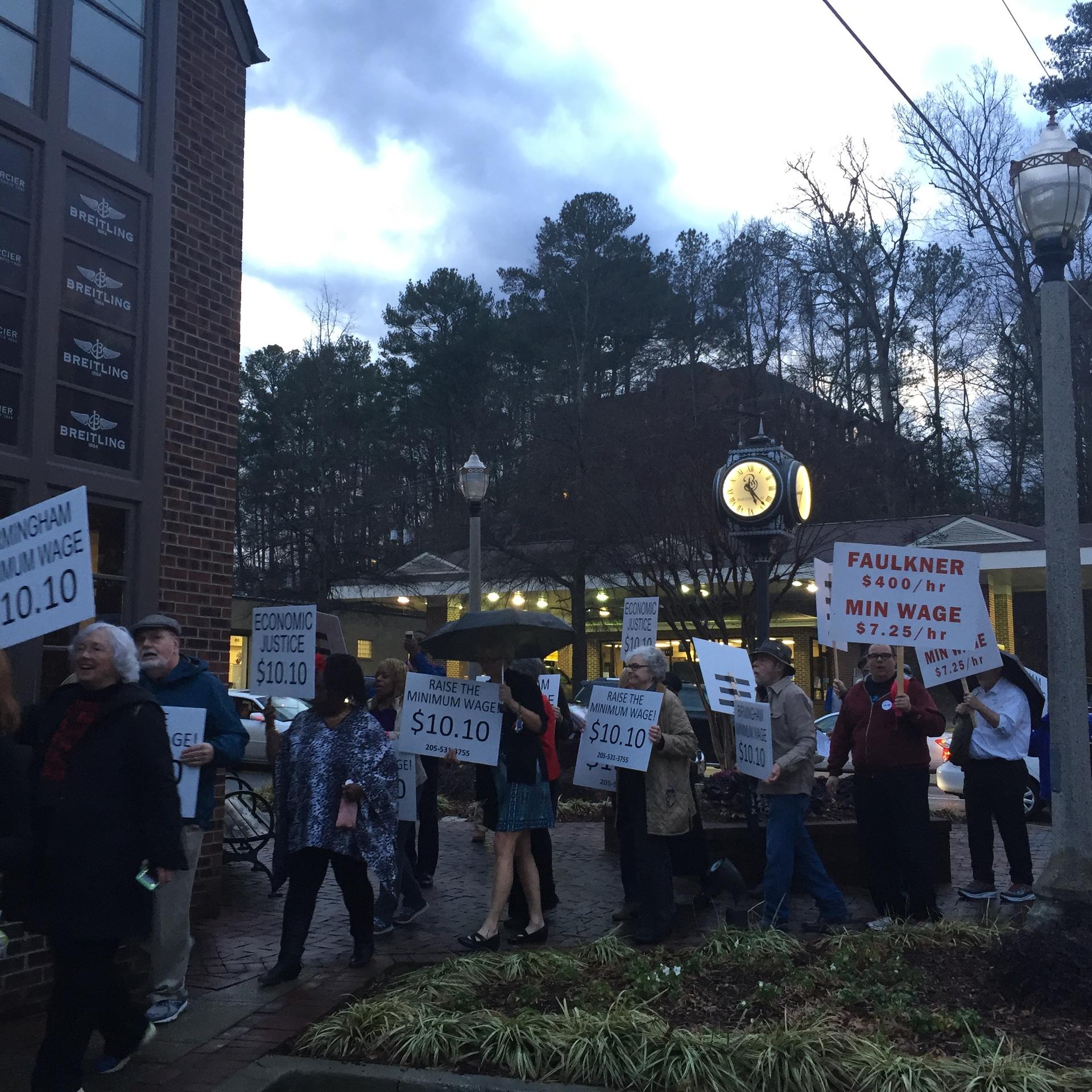
State lawmakers passed a bill out of the House Tuesday evening that would block cities in Alabama from establishing a local minimum wage. As the debate grew contentious in Montgomery, about 50 protesters gathered in Mountain Brook to protest the bill, proposed by a legislator from that city, and to show support for the Birmingham City Council’s decision to raise that city’s minimum wage.
The group, including pastors, restaurant owners, and retirees gathered in the rain on a small triangle of grass in front of Bromberg’s jewelry in Mountain Brook Village, the heart of the city where the median household income is $131,281 and the median home value is $542,800. In Birmingham, the median household income is $31,445 and the median home value is $85,000, according to the U.S. Census Bureau.
“It’s hard,” explains Larhonda Ellis. She makes $7.25 an hour which is the federal minimum wage. Alabama is one of five states that doesn’t set its own minimum wage. “I worked for $5.45 for forever and didn’t get a raise until the $7.25, and I haven’t gotten another [raise] since.”
Birmingham’s City Council unanimously passed a city minimum wage in August 2015. Plans call for the minimum wage to go up to $8.50 by March 1 and $10.10 in July 2017. The bill under consideration would roll back Birmingham’s increase.
Doug Hoffman, founder of the non-profit, advocacy group Engage Alabama, says he pushed for the $10.10 minimum wage in Birmingham and helped organize the protest.
“I started saying, you know, the state legislature’s never going to raise the minimum wage. They’re not going to expand Medicaid, it didn’t seem like,” Hoffman explains. “Let’s raise the minimum wage, and a side benefit of doing that is many many people people will qualify for a health insurance policy.”
While Birmingham is Alabama’s first city to try to raise its minimum wage, UAB, the state’s largest single employer, recently said it would raise its minimum wage to $11 an hour in March.
Ashley Cleek,WBHM
Protesters gathered in Mountain Brook in Tuesday, February 16, 2016, in favor of a higher minimum wage.
At the protest, people from Huntsville and Tuscaloosa said their city councils are also thinking about raising the minimum wage, but not if a new bill becomes law.
Last week, David Faulkner, a Republican state representative from Mountain Brook, filed a bill to block cities from adopting their own minimum wage laws. He argues the state needs uniformity instead of a patchwork of minimum wage laws.
“This bill simply says that if you’re going to do it, you gotta do it at the state level, where we can have a consistent, uniform minimum wage across the state of Alabama,” Faulkner explains.
But the protesters say Birmingham has already spoken. People driving home through the wet streets of Mountain Brook honked at them in support.
As the protesters marched around the quaint, Tudor-style village, Lida Hill, a Mountain Brook resident, joined in. She’s not one of Faulkner’s constituents, but they do go to the same church.
Hill says she came to the protest because she couldn’t understand why the legislature would be allowed to make a decision about Birmingham’s minimum wage.
“People can’t live on the minimum wage in Birmingham,” Hill explains. Hill says 40 percent of children in Birmingham live below the poverty level. She thinks raising the minimum wage would put a dent in poverty too.
Faulkner’s bill now moves to the Senate.
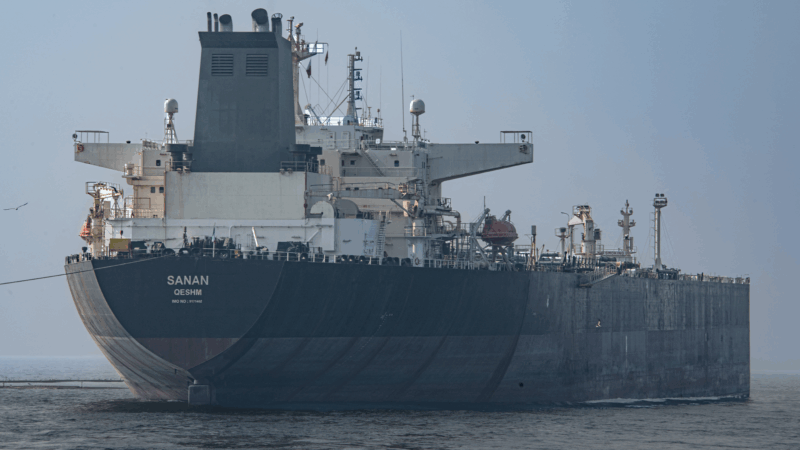
How could the U.S. strikes in Iran affect the world’s oil supply?
Despite sanctions, Iran is one of the world's major oil producers, with much of its crude exported to China.
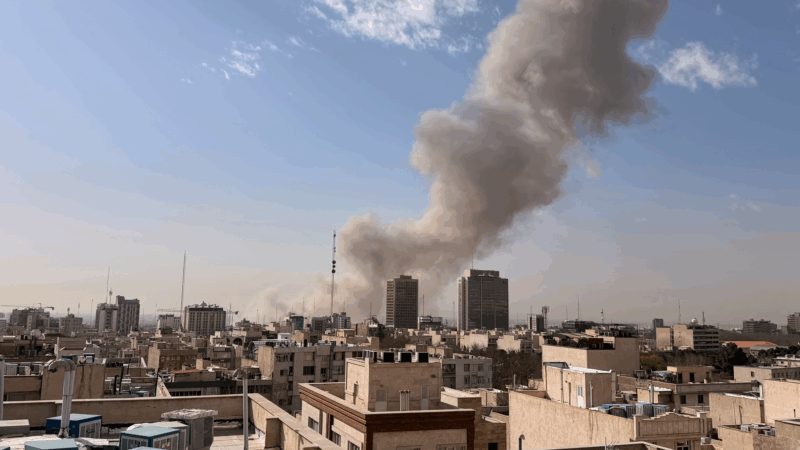
Why is the U.S. attacking Iran? Six things to know
The U.S. and Israel launched military strikes in Iran, targeting Khamenei and the Iranian president. "Operation Epic Fury" will be "massive and ongoing," President Trump said Saturday morning.
Sen. Tim Kaine calls on the Senate to vote on the war powers resolution
NPR's Scott Simon talks to Sen. Tim Kaine, D-Va., about the U.S. strikes on Iran.
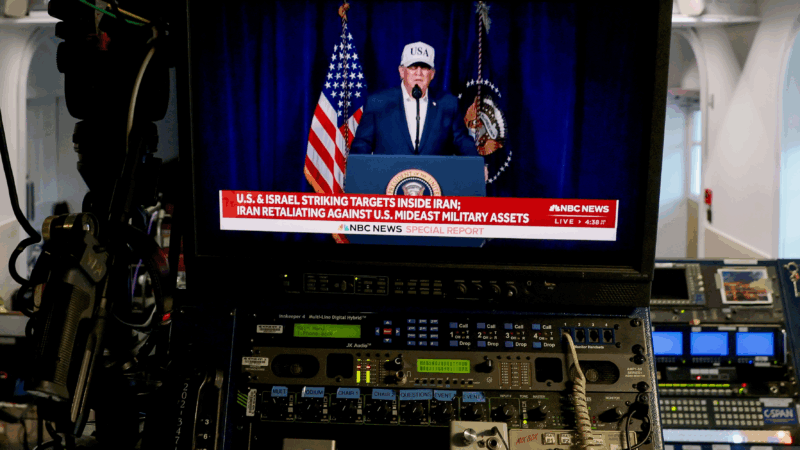
Iran strikes were launched without approval from Congress, deeply dividing lawmakers
Top lawmakers were notified about the operation shortly before it was launched, but the White House did not seek authorization from Congress to carry out the strikes.
Political science expert weighs in on Iran’s nuclear program in light of U.S. strikes
NPR's Scott Simon speaks to Ariane Tabatabai, the Public Service Fellow at Lawfare, about U.S. attacks on Iran and how President Trump's calls for regime change might be received there.
Week in Politics: Does Trump have political support for his actions in Iran?
We look at what President Trump's decision to attack Iran means, what kind of support he has in Iran and what this moment means for his administration.
