
Trump’s travel ban includes Afghanistan, where thousands await U.S. resettlement

President Trump enacted a travel ban on citizens from a dozen countries Wednesday, including Afghanistan, where U.S. troops were stationed for nearly two decades.
Even though the president’s travel ban applies to Afghanistan, it does include an exception.
Afghans who served with the U.S. during the war can still pursue what’s known as a Special Immigrant Visa. Since the chaotic military withdrawal of U.S. troops in August of 2021, around 200,000 Afghans have resettled in the U.S., many under that visa program.
In addition, more than 200,000 Afghans remain outside the U.S. while awaiting various stages of the application process, including many who worked with the Americans.
These figures are from U.S. officials and private groups assisting Afghans who want to move to the U.S., including AfghanEvac, an advocacy group which maintains statistics on the number of Afghan nationals attempting resettlement.
The president’s proclamation also carves out exceptions for individuals already in the U.S. seeking asylum. While it does not address refugee resettlement, the U.S. has paused almost all refugee programs under another executive order.
Many Afghans seeking SIVs and refugee status say they fear for their safety under Taliban rule in the country.
Trump cited the need to address the threat of terrorism as the catalyst for the travel ban, with the White House fact sheet noting specifically about Afghanistan: “The Taliban, a Specially Designated Global Terrorist (SDGT) group, controls Afghanistan. Afghanistan lacks a competent or cooperative central authority for issuing passports or civil documents and it does not have appropriate screening and vetting measures.”
The administration also cited visa overstay statistics in its reasoning for Afghanistan’s inclusion.
A separate program giving Afghan nationals temporary protected status in the U.S. expired in May, with final termination scheduled for July 14. In a news release at the time the end of that status was announced, Secretary of Homeland Security Kristi Noem stated: “Afghanistan has had an improved security situation, and its stabilizing economy no longer prevent [Afghans] from returning to their home country.”
The release further explained that Noem “determined that permitting Afghan nationals to remain temporarily in the United States is contrary to the national interest of the United States.”
The head of AfghanEvac, Navy veteran Shawn VanDiver, called the travel ban a “betrayal.”
“This ban does nothing to protect Americans. It punishes Afghan allies, family members, students, professionals, and humanitarian parolees—many of whom were already promised a pathway to safety,” he said in a statement.

Mexican army kills leader of Jalisco New Generation Cartel, official says
The Mexican army killed the leader of the powerful Jalisco New Generation Cartel, Nemesio Rubén Oseguera Cervantes, "El Mencho," in an operation Sunday, a federal official said.

Ukraine’s combat amputees cling to hope as a weapon of war
Along with a growing number of war-wounded amputees, Mykhailo Varvarych and Iryna Botvynska are navigating an altered destiny after Varvarych lost both his legs during the Russian invasion.
University students hold new protests in Iran around memorials for those killed
Iran's state news agency said students protested at five universities in the capital, Tehran, and one in the city of Mashhad on Sunday.
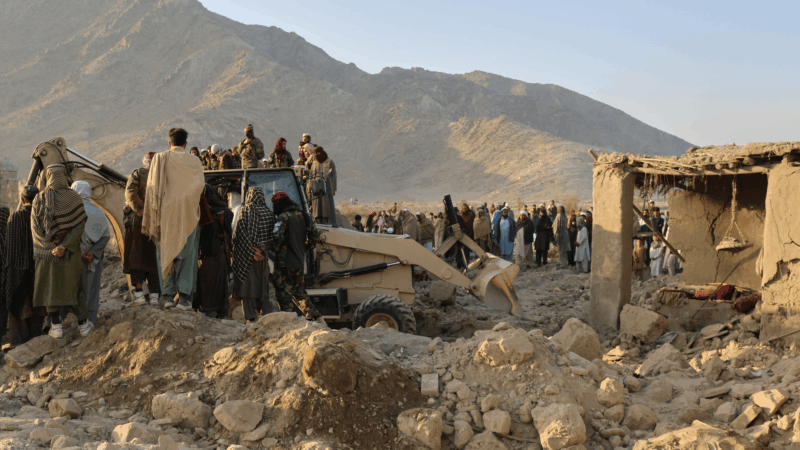
Pakistan claims to have killed at least 70 militants in strikes along Afghan border
Pakistan's military killed at least 70 militants in strikes along the border with Afghanistan early Sunday, the deputy interior minister said.
Team USA faces tough Canadian squad in Olympic gold medal hockey game
In the first Olympics with stars of the NHL competing in over a decade, a talent-packed Team USA faces a tough test against Canada.

PHOTOS: Your car has a lot to say about who you are
Photographer Martin Roemer visited 22 countries — from the U.S. to Senegal to India — to show how our identities are connected to our mode of transportation.
