
Trump hired Musk as a ‘special government employee.’ Here’s what that means
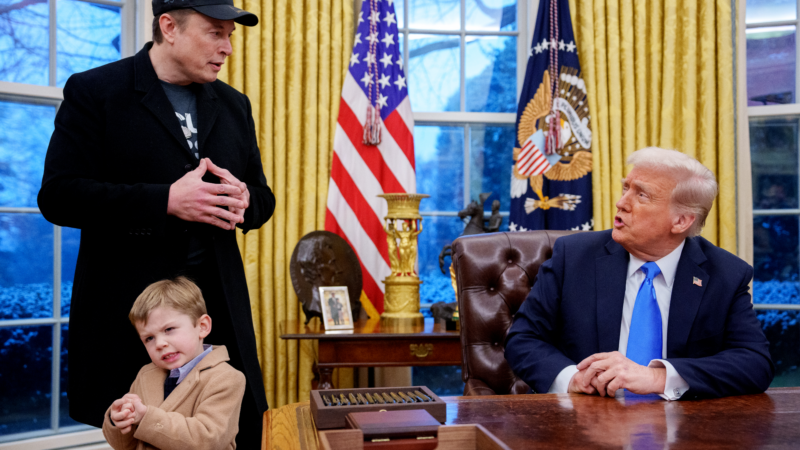
When Donald Trump took office for his second term, he moved quickly to bring his political adviser and top campaign donor — tech billionaire Elon Musk — into the government.
Musk now helms the Department of Government Efficiency, or DOGE, a White House team tasked with cutting federal spending. The unit has terminated a slew of government grants and contracts, according to its X account, and disrupted the work at agencies including the U.S. Agency for International Development and the Consumer Financial Protection Bureau, where workers have also recently been put on leave or lost their jobs.
Musk is what’s known as a “special government employee,” a designation given to people who join the government for a short period of time typically to provide specialized expertise.
Here’s what you need to know about SGEs.
What is a “special government employee”?
In 1962, Congress created the role of “special government employee,” which allows the executive branch, the legislative branch and independent federal agencies to bring on employees for specific roles on a temporary basis.
Typically, SGEs are hired as experts or consultants or serve as members of federal advisory committees, of which there are roughly 1,000 across the U.S. government.
SGEs are limited to working for the government for no more than 130 days out of a 365-day period, though they can work multiple years, and they can either be paid or unpaid. NPR has reported that Musk is not being paid for his work with DOGE.
One reason government officials take on SGEs is that it’s less burdensome than hiring regular federal employees, according to Joanna Friedman, a partner with the Federal Practice Group, a Washington, D.C., law firm specializing in federal employment law.
“If you’re hired as a federal employee, you have to go through typically the competitive selection process, which means you have to apply for a job and you must be selected as the best-qualified candidate,” Friedman said. “This is just an easier way to bring someone on board without as much red tape.”
The Trump administration has also designated other members of Musk’s DOGE team as SGEs.
What powers do SGEs have?
According to Kathleen Clark, a professor specializing in government ethics law at Washington University in St. Louis, SGEs are mostly the same as regular government employees and can be given similar powers, including access to sensitive information. Musk and DOGE were granted access to a massive Treasury Department payment system that contains Americans’ Social Security numbers and bank account information.
Clark says what’s different about Musk’s case is that he is exercising power — such as purporting to shut down entire government agencies — that she says is beyond that of anyone in the White House.
“The president does not have that power and neither does Elon Musk under our Constitution, which grants Congress the power to control how money is spent by the executive branch,” Clark said.
A group of 19 Democratic state attorneys general filed a lawsuit challenging DOGE’s authority to shut down agencies and access sensitive information, while another lawsuit alleges a lack of transparency at the office.
SGEs are bound by certain ethics rules
Because many SGEs have jobs in the private sector, there are ethics rules in place to prevent them from using their government work for personal gain.
Depending on their pay grade, SGEs have to file either a publicly available or confidential financial disclosure form, which typically happens when they start working for the government. (The president, vice president, officials requiring Senate confirmation and certain White House appointees are required to file public financial disclosures.) SGEs may also be required to receive ethics training.
NPR reported that Musk had received an ethics briefing and would file a confidential financial disclosure report.
On top of that, criminal law prevents SGEs (as well as federal workers) from participating in any government matter that could impact their finances. When a conflict arises, SGEs can either recuse themselves from the matter or divest from the relevant financial interest.
In an Oval Office appearance on Tuesday, Musk told reporters that DOGE is operating transparently and announcing its actions on its X account. “Transparency is what builds trust,” he said. “And you can see, am I doing something that is benefiting one of my companies or not? It’s totally obvious.”
Trump, who appeared beside Musk, said he would bar Musk from any government work he believed might create a conflict. “If we thought that, we would not let him do that segment or look in that area, if we thought there was a lack of transparency or a conflict of interest,” Trump said. “We watch that also.”
White House press secretary Karoline Leavitt previously said that Musk would identify any conflicts that arose.
Clark, the Washington University professor, said it is typically government ethics officials — not the employee — who decide whether an employee has a conflict of interest. That’s because the determination of a conflict can involve technical information, she said, and also because an employee may not be impartial about their own situation.
“You’re not supposed to judge your own case,” Clark said. “Even if you’re an expert, you might want to slant how you apply the law. And we don’t trust people, frankly, to apply that.”
Friedman, the federal employment attorney, said it would be up to the Justice Department to decide if Musk violated the federal conflict-of-interest law and whether to bring criminal charges.
Past SGEs have also faced scrutiny
Previous administrations have also used SGEs for high-profile roles in government.
During his first administration, Trump hired Dr. Scott Atlas as a science adviser in the summer of 2020 during the early days of the COVID-19 pandemic. Atlas, who was brought on as a special government employee, was not an infectious disease expert and clashed with other public health officials over his views on the coronavirus. He resigned in November of that year.
More recently, Anita Dunn, a founder of the consulting firm SKDK, was forced to divest a multimillion-dollar investment portfolio when she became a senior adviser to President Biden in 2022. She had previously worked as an SGE for the Biden administration.
And during the Obama administration, GOP Sen. Chuck Grassley of Iowa raised questions about the “special government employee” designation given to then Secretary of State Hillary Clinton’s aide Huma Abedin, who had also worked for the Clinton Foundation and the consulting firm Teneo.

An Alabama mayor signed an NDA with a data center developer. Read it here.
The non-disclosure agreement was a major sticking point in a lively town hall that featured city officials, data center representatives and more than a hundred frustrated residents.

The divorce between the U.S. and WHO is final this week. Or is it?
The U.S. is the only country allowed to withdraw from the World Health Organization. And Jan. 22 is the day when Trump's pullout announcement should go into effect. But ... it's complicated.

Trump’s Board of Peace has several invited leaders trying to figure out how it’ll work
It's unclear how many leaders have been asked to join the board, and the large number of invitations being sent out, including to countries that don't get along, has raised questions about the board's mandate and decision-making processes.

Researchers find Antarctic penguin breeding is heating up sooner
Warming temperatures are forcing Antarctic penguins to breed earlier and that's a big problem for two of the cute tuxedoed species that face extinction by the end of the century, a study said.

As Trump dismantles the existing world order, his version is still taking shape
In his second term, the president is embracing a foreign policy that breaks sharply from U.S. tradition. Both supporters and critics say he's upending a global system in place for 80 years.

Polyester clothing has been causing a stir online. But how valid are the concerns?
There has been a lot of conversation on social media about the downsides of polyester. But are those downsides as bad as they're believed to be? Are there upsides?
