That galaxy next door? It’s home to a monster black hole
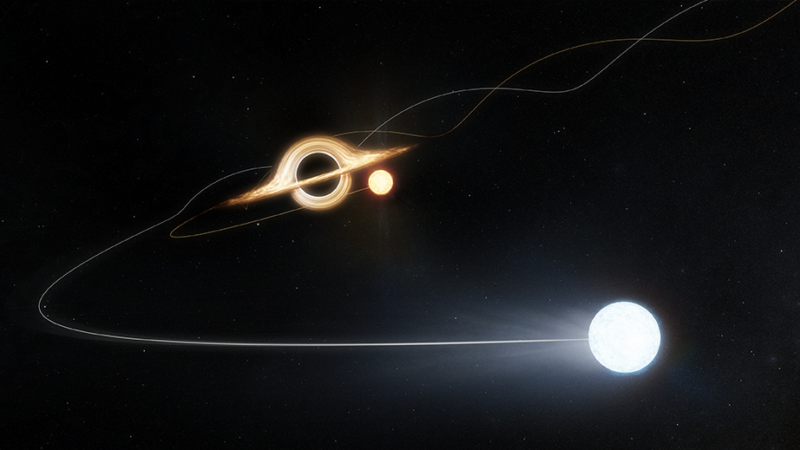
A new study of super-fast-moving stars suggests that they were accelerated by a monster black hole that’s been lurking unseen in the galaxy next door.
This appears to be the closest supermassive black hole outside our Milky Way galaxy, according to a report that’s appearing in The Astrophysical Journal.
While scientists think that most galaxies have a giant black hole at their centers, until now no one knew that one of these beasts resides in the Large Magellanic Cloud, a dwarf galaxy that’s right near the Milky Way.
“Now that there is strong evidence that it should be there, you can rest assured that we are very excitedly following up,” says Jesse Han of the Center for Astrophysics, Harvard & Smithsonian, who led the study. “The search is on and we’re using all the telescopes we can to look for it.”
Super speedy stars
Han and his colleagues realized that this black hole must exist when they were studying so-called hypervelocity stars. These stars whiz through space at the mind-bending speed of several million miles per hour.
That’s far faster than our slowpoke Sun, which orbits the center of our galaxy at about half a million miles per hour.
Hypervelocity stars are going so fast that they can’t sustain that kind of stable orbit, says Han, which means they are basically flying out of the galaxy.
“They’re just on their way out. They’re never going to come back again,” he says. “We’re catching them as their last glimpse before they’re leaving the galaxy forever.”
Researchers think these speedy stars weren’t born fast. Instead, they started out as normal stars that were part of a binary system, or two stars orbiting each other. When that kind of pair ventures too close to a supermassive black hole, says Han, “what can happen is one of the stars can get captured by the black hole. It is basically ripped apart from its companion.”
The bereft companion star, meanwhile, gets flung away, going at ridiculously high speeds. It’s as if the black hole basically hurled it out of the galaxy.
Han and his colleagues recently studied 21 of these hypervelocity stars at the fringes of the Milky Way. They traced the speedy stars’ trajectories, using data from the European Space Agency’s Gaia space telescope, as a way of figuring out where the stars came from.
The common wisdom, he says, was that these stars got jettisoned by the supermassive black hole at the center of our galaxy. But it turns out that this black hole only accelerated about half the stars.
The other half got sped up in the Large Magellanic Cloud, a dwarf galaxy that is the closest galaxy to our own. (Han notes that while many people think of Andromeda as the closest galaxy, it’s actually the closest major galaxy.)
Unseen neighbor
Their calculations suggest that the Large Magellanic Cloud must be harboring a black hole that’s about 600,000 times the mass of our Sun. That’s smaller than the black hole at the center of the Milky Way, which is about 4 million times more massive than the Sun.
Astronomers had previously thought the Large Magellanic Cloud should have a big black hole, but until now there’s been no evidence of it, says Han.
Partly that’s because any such black hole should lie at the center of the Large Magellanic Cloud, but its center is not well-defined. That’s because this little galaxy is in the process of merging with our Milky Way, and it also interacts with its buddy dwarf galaxy, the Small Magellanic Cloud. Those interactions shake up the stars and gas and make it hard to locate the center.
Now, though, astronomers have a better sense of where to hunt for any X-ray, radio, or visible-light signatures that are the telltale signs of an invisible black hole that’s devouring everything nearby.
“It is within the realm of possibilities that it is already detectable in radio and X-ray and optical,” says Han. “We just haven’t looked at the right place.”
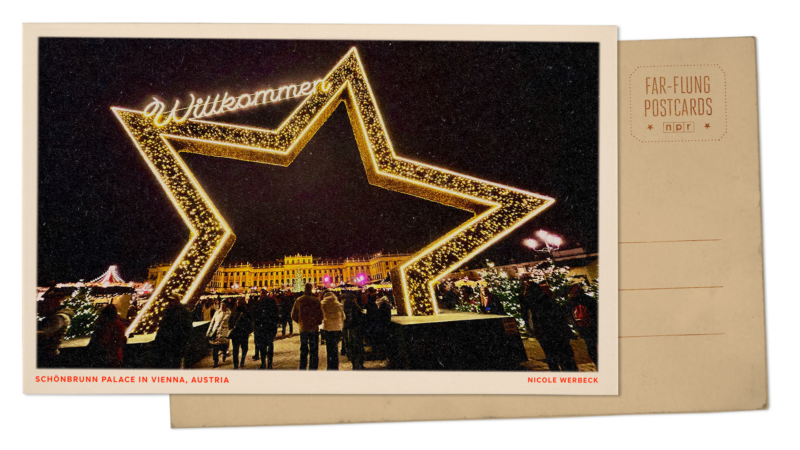
Greetings from Vienna, where an imperial palace hosts a holiday market for all
Far-Flung Postcards is a weekly series in which NPR's international team shares moments from their lives and work around the world.

Out with the mayo: How Ukrainians reclaim holiday food
For many people from former Soviet countries, New Year's is a big holiday feast time. A Ukrainian restaurant in Washington gives NPR a taste of what's on the menu.
His brother’s mental illness isolated his family. Now he’s helping other caregivers
When it comes to serious mental illness, family caregivers are crucial partners. But often, they must fend for themselves. A new solution offers them support.

Farmers are about to pay a lot more for health insurance
Tariffs, inflation, and other federal policies have battered U.S. farmers' bottom lines. Now many farmers say the expiration of federal health care subsidies will make their coverage unaffordable.

50 wonderful things from 2025
Each year, critic Linda Holmes looks back on the year and compiles a list of the things that brought her joy.
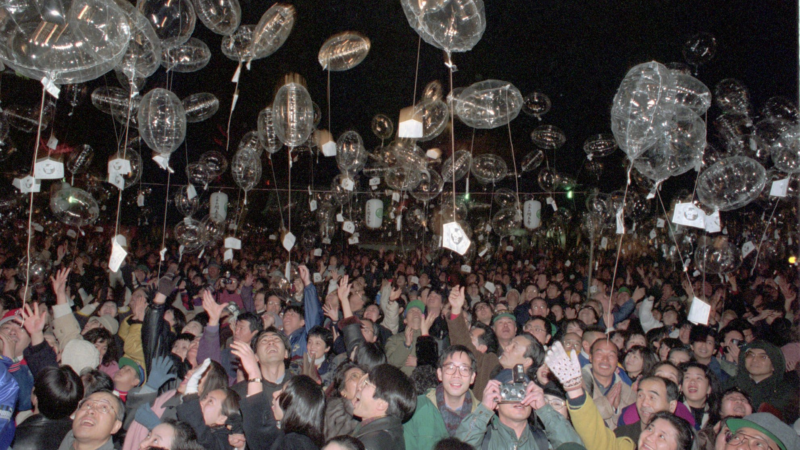
Why do we make New Year’s resolutions? A brief history of a long tradition
One of the earliest mentions of New Year's resolutions appeared in a Boston newspaper in 1813. But the practice itself can be traced back to the Babylonians.