
Rubio leads a U.S. team for Paris talks as Macron seeks unity on Ukraine
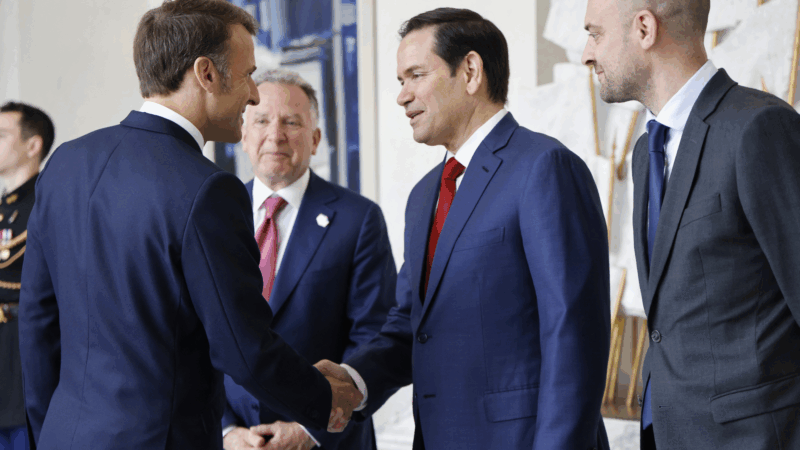
PARIS and KYIV — French President Emmanuel Macron hosted top diplomats from the United States, Germany, the United Kingdom and Ukraine on Thursday to discuss efforts toward a peace deal between Russia and Ukraine, and try to salvage a fraying alliance between Europe and the Trump administration.
“Everyone wants to get peace. A robust and sustainable peace,” Macron said while meeting the U.S. delegation at Élysée Palace. “The question is about phasing.”
The U.S. delegation included Secretary of State Marco Rubio, special envoys Steve Witkoff and Keith Kellogg.
“Very productive meetings at Elysee Palace on efforts to end the Ukraine-Russia war,” Kellogg wrote on the social media platform X, along with a photograph of himself with Ukraine’s representatives.
The State Department said Rubio later spoke with Russian Foreign Minister Sergey Lavrov and said the administration has “now presented to all parties the outlines of a durable and lasting peace.” Witkoff has had multiple meetings with Russian President Vladimir Putin, including last week in St. Petersburg, Russia.
Ukraine has been pushing the U.S. to take a tougher stance on Russia, whose full-scale invasion of Ukraine launched in February 2022 and continues to claim lives. Speaking to journalists in Kyiv Thursday, Ukrainian President Volodymyr Zelenskyy said Witkoff “has adopted Russia’s strategy.”
Ukrainians have criticized Witkoff for statements made to Fox News that a potential peace deal could center on the status of five Ukrainian territories. The Kremlin illegally annexed the southern region of Crimea in 2014 and, since its full-scale invasion, has partially occupied the regions of Donetsk, Luhansk, Zaporizhzhia and Kherson.
“It’s very dangerous because he’s consciously or unconsciously spreading Russian narratives,” Zelenskyy said. “And he does not have the mandate to discuss Ukrainian territories, because our territory belongs to our people.”
Asked about President Trump’s statement calling Russia’s deadly Palm Sunday strike on the northeastern of Sumy “a mistake,” Zelenskyy declined to criticize Trump and pointed out that Rubio had condemned the strike. Ukraine’s president did add that European leaders were far more forceful in their condemnation, slamming Russia for a strike that killed 35 civilians and injured 100.
“I think the [Trump] administration’s soft response reflects the continuation of their current policy,” Zelenskyy said. “I believe they think that this kind of diplomacy, this format, will help bring the war to an end.”
Trump has long said that he wants to end the war quickly. He says he is frustrated with both Kyiv and Moscow, even as his administration appears to have embraced Moscow’s account of the war.
Macron called Zelenskyy before and after Thursday’s meetings. More meetings are planned in London next week.
Eleanor Beardsley reported from Paris and Joanna Kakissis from Kyiv.
‘One year of failure.’ The Lancet slams RFK Jr.’s first year as health chief
In a scathing review, the top US medical journal's editorial board warned that the "destruction that Kennedy has wrought in 1 in office might take generations to repair."
Here’s how world leaders are reacting to the US-Israel strikes on Iran
Several leaders voiced support for the operation – but most, including those who stopped short of condemning it, called for restraint moving forward.

How could the U.S. strikes in Iran affect the world’s oil supply?
Despite sanctions, Iran is one of the world's major oil producers, with much of its crude exported to China.

Why is the U.S. attacking Iran? Six things to know
The U.S. and Israel launched military strikes in Iran, targeting Khamenei and the Iranian president. "Operation Epic Fury" will be "massive and ongoing," President Trump said Saturday morning.
Sen. Tim Kaine calls on the Senate to vote on the war powers resolution
NPR's Scott Simon talks to Sen. Tim Kaine, D-Va., about the U.S. strikes on Iran.
Iran strikes were launched without approval from Congress, deeply dividing lawmakers
Top lawmakers were notified about the operation shortly before it was launched, but the White House did not seek authorization from Congress to carry out the strikes.
