
It’s showdown time for the Fed’s independence at the Supreme Court
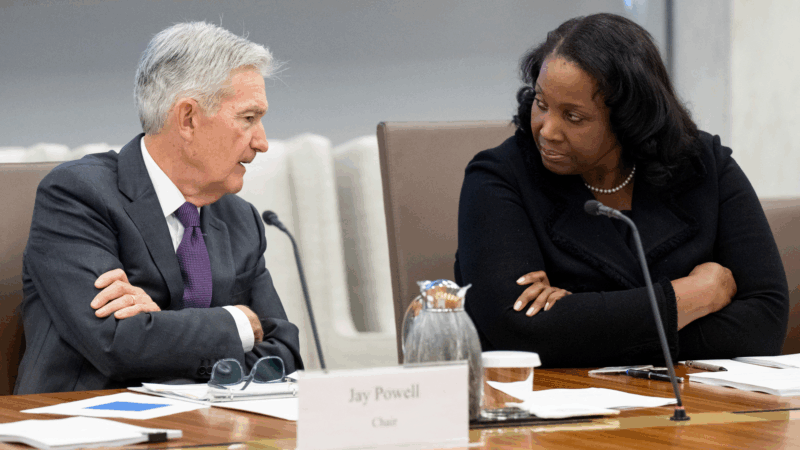
The U.S. Supreme Court hears arguments Wednesday in a case that has Wall Street and the financial markets in a near panic.
At issue are President Trump’s efforts to break with 112 years of law and precedent by firing Lisa Cook, a member of the Federal Reserve’s governing board appointed by President Biden.
Cook’s case is not unique, as evidenced by the recent blow up between Trump and Jerome Powell, who was appointed Fed chair in 2018 by Trump himself.
Powell, known for a cool head and a quiet demeanor, has consistently avoided direct confrontations with Trump, even as the president’s personal displeasure with the Fed chair escalated from behind the scenes pressure to public bashing.
As Trump put it on CNBC in speaking of Powell last week, “Either he’s incompetent or he’s crooked.”
Trump v. Powell
The Trump administration hit the Fed with grand jury subpoenas on Jan. 9 initiating a criminal investigation into Powell for his testimony before the Senate Banking Committee last June. That testimony dealt with cost overruns at two Federal Reserve buildings being renovated for the first time since the 1930s.
The normally reticent Powell finally blew.
“This new threat is not about my testimony last June or about the renovation of federal reserve buildings. Those are pretexts,” Powell said in a video posted on social media. “The threat of criminal charges is a consequence of the Federal Reserve setting interest rates based on our best assessment of what will serve the public rather than following the preferences of the president.”
Congress established the Federal Reserve board in 1913 after a series of financial panics in the late 1800s. In an effort to stabilize the economy, the legislative branch sought to shield monetary policy from political manipulation by establishing limited terms for Fed governors and barring them from being fired, except for malfeasance in office.
Daniel Tarullo, a Harvard law professor and former Fed governor, observes that presidents of both parties always want interest rates to go down, particularly in election years, but he says that inevitably destabilizes the economy.
“When those long-term rates start to go up because of fears of inflation down the road, what gets affected?” he asks. “Mortgages and business investment.”
The issue before the court
That said, the actual legal issue before the court Wednesday is, at least superficially, quite narrow. Trump’s lawyers will tell the Supreme Court that he is not asking for a free pass to fire Cook. He is firing her for cause; namely, the administration claims that Cook falsified documents to obtain loans on two different properties she listed as her primary residences. Her lawyers say she listed one of the properties as a vacation home. The accusations against her were lodged initially by Bill Pulte, Trump’s head of the Federal Housing Finance Agency.
Cook, for her part, denies any wrongdoing whatsoever. Her lawyers in their Supreme Court papers contend that Cook’s mortgage applications were “cherry-picked” by Pulte to make it appear that perfectly legal mortgage applications were somehow nefarious. And to underline the point, her lawyers point to recent reporting that four of Trump’s Cabinet members, plus his deputy attorney general, and even Pulte’s own relatives have recently made applications for multiple mortgages similar to Cook’s, without any suggestion of wrongdoing.
But the Trump administration argues that once the president has determined he has cause to fire a Fed board member, that decision is not reviewable by any court. That’s a big caveat that essentially hands the president unrestricted power to fire members of the Fed and replace them with his personal picks.
That is as it should be, argues Jacob Huebert, senior litigation counsel at the conservative New Civil Liberties Alliance.
Because Article II of the U.S. Constitution vests all executive power in the president, Huebert explains, the president “has to be able to remove people who he doesn’t want to work with. Otherwise he’s being forced to share executive power with someone he doesn’t want to share it with.”
Plus, he adds, just because “we’ve had a Federal Reserve that functions as it does now for a long time doesn’t mean we need to have it forever.”
Experts warn Fed’s independence is in peril
Economists of varying political stripes see the situation as far more dire. With the exception of Powell, every living Federal Reserve board chair, plus Treasury secretaries, and prominent economists from both parties have signed on to Supreme Court briefs urging the justices not to tinker with the Fed’s independence.
Top business leaders like Jamie Dimon, CEO and chairman of JPMorganChase, warned last week that interference with the Fed “will have reverse consequences,” likely raising inflation and increasing borrowing rates over time.
Just what the Supreme Court will do is unclear. In other cases last year, the court’s conservative majority allowed Trump to remove other agency leaders, at least temporarily overriding federal laws that had protected term-limited agency heads from firing.
But at the same time, the court’s conservatives, in one cryptic passage of an emergency docket opinion, said that the Fed is different because it is a “uniquely structured, quasi-private entity that follows in the distinct historical tradition of the First and Second Banks of the United States.” Indeed, the first Congress created the first bank in 1791, and the second was created in 1816.
Should Trump prevail, however, he almost certainly would seek to replace not just Cook, but other Fed governors. Powell’s term as Fed chair expires this spring, but he has two more years on his term as a Fed governor. Unless Trump is able to remove sitting governors, he will not have a majority of his own appointees on the board during the remainder of his presidency.
Noteworthy is that making the case against Trump and for Cook, and indirectly the Fed, will be Paul Clement, who served as solicitor general for President George W. Bush. Additionally, Chair Powell is expected to be in the Supreme Court chamber when the case is argued.

Greetings from Kalk Bay, a South African fishing village where wild seals await scraps
Far-Flung Postcards is a weekly series in which NPR's international team shares moments from their lives and work around the world.

Public domain contest challenges filmmakers to remix Betty Boop, Nancy Drew and more
Nearly 280 filmmakers entered the Internet Archive's annual contest celebrating creative freedom without copyright restrictions.

How North Carolina erased medical debt for 2.5 million people
The state partnered with a nonprofit to wipe out the debts. It also has a plan in place to prevent medical debt for people in specific income brackets.
1 year into Trump’s second term, a consumer watchdog agency is ‘hanging by a thread’
The Trump administration has ordered work stoppages and layoffs and has tried cutting off funding to effectively dismantle the Consumer Financial Protection Bureau.
Trump heads to Davos after upending European relations over Greenland
The U.S. president is set to meet with an array of leaders to discuss Greenland. Trump's push to acquire Greenland has turned to antagonism toward allies in recent days.

How ICE grew to be the highest-funded U.S. law enforcement agency
ICE's budget hovered around $10 billion for years. But President Trump and the Republican-controlled Congress are taking the agency's funding to unprecedented levels.
