
How Trump made a 30% tariff feel like a relief
Yair Reiner sells kitchenware: a splatter guard for stovetop cooking called the Frywall.
But when President Trump imposed 145% tariffs on Chinese goods, Reiner knew his Brooklyn business was in trouble.
“When the tariffs were at 145%, it felt like someone had their boot on the neck of my business, and I couldn’t really get any oxygen,” he said. “I didn’t know what my next move was going to be.”
Reiner makes the splatter guard in China. So when Trump lowered those tariffs to 30% last week, Reiner, the CEO of Gowanus Kitchen Lab, said he felt relief — but only some.
“The boot’s still there,” he said. “The level of pressure has eased, but certainly I’m not breathing well and it’s very hard to figure out what my next steps are going to be.”
Prior to Trump’s trade war, Reiner says he was paying tariffs of around 3% or 4% to bring his splatter guards into the country — so 30% isn’t low for him by any stretch.
But there’s a sign here of how remarkable Trump’s tariff shifts have been: they’ve made 30% feel like something of a relief.

This is part of a pattern on tariffs
This pattern has played out repeatedly with Trump’s chaotic tariff policy: he first suggests a high number, only to later ratchet it down or offer exemptions.
On April 2, for example, Trump announced tariffs on nearly every country – some of them prohibitively high. A week later, Trump pulled many of those tariffs back, setting a rate of 10% on goods from most countries.
But the end result was still a broad tariff that didn’t exist before Trump took office.
Marcus Noland, director of studies at the Peterson Institute for International Economics, put the whiplash in historical perspective.
“With the so-called ‘Liberation Day‘ tariffs, he took us to just catastrophic levels,” Noland says. “And now with these cuts, he’s brought us back down to roughly where they were in 1940.”
Currently, the average effective tariff rate in the U.S. is nearly 18% – the highest level since 1934, according to the Budget Lab at Yale. That represents a sharp spike from the past couple of decades, when the figure had been in the low single digits.
Despite that, Noland thinks Trump’s tariff swings have successfully reframed tariffs for investors.
“Markets seem to believe that things are back to normal, but they’re not,” Noland said. “The tariffs now are much higher than when Trump took office.”

Trump has been doing this his entire career
In the business world, this tendency to recontextualize numbers in a negotiation is something called the anchor effect.
“In many negotiations, you open high in order to anchor the party on your end of the range — or open low, depending on whether you’re buying or selling,” said Richard Shell, a professor at the Wharton School of business at the University of Pennsylvania.
“Then when you come in with a more reasonable offer, that’s still very favorable to you, there’s a psychological relief that sets in.”
Shell has studied Trump’s business career and said his tariff shifts seem like a classic Trump move. But he said that Trump’s intention isn’t clear.
“It’s not clear whether the president is doing this on purpose or whether he is doing it because he throws his fishing rod out there, his fishing line, and then he sees whether or not it causes the trouble and if it causes enough trouble, he pulls it back in again,” Shell said.

But the uncertainty has caused its own problems
And all that change creates problems — namely, uncertainty, said Scott Lincicome, vice president of general economics at the libertarian Cato Institute.
“If you simply don’t know what the tariff rate is going to be 10 days from now, it’s pretty impossible for you to invest in, say, a new factory in the United States — or for you to settle in and a long-term contract with an overseas supplier,” Lincicome said.
Trump has justified his tariffs by saying they will create long-term gain, in the form of more U.S. manufacturing.
Reiner, the splatter guard maker in Brooklyn, doesn’t necessarily disagree with that goal.
“I could see the logic of that,” he said. “What gets in the way is that I think long-term gain hinges on long-term planning, and I’m not able to do that.”
Trump has said that the 30% China tariffs would only last 90 days. The United States and China could reach a longer-term deal before then… but if not, that means the tariff rate could change again down the road.
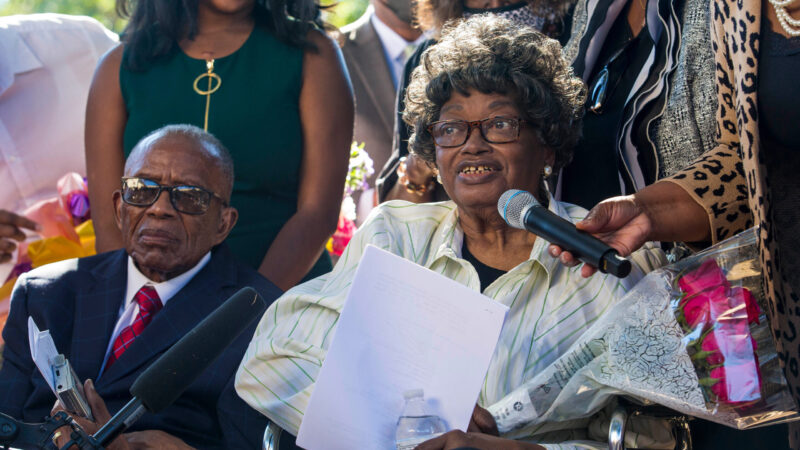
Claudette Colvin, who refused to move seats on a bus at start of civil rights movement, dies at 86
Colvin, at age 15, was arrested nine months before Rosa Parks gained international fame for also refusing to give up her seat on a segregated bus.
Republicans say Clintons risk contempt of Congress for not testifying on Epstein
House Republicans are seeking testimony as part of their investigation into convicted sex offender Jeffrey Epstein. The Clintons say they've already provided in writing what little they know.

FTC accuses AI search engine of ‘rampant consumer deception’
Federal officials say a company that operates hundreds of landing pages for AI answers is running an operation that has duped thousands of users, who were unable to stop costly monthly charges.
How Minnesota faith communities are resisting aggressive immigration operations
As immigration enforcement actions have ramped up in Minnesota, people of faith have been at the forefront of the response to ICE detentions and the killing of Renee Macklin Good by a federal agent.

‘My role was making movies that mattered,’ says Jodie Foster, as ‘Taxi Driver’ turns 50
Foster was just 12 years old when she starred in the 1976 film. "What luck to have been part of that, our golden age of cinema in the '70s," she says. Her latest film is Vie Privée (A Private Life).
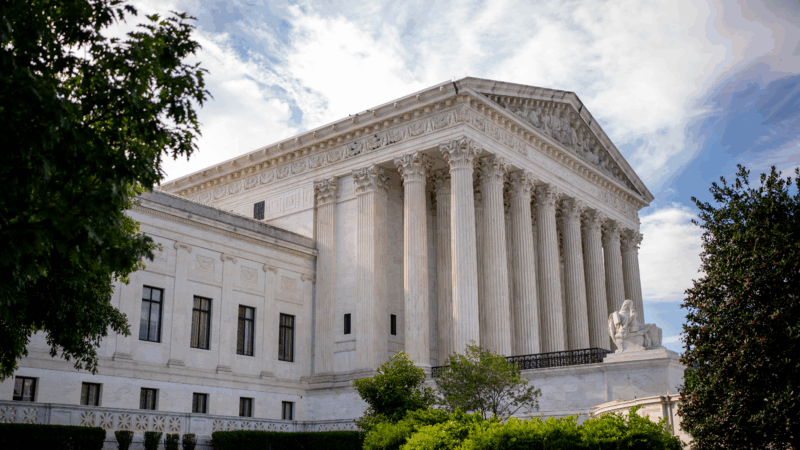
Supreme Court appears likely to uphold state bans on transgender athletes
To date, 27 states have enacted laws barring transgender participation in sports.
