How astronauts adjust when back on Earth after being in space
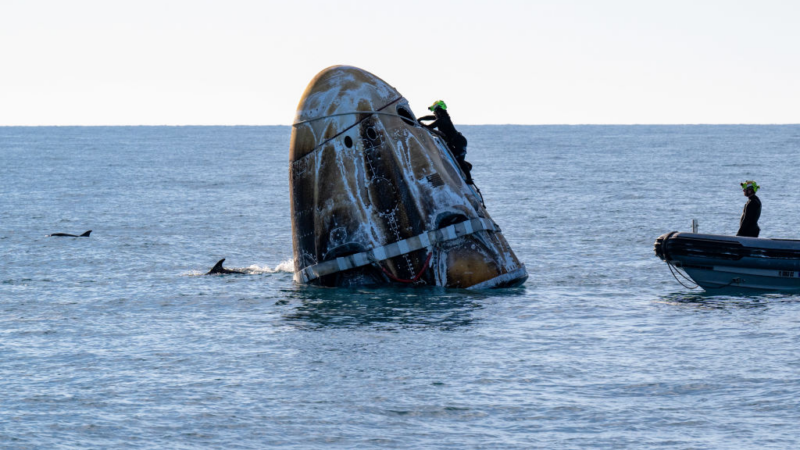
NASA astronauts Butch Wilmore and Suni Williams are finally back on Earth after spending more than nine months in orbit on the International Space Station, splashing down off the coast of Florida on Tuesday evening.
The duration of their time in space was unexpectedly long after launching on June 5, 2024, with the mission to stay on the ISS for nearly a week. Due to issues with the Boeing Starliner flight to the space station, however, the return flight was delayed. In November, NASA’s chief health and medical officer had to push back against tabloid rumors that the astronauts’ health was deteriorating.
But their prolonged mission is not the first time astronaut crews have spent a longer duration in space than planned, NASA says. Both Wilmore and Williams transitioned to “long-duration” status early in the mission, so they could access the station’s crew health care system, the agency tells NPR. A “comprehensive reconditioning process” is also in place for the astronauts.
Here is a look at what the recovery process will look like for Wilmore and Williams, as well as for other astronauts coming back from a stint in space.
A special team of doctors
After Wilmore and Williams’ capsule landed, post-mission recovery and medical teams met the astronauts and transported them to NASA’s Johnson Space Center in Houston. While there, they will undergo “a progressive 45-day post-mission recovery program,” NASA says. During this time, the crew will have medical and performance testing, participate in studies and follow a “structured reconditioning program.”
They’ll spend two hours every day with trainers, working on a personalized recovery plan to work back toward the fitness levels they had before they left on their mission, NASA says.
“Generally, most crew members’ physiological systems recover within this timeframe,” according to the agency.
Leland Melvin, who flew to the ISS on two separate missions in 2008 and 2009, the last with Wilmore, said he was able to get back to his baseline after being home for about a month. He was part of the 17th group of NASA astronauts with Williams and has logged over 565 hours in space, according to NASA. He is also the author of the children’s book Space Chasers. Still, he was not allowed to drive for a week to avoid the possibility of passing out or falling over while behind the wheel.
And at one point while still getting adjusted to being back on Earth, he forgot he could no longer float.
“I was like, laying in bed. I had to go to the bathroom and I just started pushing off my back thinking, ‘I’m going to float to the bathroom.’ And the light was out and I’m pushing up and I roll out of bed,” he says.
Dr. Natacha Chough, a NASA flight surgeon and assistant professor in the aerospace medicine division at the University of Texas Medical Branch, oversees crew members’ health care before, during and after missions. She says one of the first illnesses she looks for in astronauts upon return is motion sickness.
“Your inner ear kind of shuts off more or less in weightlessness,” Chough tells NPR. “So when you reintroduce that sense of gravity, it can be a little bit disorienting.”

Within the inner ear is the vestibular system, which is made up of sensory organs that help with one’s sense of balance. In weightlessness, the system receives mixed messages, making it difficult to determine which way is up or down.
To help his vestibular system readjust, Melvin says he had to walk in a certain way while he recovered.
“You’re walking in a straight line and then you start doing a curve. You start turning and your vestibular system is all whacked out and you can just fall over,” Melvin tells NPR. “So, you walk straight and then you turn. And then you walk straight and then you turn.”
And while astronauts get medical attention from flight surgeons once they return from space, it takes a village to support crews even before the mission ends. There are teams who create a nutrition plan for astronauts before their mission, physicians who monitor their health while on the ISS and those who help them readjust to family life.
“It’s not just flight surgeons, but also schedulers, nurses, trainers, psychologists, research scientists, radiation specialists, toxicologists, audiologists, and others who all work together during various phases of the mission to optimize crew health and safety,” Chough says.
Risks of spaceflight

Being in space also carries several health hazards, including exposure to space radiation. An environment with little gravity can also weaken the bones.
“We definitely track muscle mass and bone mineral density preflight and postflight because weightlessness is what I refer to as a ‘use it or lose it’ environment,” Dr. Chough says. “If you’re not regularly exercising in flight, your body is not going to expend the energy to preserve your muscles and bones.”
To counter this, astronauts aboard the ISS do two and a half hours of daily strength and cardio training. This also helps minimize bone and muscle loss, she says.
Melvin, who was also an athlete and NFL player before becoming an astronaut, says he lifted free weights to help prepare for spaceflight and worked out while on the ISS.
The impacts of being in space, especially for long periods of time, on the body are still being studied. During a study conducted on astronaut twins Mark and Scott Kelly, researchers found that while Scott was on the ISS, he temporarily became two inches taller.
Chronic weightlessness can also cause bodily fluids like blood to rise up toward one’s head, leading to swelling in the brain and flattening of the back of the eye – both contributing to what is known as “spaceflight associated neuro-ocular syndrome.” Some astronauts who develop this condition have mild changes and in others it can cause “significant outcomes,” according to NASA. And the long-term outcome from the changes is unknown.
Astronauts do the work they do to find out what the risks of spaceflight are, Melvin says. He says he feels healthier now that he has been to space because he has “a newfound perspective on what it means to be a human being.”
“I went around the planet every 90 minutes. I saw everyone that was, is and will be on planet Earth,” he says.

His brother’s mental illness isolated his family. Now he’s helping other caregivers
When it comes to serious mental illness, family caregivers are crucial partners. But often, they must fend for themselves. A new solution offers them support.

Out with the mayo: How Ukrainians reclaim holiday food
For many people from former Soviet countries, New Year's is a big holiday feast time. A Ukrainian restaurant in Washington gives NPR a taste of what's on the menu.

50 wonderful things from 2025
Each year, critic Linda Holmes looks back on the year and compiles a list of the things that brought her joy.

Farmers are about to pay a lot more for health insurance
Tariffs, inflation, and other federal policies have battered U.S. farmers' bottom lines. Now many farmers say the expiration of federal health care subsidies will make their coverage unaffordable.

Why do we make New Year’s resolutions? A brief history of a long tradition
One of the earliest mentions of New Year's resolutions appeared in a Boston newspaper in 1813. But the practice itself can be traced back to the Babylonians.
In one year, Trump pivots fentanyl response from public health to drug war
Experts say Biden's focus on addiction health care saved tens of thousands of lives and slowed fentanyl smuggling. Trump scrapped Biden's approach in favor of military strikes.