
Her cancer diagnosis made motherhood both harder and more sweet

Three years ago, Monique Morris was 31 and finding her stride in her career, and as a newlywed and new mom. “We celebrated our son’s first birthday; three days later, we got married; and then six weeks later, I was diagnosed,” she says.
The Stage 2 breast cancer diagnosis came over a phone call when Morris was working from home, while her mother played with the baby in his bedroom nearby.
“What do I say to my mom? I’ve had two siblings pass away from illness already,” says Morris, who recalls, in cinematic detail, every moment that followed: “I can still see it in my head; I can see her holding him, and I can remember when I opened up the door. They look so warm and I just feel so awful for the fact that I’m going to ruin this moment.”
Morris felt wracked with guilt for having brought a child into the world, only to face the possibility of losing his mother. “The next thing I could manage to get out of my mouth is: ‘What about him? My son?'”

More and more people, like Morris, are facing the heightened emotions and challenging logistics of parenting with cancer. Cancer is spiking at alarming rates, especially among women under age 50. What was once predominantly an older person’s disease is now skewing younger, and 1 in 5 adults diagnosed today is a parent or guardian raising a child under 18.
For many, including Morris, facing cancer while raising kids comes with both burdens and blessings.
“Early on, when it was very difficult to find a reason to smile, I could look at him and there was one right away,” Morris says. She felt guilty, among other things, for losing afternoons to fatigue after treatments, or having to explain being “sad Mommy” to her toddler.
But with his robust frame and his toothy toddler smile, baby Brandon Junior — BJ, for short — intuitively seemed to understand how best to heal his mother. “You can’t say ‘no’ to him when he’s asking you to dance with him.”

The well-being of children is the No. 1 preoccupation of parents with cancer, says Carissa Hodgson, a social worker and director of outreach at Bright Spot Network, a support group for parents with cancer. To them, she says “Kids will get through this.”
Children may need extra support, she says, and they most definitely need honesty. Hodgson, who lost her own father to cancer when she was 7, says her mother’s candor at the time helped her.
“She was also honest about — ‘He’s not getting better. He’s going to die’ — and I needed that, I needed that clarity,” Hodgson says.
Children can pick up when adults are upset or worried, speaking in hushed tones, so they’re often reassured by knowing what is happening.
“It actually helps a child to accept what’s going on, and work through those big feelings because it’s the fear and the unknown and feeling like you’re being kept from the truth that really revs up a child’s fear,” Hodgson says.
She says it’s good for supportive adults in their lives to keep children’s attention on the present and on concrete facts. “I start focusing on the here and now and what we’re doing,” instead of speculating about what they fear might happen in the future.
Perhaps the most difficult aspect of parenting with cancer is that it can make all of life’s other burdens feel heavier. Child-rearing parents are typically earlier in their careers and less financially stable than older cancer patients. Plus, the normal strains of parenting can already feel isolating — let alone the side-effects of disease.
“Just because there is a cancer diagnosis doesn’t mean there’s a magic wand that says all of your other life stressors are going to go away,” Hodgson says. “And in fact, if anything, it just turns it all up.”
Supporting parents contending with cancer can also be hard, because their needs are so complex, and also very specific — like juggling making dinner, driving to soccer practice, and getting to treatment, says Arif Kamal, chief patient officer with the American Cancer Society.
Kamal says one way his group is trying to help is by designing software to make it easier for neighbors to help one another. “We are building moments of micro-volunteerism where someone could say, ‘Hey, I would do some babysitting.'”
But mentally and emotionally, managing the fatigue and other side effects of cancer can add to the isolation of being in the “sandwich generation,” Kamal says.

That’s why many in cancer care say it’s essential for parents with cancer to find other patients in the same season of life with shared experiences in online or in-person communities.
Monique Morris turned to Bright Spot Network and parent groups on Facebook for support through her illness and treatment. BJ is now 3 and Morris’ cancer is in remission, but she says the experience left a lasting impression on her son.
“He wanted a doctor kit really badly,” she says, as an example. With his chubby fingers, he insists on conducting his own regular checkups. “‘I have to check, Mommy. I have to check Mommy,'” he would say, when visiting her at the hospital. “He would come with a little toy stethoscope in and examine me.”
In those moments, Morris sees silver linings in her family’s experience: “I think about how compassionate he’s going to be because of all of this, and I can already see that, and that warms my heart.”

At diagnosis, she says she worried that her disease would burden him. “I felt so guilty at first for how much we were going to have to go through as a family,” Morris says. “But I also have this really profound gratitude,” because baby Brandon Jr. has also been her salvation.

National Portrait Gallery removes impeachment references next to Trump photo
A new portrait of President Trump is on display at the National Portrait Gallery's "America's Presidents" exhibition. Text accompanying the portrait removes references to Trump's impeachments.

America’s top figure skaters dazzled St. Louis. I left with a new love for the sport.
The U.S. Figure Skating National Championships brought the who's who of the sport to St. Louis. St. Louis Public Radio Visuals Editor Brian Munoz left a new fan of the Olympic sport.
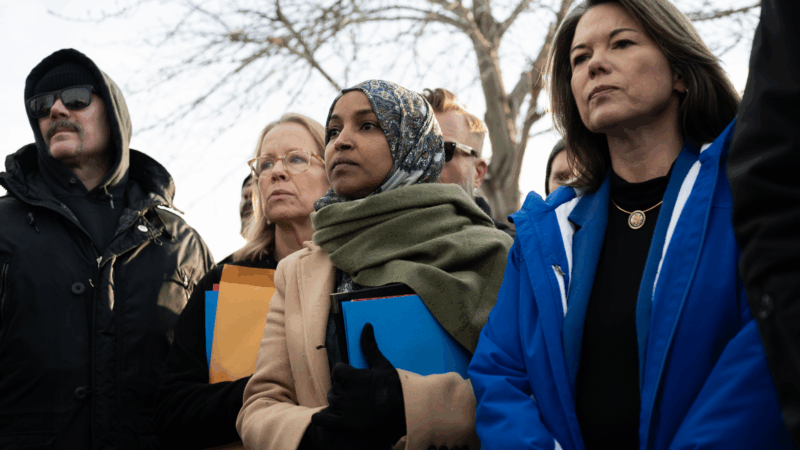
DHS restricts congressional visits to ICE facilities in Minneapolis with new policy
A memo from Homeland Security Secretary Kristi Noem, obtained by NPR, instructs her staff that visits should be requested at least seven days in advance.

Historic upset in English soccer’s FA Cup as Macclesfield beat holders Crystal Palace
The result marks the first time in 117 years that a side from outside the major national leagues has eliminated the reigning FA Cup holders.

Sunday Puzzle: Pet theory
NPR's Sacha Pfeiffer plays the puzzle with KAMW listener Daniel Abramson of Albuquerque, N.M, and Weekend Edition Puzzlemaster Will Shortz.

Venezuela’s exiles in Chile caught between hope and uncertainty
Initial joy among Venezuela's diaspora in Chile has given way to caution, as questions grow over what Maduro's capture means for the country — and for those who fled it.
