For 25 years, The Sims have made a game out of the daily grind

When I first started playing The Sims, which was probably not long after it launched in 2000, I wasn’t sure what to make of it. I had played the precursor, SimCity, where you build your own little kingdom, which at the time involved a lot of complicated and tedious placement of pipes and wires. But The Sims was different. Instead of a city, you were making a person.
Back then, at least the way I played it, you sort of plunked your Sim down in a virtual house and things started to happen. Including the thing that surprised me most: Your Sim had to periodically use the restroom. As you doubtless know, most TV shows and movies completely ignore anyone’s need for bathrooms, and here was a game where my little person’s graphics would tell me that she was getting desperate. When this happens to your Sim, both then and now, she goes to the bathroom, she sits, and she is briefly blurred out like a person on COPS, for privacy, even though she is imaginary.
Honestly, this is what I remember about my Sim’s life back then: she went to the bathroom, she ate, she left her dishes all over (which obviously is because I didn’t realize I had to do anything with them), and occasionally she played music. On one memorable occasion, she got robbed, and she then sadly danced to the boombox that was the only thing the robbers didn’t take. Poignant, that.
It’s not as easy for me to explain the charm of The Sims as it is with games where more actually happens. The mechanics of the game have stayed consistent over the years. Your Sim has a little green diamond (a plumbob) floating over their head. Conversation takes the form of two Sims spiritedly conversing in what sound to me like random syllables, but which are apparently an actual language called … Simlish. (If you have the time, read the Wikipedia entry about Simlish. It is a lot. I had no idea.)
Sometimes, to give you a hint of what two Sims (or more) are talking about, a thought/speech balloon will appear over someone’s head while they’re speaking, which shows a little drawing of something that is presumably the topic. I follow my own Sims’ conversations like this: “Oh, I just said something about art. Then this other person said something about food. Then I said something about … underwear?” It can be confusing.
The franchise is 25 years old this year, and surprisingly, they’re only up to The Sims 4. There hasn’t been a whole new version since 2014. They update it, of course. But really, the franchise runs on its releases of downloadable content (DLC) — the expansion packs and kits that facilitate your going on dates or becoming famous or getting a pet. They presumably don’t make a new version because they don’t need one; they just add stuff you can do and buy in the one you already have. You can get a pack that lets you live at a college, or in a cottage, or in a snow town. You can buy the (virtual) stuff you need for a bowling night, or for a thriving knitting hobby. It allows them to be trend-sensitive without messing around too much with the basics.
It isn’t an adventure, it isn’t a battle and it isn’t a dystopia. It sometimes seems eerily close to duplicating the grind of life. You get up, you eat, you take a shower, you use your bathroom (don’t forget to do this, just … don’t), you go to some job or another, and you come home. You hang out, you talk to people — and sometimes, you go to an event. You get a little happier, a little sadder, a little more social, a little more introverted.
Although, of course, you can decide to be a chaos agent. My Sim recently attended a party where she played the piano badly while someone else was trying to do stand-up comedy in the same room. No one liked it. Everyone was grumpy. Sometimes, you just want to watch a nonthreatening collapse of a simulated social event, I suppose.
At 25, The Sims is still a game that I find charming but puzzling. The Sims are like humans, but … not really. They’ll come over to your Sim’s house and stay after she goes to bed unless you kick them out. Someone will want to socialize at 9:00 in the morning when your Sim is about to go to work. A Sim who goes to bed early will wake up at 4:00 a.m. A bad date isn’t just awkward; someone will eventually look at the other person and say something that sounds a lot like “EW!” and cringe.
Bad dates, waking up too early, people not respecting your personal space and your schedule — maybe it is a dystopia.
This piece also appeared in NPR’s Pop Culture Happy Hour newsletter. Sign up for the newsletter so you don’t miss the next one, plus get weekly recommendations about what’s making us happy.
Listen to Pop Culture Happy Hour on Apple Podcasts and Spotify.

Taiwan’s president pledges to defend island’s sovereignty after Chinese military drills
Taiwanese President Lai Ching-te vowed to defend the self-ruled island's sovereignty in the face of what he termed China's "expansionist ambitions," days after Beijing wrapped up live-fire military drills near its shores.
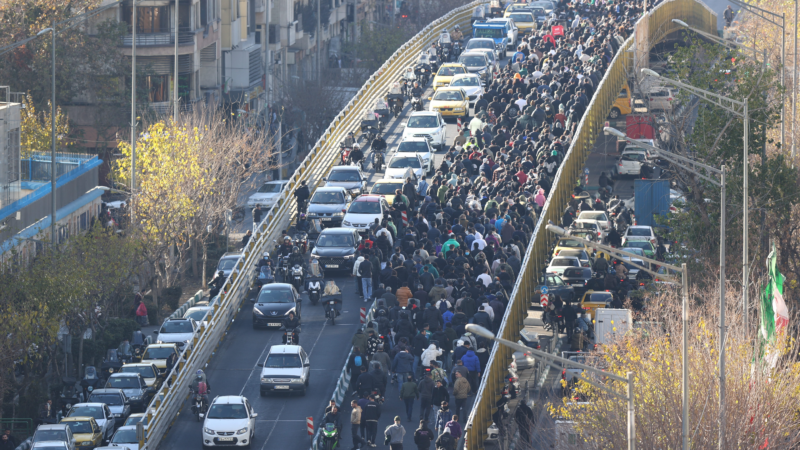
Deaths reported during widening protests in Iran sparked by ailing economy
The protests began due to economic pressures, with Iran's currency rapidly depreciating. Demonstrators have also chanted against the country's theocracy.

Congress failed to extend Obamacare subsidies. This Democrat says Trump can save them
Sen. Peter Welch, D-Vt., says he thinks the Senate can pass a "retroactive" Affordable Care Act subsidy extension, but "we need President Trump."

Rideshare union rights, social media limits and other state laws taking effect Jan. 1
Every new year, public media reporters across the country bring us some of the new state laws taking effect where they are. Here are six in 2026.
Guides to help you tackle your New Year’s resolutions
From building your strength to tackling credit card debt, NPR's Life Kit has a newsletter journey to help you tackle your New Year's resolution.
Guides to help you tackle your New Year’s resolutions
From building your strength to tackling credit card debt, NPR's Life Kit has a newsletter journey to help you tackle your New Year's resolution.