
Christoph Von Dohnányi, longtime conductor of the Cleveland Orchestra, has died
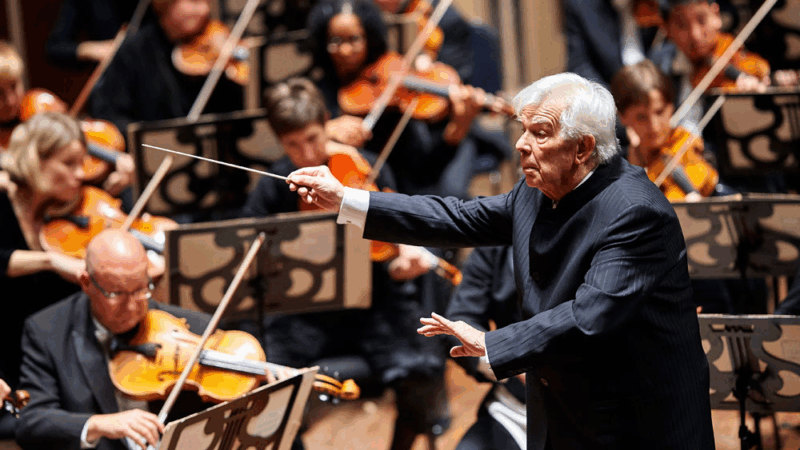
Christoph von Dohnányi, a conductor known for his illuminating and intellectual approach to music, died Saturday. His death was announced in a statement by the Cleveland Orchestra, which did not specify a cause. He was 95.
Dohnányi was best known in the United States for his time as the music director of the Cleveland Orchestra, which he led from 1984 to 2002. He also made numerous recordings with the symphony, programming a broad swath of music that ranged from J.S. Bach to Harrison Birtwistle, while remaining grounded in the Austro-Germanic repertoire.
“They were the most-recorded American orchestra for about a decade during his tenure,” says Don Rosenberg, former music critic of the Cleveland Plain Dealer and author of the book The Cleveland Orchestra Story: Second to None.
Rosenberg reviewed many of Dohnányi’s performances with the Cleveland Orchestra. He says that the conductor’s devotion to the score, and willingness to rethink pieces he had conducted many times, were central to Dohnányi’s interpretations.
“You could hear everything in the texture,” Rosenberg recalls. “He was not one for big flourishes in terms of sonority; he always wanted the details to be heard. He took a very analytical approach, which nevertheless made for performances that were not only very clear but very vibrant.” For Dohnányi, the arc of a piece was crucial — he believed that the listener should be able to hear inside the music, but also see the big picture.
Andrew Porter, praising a Cleveland Orchestra performance of Bruckner‘s Seventh Symphony in The New Yorker in 1988, wrote: “Mr. Dohnányi and his orchestra cast a spell of attention such as is rarely encountered in New York’s concert halls. Beauty of sound, eloquence of individual phrasing, balance of long periods and a sense of high purpose were united.”
The secret of Dohnányi’s success, he once told a BBC broadcaster, was deceptively simple. “The main goal of a conductor,” he claimed, “should be that he is not important any more — that the orchestra listens to each other, that the orchestra has a certain spirit which you try to convey to them while you’re rehearsing.”
Dohnányi was born Sept. 8, 1929, in Berlin, into a family of musicians, politicians and an esteemed theologian. His grandfather, Ernst (Ernő) von Dohnányi, was a celebrated Hungarian composer and pianist. His father, Hans, a lawyer and member of the Hamburg senate, and his uncle, the theologian Dietrich Bonhoeffer, were both executed on Adolf Hitler’s orders in 1945 for their involvement in a plot to assassinate the German leader. Klaus von Dohnányi, Christoph’s older brother, served as mayor of Hamburg from 1981 to 1988.
Dohnányi’s musical life began at the piano, which he studied until World War II intervened. Afterward, in Munich, he studied law before entering the state music school, where he graduated in 1951 and won the city’s Richard Strauss Conducting Prize. He followed his grandfather to the U.S., studying with him in Florida and later with Leonard Bernstein at Tanglewood in Massachusetts.
Early on, Dohnányi built a solid foundation in conducting by working his way through provincial German opera houses, eventually graduating to director’s posts in Frankfurt and Hamburg. “I think he had an advantage that a lot of young conductors today don’t have,” Rosenberg says. “He started in an opera house, as a coach, and learned the ropes from the ground up. That kind of training doesn’t happen a lot anymore, and that’s too bad because those conductors who had all those experiences brought a very rich culture to their music-making.”
Along with his work in opera houses such as London’s Covent Garden and New York’s Metropolitan, Dohnányi held posts at symphony orchestras in Cologne, London and, beginning in 1984, Cleveland.
Dohnányi was something of a dark horse pick for Cleveland, considering the visibility of his predecessors Lorin Maazel and the legendary George Szell, who led the orchestra from 1946 to 1970. But Rosenberg notes that during Dohnányi’s tenure, he upheld the orchestra’s top-tier reputation while crafting a sound of his own.
“He made splendid use of the orchestra’s chamber-music-like qualities,” Rosenberg says. “I think he softened some of the edges that Szell preferred and that continued under Maazel. There was attention to detail and transparency — all the qualities that we associate with the Cleveland Orchestra for half a century.”
Although Dohnányi’s podium demeanor was reserved and his tone was generally soft-spoken, the conductor was known to freely speak his mind. An article in London’s Times in 1994 finds Dohnányi openly criticizing other conductors, calling Simon Rattle‘s performance of Mozart’s The Marriage of Figaro a “total misunderstanding” and Mahler symphonies under Bernstein “totally wrong.”
In recent years, Dohnányi kept busy guest conducting the world’s great orchestras and keeping up his website, on which he was politically outspoken. In a post from February 2017 called “Resist the Beginnings,” he starts by recalling the deaths of four men in his family at the hands of Nazis, before going on to lament “intolerance” in the United States. “What kind of world are we living in?” he wrote. “A world of ‘Texas first!’ ‘California first!’ Asia, Africa, America, Europe or Australia ‘first!’? Or do we live in a world that puts human dignity, humanity, fearlessness and compassion above everything else? In its great days our much-loved USA was such a country.”
The economy slowed in the last 3 months of the year — but was still solid in 2025
The U.S. economy grew 2.2% in 2025, a modest slowdown from 2.4% the previous year. GDP gains were fueled by solid consumer spending and business investment.

Ali Akbar, who’s sold newspapers on the streets of Paris for 50 years, is now a knight
For decades, Ali Akbar has sold papers on the Left Bank of Paris. Last month, France gave the beloved 73-year-old immigrant from Pakistan one of its highest honors — and his neighborhood is cheering.
Bill limiting environmental regulations goes to the governor’s desk
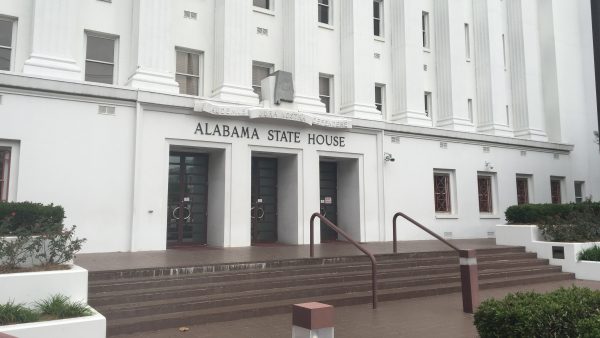
President Trump has taken steps to roll back environmental regulations. Some of that same action is taking place in statehouses, including Alabama's. Lawmakers gave final passage this week to a bill that would ban the state from enacting environmental rules more stringent than those at the federal level. That's where we start our weekly legislative update with Todd Stacy, host of Capitol Journal on Alabama Public Television.

For years the Taliban told women to cover up in public. Now they’re cracking down
At hospitals, at seminaries and on buses, the Taliban is stepping up enforcement of rules on women's dress in the city of Herat.

What I learned watching every sport at the Winter Olympics
Sit down with pop culture critic Linda Holmes as she watches the 2026 Winter Games. She is exhausted by cross-country, says "ow ow ow" during moguls, and makes the case, once and for all, for curling.

Scientists worry about lasting damage from Potomac sewage spill
Drinking water around the District of Columbia hasn't been contaminated. But scientists say the environmental damage could be severe.
