A moose trek across Sweden pulls in millions of viewers looking for ‘Slow TV’
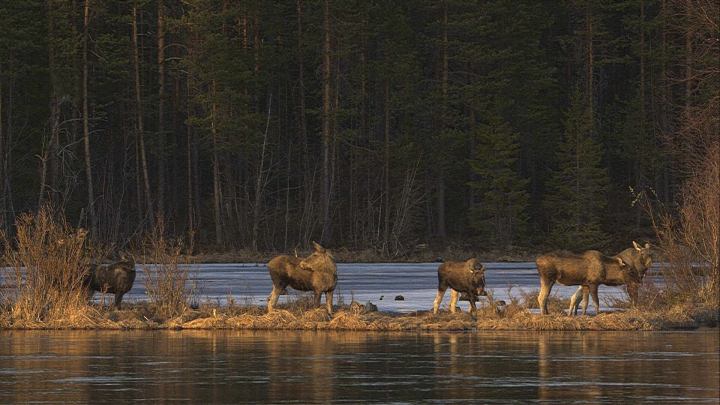
The moose are on the move again.
Across Sweden, that is. The mammals have begun their annual migration in the small village of Kullberg, in the northern part of the country. And over the past few years, they’ve had millions of eyes on them.
The Great Moose Migration is a 24-hour livestream program categorized as “slow TV,” which is live, unedited and hours-long coverage of some routine event, usually with a theme or journey in mind.
Since 2019, the moose’s trip has aired for several weeks each spring on SVT, the country’s public broadcasting service.
The coverage switches camera shots between various wooded areas and the Ångerman River. Much of the footage is “mooseless” — birds, trees and bears. But every now and then, antlers peek above the surface of the water or through the trees, and their six-foot silhouettes emerge.
About a million people watched the mammals’ trek during the program’s debut year. More than 9 million people watched across the globe last year, and executive producer Johan Erhag told NPR he expects viewership will be even higher this year.
In a short documentary about the program, a rock musician performed a song about the moose, while a man gathered around the TV with children to watch.
“It is my equivalent of the Super Bowl,” one moose fan said. “It’s like rooting for a sports team. I don’t watch sports, I don’t like sports. I like moose.”
A look at their path
From late April to late May, between 300 and 500 moose migrate from their winter hangout spot by the Bothnian Bay, to their summer one — in the mountains near the Sweden-Norway border, said Göran Ericsson, dean of forest sciences at the Swedish University of Agricultural Sciences.
Moose in northern Sweden, where Kullberg is, migrate up to 56 miles, much longer than moose in southern Sweden, who migrate up to 6 miles, according to the university.
“In the summer, they migrate to good places where they can birth the calves, and good places where they can find good food,” Ericsson said.
They’ll complete their journey in about one to three weeks, just in time for the nutrients to mature in the vegetation they like, which include bilberries and Scots pine, Ericsson said.
Climate also influences the moose’s migration patterns. They’re less inclined to leave their spots if they live in areas with not as much snow, according to the university.
Over the years, the moose’s trip across the river has been affected by the development of roads and hydroelectric power facilities, which created dams that diminish the ice. Ericsson said. “Because when we use electricity, we use more water, and then the ice gets thinner.”
How the program got started
The Great Moose Migration producers, Johan Erhag and Stefan Edlund, worked together in 2016 on a nature program that included a segment about swimming moose.
During that taping, they filmed a few moose, but heavily relied on a handwritten log by Swedish resident Irene Hägglund, who would count how many moose she saw swim across the river outside her house.
After a trip to Norway, Erhag and Edlund were inspired by various “slow TV” productions made by NRK, Norway’s public broadcasting service, they said in the documentary. NRK’s “slow TV” programs have captured cliff-dwelling birds, a cross-country train route and people knitting.
Erhag and Edlund wanted to turn their moose segment into a “slow TV” spin-off of sorts.
But it took a few years to convince the network. Executives weren’t sold that waiting for moose to walk by a camera was enthralling content, and much of the moose action Erhag and Edlund promised the network was based on Hägglund’s notes, the producers said.
They would need more footage. So, they went and got it — and eventually the network budged.
What draws people to slow TV?
Thomas Hellum is a producer at NRK who helped kick off its “slow TV” movement with the cross-country train route 16 years ago.
“When we first created slow TV from the Bergen Line back in 2009, the audience reactions – and especially the number of viewers – came as a big surprise. It was something new, something that hadn’t been done before – at least not on the big TV screen and in prime time,” he told NPR in an email.
Since then, the Norwegian public broadcaster has created at least 30 more “slow TV” programs, but they’ve never repeated one as SVT has done with the moose.
“I really like what they’ve achieved in Sweden – establishing a tradition and an expectation among the audience,” Hellum said.
His theory on why it has become so popular today is that it is a complete story that mirrors reality.
“I think people enjoy it because EVERYTHING is there,” Hellum said. “All the boring parts, all the exciting parts – everything that could happen. There’s no producer who’s selected only the most exciting bits for you – in a way, you have to do that yourself. You have to figure out what’s interesting and what’s boring. Just like in life.”
Additionally, it gives people a sense of togetherness.
“It created a kind of community among those who were watching — as if we were all passengers on the same train, taking the same journey, sharing the same view,” Hellum said.
Zohran Mamdani sworn in as New York City mayor, capping historic rise
Mayor Zohran Mamdani took the oath of office in New York City after midnight Thursday. The city's first Muslim mayor, a member of the Democratic Socialists of America, has promised to focus on affordability and fairness.
Rising from the ashes, a symbol of hope at the Rose Parade
Survivors of the Eaton and Palisades Fires find healing and community working on a Rose Parade float to honor the lives and communities lost in last year's wildfires.
The history behind the NYC subway station chosen for Mamdani’s swearing-in
The city shut down the station in 1945 on New Year's Eve. Eighty years later, it's a symbolic venue choice for the incoming mayor's private swearing-in ceremony.
U.S. military strikes 5 more alleged drug boats, killing 8
The U.S. military says it struck five alleged drug-smuggling boats over two days. The attacks killed eight people, while others jumped overboard and may have survived. U.S. Southern Command did not reveal where the attacks occurred.
Capitol riot ‘does not happen’ without Trump, Jack Smith told Congress
Former special counsel Jack Smith also described President Trump as the "most culpable and most responsible person" in the criminal conspiracy to overturn the 2020 election results, according to a transcript of Smith's closed-door interview with the House Judiciary Committee.
Trump will drop push for National Guard deployments in Chicago, LA and Portland, Ore.
Courts blocked troops from deploying in Chicago and Portland, Ore., and the Los Angeles deployment effectively ended after a judge blocked it earlier this month.