
A colossal squid is filmed in its natural habitat for the first time
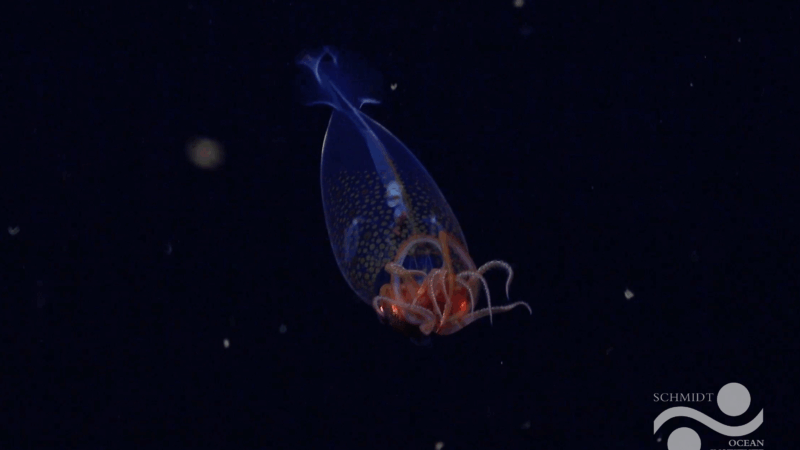
A colossal squid has been captured on camera in its natural habitat for the first time in the 100 years since its discovery — and it’s a baby.
The squid, measuring about one foot in length, was seen nearly 2,000 feet below the surface in March, in the South Atlantic Ocean, the Schmidt Ocean Institute said in a statement. The footage was recorded by an underwater vehicle operated remotely by a crew with the organization.
“It’s exciting to see the first in situ [on site] footage of a juvenile colossal and humbling to think that they have no idea that humans exist,” said Dr. Kat Bolstad, an associate professor at the Auckland University of Technology who helped verify the footage. “For 100 years, we have mainly encountered them as prey remains in whale and seabird stomachs, and as predators of harvested toothfish.”
Bolstad explained to NPR that reason colossal squids have likely not been caught on camera until now is due to their large, sensitive eyes, which probably cause them to avoid research equipment that can be bright and loud.
Because of their elusive nature, researchers still know little about their diet, lifespan or reproductive traits. But Bolstad said that this new footage allows scientists to gather more information about their behavior during the early stages of life.
The juvenile squid displayed had pearly eyes and organs and was transparent, typical for members of the Cranchiidae family, also known as “glass squids.” As it matures, it will likely become more opaque as its muscles thicken, Bolstad said.
More on colossal squids
Colossal squids live in the deep sea near Antarctica. They can reach lengths of 23 feet and weigh at least 1,100 pounds, making them the heaviest known invertebrates. Their tentacles feature hooks that help them catch prey and defend themselves against predators, such as sperm whales.
These intriguing creatures were first discovered in 1925 when two of their appendages were found in the stomach of a sperm whale.
It’s important to note that colossal squids should not to be confused with giant squids. While giant squids are longer, they are not as heavy. Giant squids also inhabit the deep sea but are found in tropical and temperate waters.

In blunt warning, the U.S. says Peru could lose its sovereignty to China
The Trump administration on Wednesday expressed concern that China was costing Peru its sovereignty after a Peruvian court ruling restricted a local regulator's oversight of a Chinese-built mega port.
U.S. ice dancers Madison Chock and Evan Bates win Olympic silver, in a stunning upset
Chock and Bates, four-time Olympians, were heavily favored for gold. But they lost by less than two points to a French duo who has been clouded by controversy involving their former partners.

AI brings Supreme Court decisions to life
Like it or not, the justices are about to see AI versions of themselves, speaking words that they spoke in court but that were not heard contemporaneously by anyone except those in the courtroom.
These monks’ walk for peace captivated Americans. It ends this week
A group of Buddhist monks walked from Fort Worth, Texas, to Washington, D.C., in the name of peace. The 108-day pilgrimage captivated Americans.

The airspace around El Paso is open again. Why it closed is in dispute
The Federal Aviation Administration abruptly closed the airspace around El Paso, only to reopen it hours later. The bizarre episode pointed to a lack of coordination between the FAA and the Pentagon.

‘Dawson’s Creek’ star James Van Der Beek has died at 48
Van Der Beek played Dawson Leery on the hit show Dawson's Creek. He announced his colon cancer diagnosis in 2024.
