
A book vending machine provides an outlet for D.C.-area authors after funding cuts
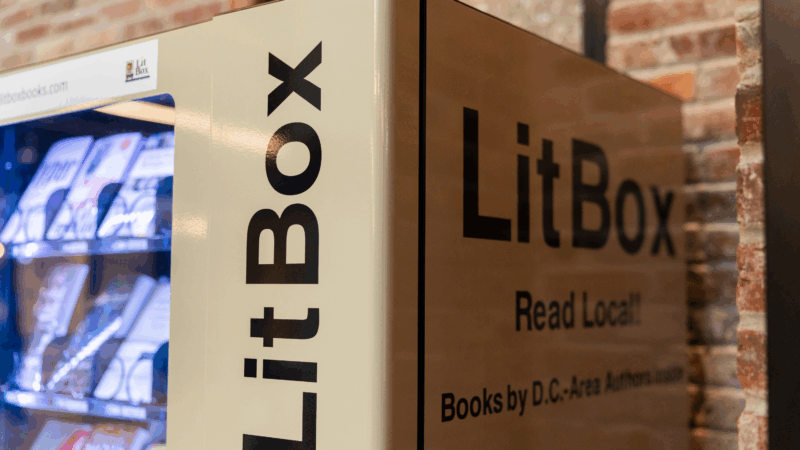
A vending machine in Washington, D.C., is providing nourishment — for the mind. LitBox is filled with books by local authors, just steps from the White House, World Bank and International Monetary Fund.
Lauren Woods launched the project in May after growing frustrated with what she saw as some publishers’ focus on sensationalism and the lack of bookstores focused on local authors in the area. “I had friends who wrote award-winning books and couldn’t get their books into D.C. bookstores because they were smaller presses, or they didn’t have a mass appeal, or the book buyer didn’t think they would be profitable,” Woods said. “And that always seemed wrong to me.”
Hardships for authors
Woods is the author of The Great Grown-Up Game of Make-Believe, which won the Autumn House Press fiction prize last year. Her husband, Andrew Bertaina, is also an author.
Inspired by a European book vending machine, she set about planting one in the nation’s capital to try to market books more equitably and see how they sell. The hypercompetitive publishing industry makes it challenging for some books to get into stores, and Woods wants those she still finds excellent to get to readers. “Although those bigger books are going to be marketed differently, when they are marketed equally, they sell pretty equally,” Woods said.

Her experiment seems to have worked out so far. People are buying from the vending machine almost as many smaller press books as those from the “Big Five” publishers — Penguin Random House, Hachette Book Group, HarperCollins, Macmillan and Simon & Schuster.
Motivated by funding cuts
The Trump administration’s slashing of federal funding for the arts, which Woods calls “incredibly dispiriting,” has impacted writers. “Everyone is telling you that your words and your voice don’t matter, that they’re not worth putting money behind, and then that’s no longer a priority,” she said.
Woods hopes LitBox can also raise the literary profile of Washington, D.C., whose budget is ultimately controlled by the U.S. Congress. “It’s such a proud literary town, in addition to being a political town,” Woods said. “I’m so proud to live in this city, and it doesn’t get enough good attention. And so I wanted to do something to share my pride in the people that I live with and talk to every day, too.”
The vending machine features a variety of selections, including Let’s Get Back to the Party by Zak Salih, Little Witch’s To-Do List by Helen Kemp Zax and Be with Me Always by Randon Billings Noble. “D.C. is very underlooked in terms of writing. New York is this sort of locus, everybody who wants to be in publishing will go up there and the resources are there, but LitBox is a whole new resource and the sky’s the limit for what it can do and who it can reach,” said Majda Gama, whose coming-of-age poetry collection In the House of Modern Upbringing for Girls is also featured.
Beirut-born Gama says the vending machine has an immediate, tactile feel similar to when people could get their local paper from a newspaper box on the street. “The average person might just want to interact with a local writer without knowing anything about them and they don’t have to go into a Barnes & Noble,” she said.

MRP Realty market manager Danielle Fisher oversees operations at Western Market food hall, which hosts LitBox. She’s noticed passersby captivated by the vending machine throughout the day. “When picking vendors for the food hall, we like to gear towards local chains and staples,” Fisher said. “So the idea that LitBox showcases local authors really was a special touch.” LitBox was featured in a book crawl, and Woods has also brought other literary events to the site.
Woods raised nearly $7,000 through crowdfunding and offline for LitBox’s launch. She now hopes to expand to other locations across D.C. in the future, especially in areas that might not normally showcase books.
This story was edited by Olivia Hampton.
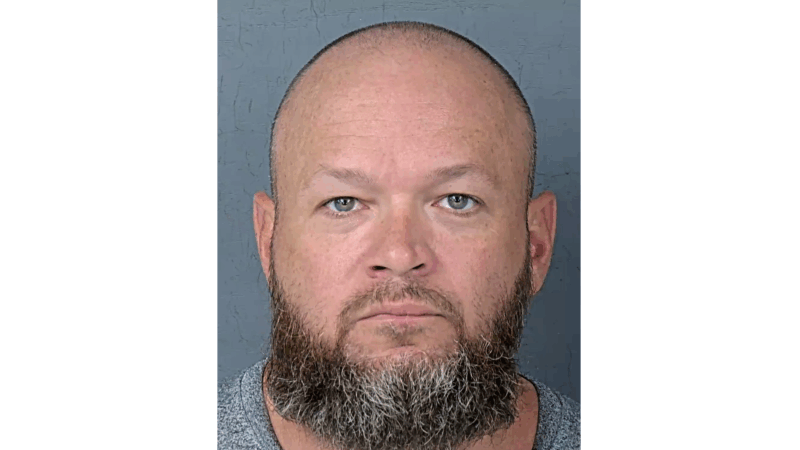
A Jan. 6 rioter pardoned by Trump was sentenced to life in prison for child sex abuse
Since receiving presidential pardons, dozens of former Capitol rioters have gotten into more legal trouble. In Florida, Andrew Paul Johnson was sentenced to life in prison for child sex abuse.
President Trump, Pam Bondi sued over sale of TikTok assets
The case, filed in a federal court in Washington, D.C., accuses the Trump administration of ignoring legislation designed to stop the spread of Chinese propaganda — and instead helping to broker a partial sale to businessmen close to Trump.

A rift between Spain and Trump widens over Spanish opposition to the Iran war
The Spanish government reiterated it would not let U.S. forces use two joint military bases in Spain as the U.S.-Israeli war in Iran escalates, widening a rift with the Trump administration.
Blackpink, modern K-pop’s trailblazing group, tries to find its way home
A new mini-album finds the world's biggest girl group in a tight spot: competing with its own legacy.
If you loved ‘Sinners,’ here’s what to watch next
So you loved best picture nominee Sinners. What should you watch next? We asked our audience to share their recommendations. They suggested Near Dark, The Wailing and other vampire horror films.

U.S-Israeli strikes continue across Iran, Iranian drones hit Azerbaijan
The U.S. and Israel said they conducted new strikes inside Iran overnight, targeting ballistic missile launchers. Iran claimed it struck a U.S. oil tanker in the northern Persian Gulf.
