
No soil required: New York program brings hydroponics to Birmingham students
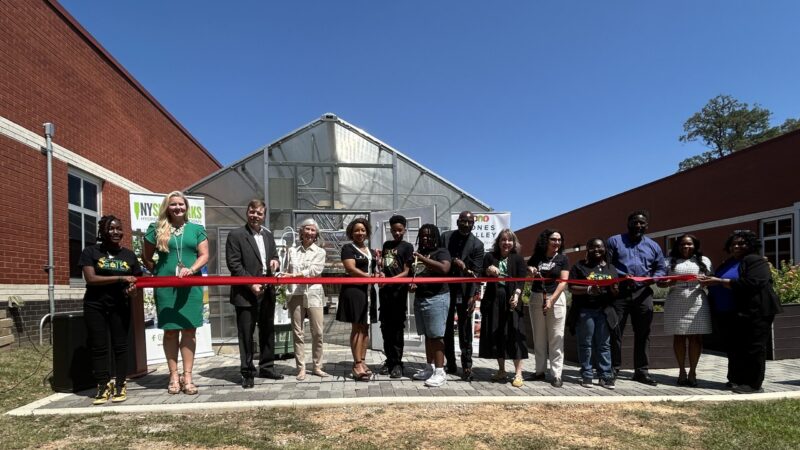
City councilors, directors of Jones Valley Teaching Farm and NY Sun Works cut a ribbon with students, teachers and staff of the Bush Hills STEAM Academy.
“Welcome to the greenhouse,” said 8th grader Tyler Martin as she stepped inside a greenhouse at the Bush Hills STEAM Academy in Birmingham. She took a basil seedling from a growing tower, showing how its roots are tangled in a sponge-like pod of peat.
“The water soaks into that, and it helps the plant grow up,” Martin said. “See how it’s starting to grow?”
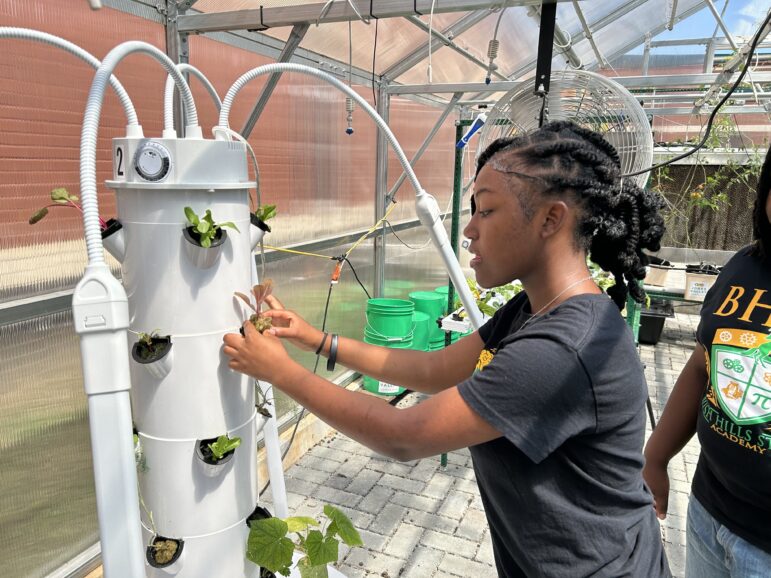
She is one of the students in eight Birmingham City Schools who will take part in a first of its kind hydroponics program in the city. The program aims to teach students about sustainable food practices and how to combat food deserts in their communities. It comes through a partnership with the New York-based non-profit New York Sun Works and Birmingham’s Jones Valley Teaching Farm. The project strives to create pathways to higher education and careers while growing thousands of pounds of fresh produce.
Hydroponics uses only water with powdered, dissolved electrolytes and nutrients to grow plants — no soil required. Martin’s classmate, Deandre Hall, explained that the irrigating growing tower is made for people who may not have much access to water.
“It reuses the water to water the plants,” he said, adding that hydroponics uses 90% less water than traditional irrigation.
The students later give a tour to Mayor Randall Woodfin, who tried, and apparently enjoyed, a cherry tomato already growing on a vine at the back of the greenhouse.
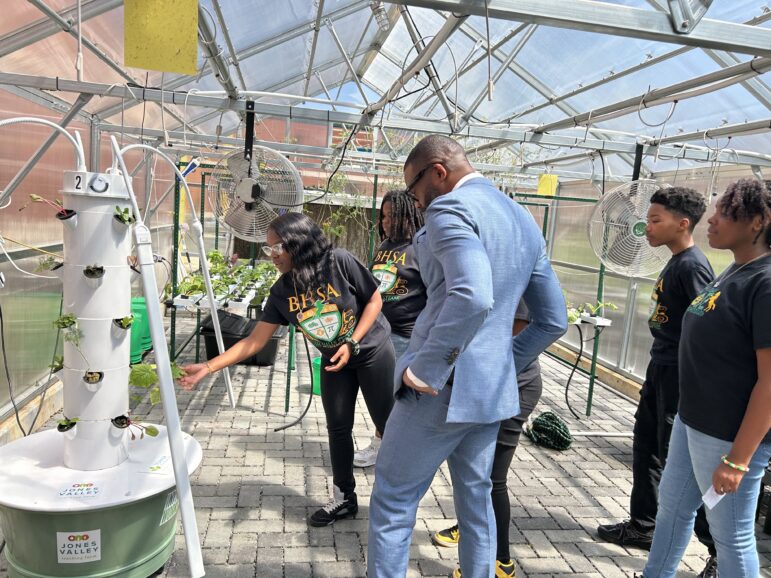
While hydroponics can’t be used to grow every kind of plant, Manuela Zamora, executive director of New York Sun Works said hydroponics is best used on leafy vegetables like lettuce, also peppers, cucumbers and cherry tomatoes. Students in Birmingham schools are now set to grow thousands of pounds of produce for their community.
“We’re connecting the students with a hands-on and project-based approach to learning science while they are growing plants from seed to harvest,” Zamora said.
Zamora said the students will learn about how hydroponics fits into the larger world of farming.
“Why are we doing this if we have traditional agriculture?” Zamora said. “Well, maybe because you want to maximize those leafy greens in hydroponic technology while leaving space for those other plants in soil.”
She added that the program represents the future of agriculture as a method of preserving both healthy soil and water while maximizing the growth of specific plants and vegetables.
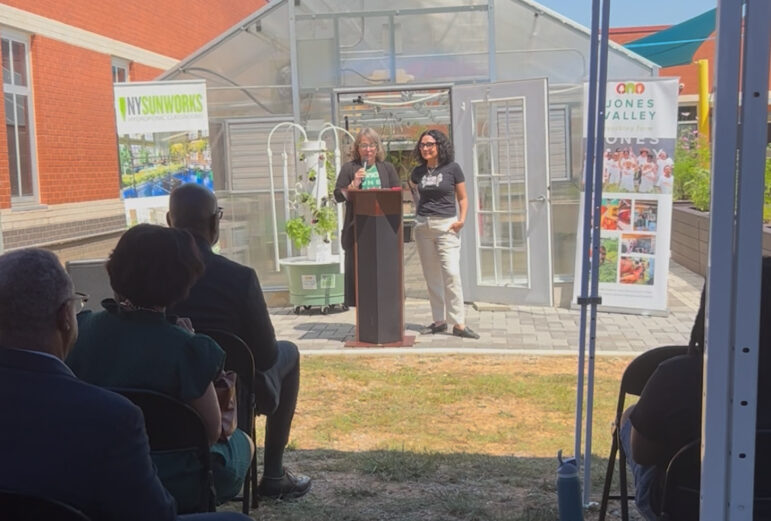
Eighth grader Kierra Norris said even though hydroponics classes are just beginning, she and her classmates are already learning about how the world of sustainable food practices can be applied in their own lives.
“We live in a food desert,” Norris said. “It’s very useful to us to have something to grow without any soil available to us.”

Top Arizona lawmaker says he’s complied with a subpoena for 2020 election records
Arizona's state Senate president says he has complied with a subpoena he received last week seeking records from a flawed, Republican-led review of the 2020 election in Maricopa County.

Colors fly as Hoover celebrates Holi
Colored powder filled the air at Veterans Park in Hoover on Saturday. Crowds gathered to celebrate Holi, the Hindu festival of Spring, usually identified by the throwing of colors.
Americana’s newcomer Jobi Riccio faces the pressure on her new record
The country and bluegrass songwriter talks about her sophomore album, Face the Feeling, out May 15.

What to know about Mojtaba Khamenei, Iran’s new supreme leader
The second son of the late supreme leader keeps a low profile. But he's long been viewed as wielding his power behind the scenes, from crushing dissent to influencing presidential elections.
Anthropic sues the Trump administration over ‘supply chain risk’ label
The Pentagon told suppliers they can't use Anthropic's artificial intelligence tools after the company said it would not let its tech be used for autonomous weapons and mass domestic surveillance.
This historian dug up the hidden history of ‘amateur’ blackface in America
In her new book, Darkology, historian Rhae Lynn Barnes writes about how blackface and minstrel shows became one of the most popular forms of entertainment in 19th- and 20th-century America.
