
Nonprofit erases millions in medical debt across Gulf South, says it’s ‘Band-Aid’ for real issue
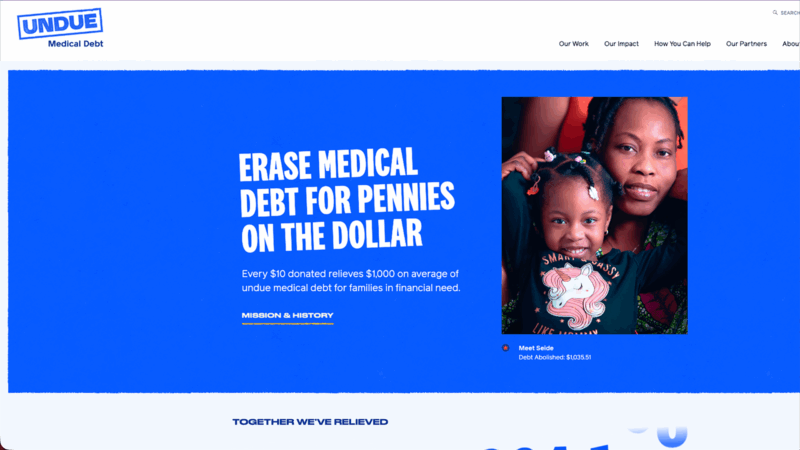
A screenshot of Undue Medical Debt's website touts how the nonprofit can help erase medical debt for "pennies on the dollar."
Over the last two years, thousands of New Orleanians have opened letters from Undue Medical Debt — or maybe they didn’t, assuming it was junk mail or another bill collector notice.
It wasn’t.
The national nonprofit works with hospitals, local governments and donors to buy and erase unpaid medical bills. The letter was notifying residents that some, or all, of their medical debt had been wiped away.
“It’s really a surprise for most people,” said Ruth Landé, vice president of provider relations at Undue Medical Debt. “They get a letter in the mail telling them their debt is gone — no application, no process, no strings attached.”
Undue Medical Debt uses donated or public funds to purchase large portfolios of unpaid accounts from hospitals and collection agencies at a steep discount, then simply erases them. Every dollar donated relieves about $100 in medical debt.
The relief is automatic for those who qualify — typically residents earning less than four times the federal poverty level or whose medical debt exceeds 5% of their annual income.
In total, more than 123,000 people across Orleans Parish had their debt abolished through a partnership between the nonprofit and the New Orleans Health Department, LCMC Health and Ochsner Health. The $1.3 million initiative, funded with federal American Rescue Plan (ARPA) dollars, erased $150.5 million in unpaid medical debt for 123,436 people across Orleans Parish.
In neighboring Mississippi and Alabama, the group has wiped out roughly $260 million and $299 million, respectively.
But while life-changing for many, the relief barely puts a dent in the scale of Louisiana’s medical debt crisis. Statewide, residents owe nearly $1.9 billion — more than the entire annual budget for the city of New Orleans — according to the Consumer Financial Protection Bureau.
And the debt is not spread evenly. It falls hardest on those already vulnerable — families with children, Black households and people in poor health or living with disabilities. Nearly 28% of Black households carry medical debt, compared to 17% of white households. And families with children are more likely to face it than those without.
Medical expenses are now the leading cause of personal bankruptcy, and the most common reason for foreclosure — accounting for 57% of cases. Losing a home to medical debt doesn’t just mean displacement; it makes it harder to rent or qualify for another mortgage.
Landé agrees that while programs like Undue Medical Debt provide relief, they can’t fix the underlying system that produces such staggering debt.
“It’s like putting on a Band-Aid — which is useful and necessary — but we still need to stop the bleeding,” she said. “The real issue is lack of affordable, comprehensive health insurance.”
That problem could soon get worse. Federal pandemic-era policies that expanded Medicaid enrollment have expired, and subsidies under the Affordable Care Act are set to lapse at the end of 2025 unless Congress renews them — an issue currently at the heart of the federal government shutdown.
Millions could lose coverage nationwide — and many more will face higher premiums and out-of-pocket costs.
Louisiana, which expanded Medicaid in 2016, fared better than neighboring Mississippi and Alabama, where large numbers of low-income residents remain uninsured. Still, one in five Louisianans currently carries medical debt, according to federal data.
The consequences ripple through the state’s economy and health care system. Hospitals absorb billions in uncompensated care, especially in rural areas where many patients can’t pay. Some facilities cut services or close altogether, leaving patients to travel farther for treatment — often racking up more debt along the way. That, in turn, pushes patients further from care and deeper into debt.
Landé said states could take simple steps, like prohibiting interest on medical debt, banning wage garnishment or liens and ensuring medical bills don’t appear on credit reports.
“This isn’t a partisan issue,” Landé said. “Everyone agrees people shouldn’t be punished financially for getting sick. Medical debt is not a debt of choice — it’s not like buying a car or a TV. You can’t always be lucky enough to stay healthy.”
This story was produced by the Gulf States Newsroom, a collaboration between Mississippi Public Broadcasting, WBHM in Alabama, WWNO and WRKF in Louisiana and NPR. Support for health equity coverage comes from The Commonwealth Fund.
Lack of transportation keeps many Alabamians from working. Rural public transit programs are trying to help
While lack of transportation is a major employment barrier in Alabama, few people take public transit to work. That dynamic is even more pronounced in rural areas.

When a horse whinnies, there’s more than meets the ear
A new study finds that horse whinnies are made of both a high and a low frequency, generated by different parts of the vocal tract. The two-tone sound may help horses convey more complex information.

Trump’s many tariff tools mean consumer prices won’t go down, analysts say
The Supreme Court struck down President Trump's signature tariffs. But the president has other tariff tools, and consumers shouldn't expect cheaper prices anytime soon, economists say.
Hundreds of American nurses choose Canada over the U.S. under Trump
More than 1,000 American nurses have successfully applied for licensure in British Columbia since April, a massive increase over prior years.
Tax credits for solar panels are available, but the catch is you can’t own them
Rooftop solar installers are steering customers toward leases instead of purchases. Federal tax credits for purchased systems have ended but are still available for leased ones.
5 takeaways from Trump’s State of the Union address
President Trump hit familiar notes on immigration and culture in his speech Tuesday night, but he largely underplayed the economic problems that voters say they are most concerned about.
