
Legendary civil rights attorney Fred Gray honored with statue in Alabama
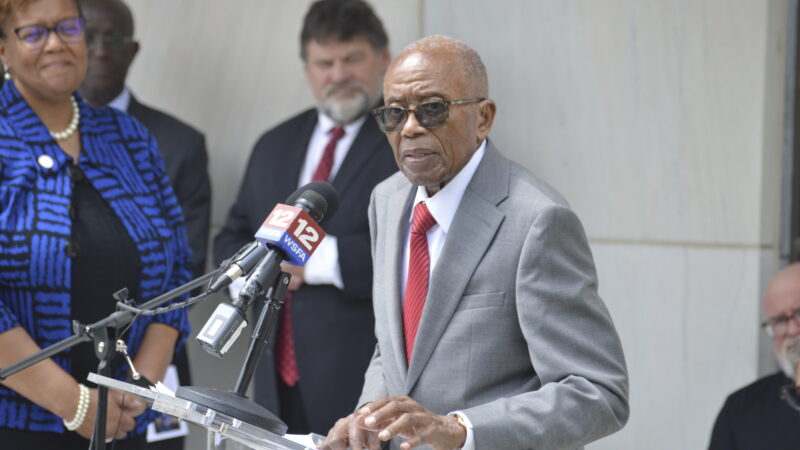
Prolific civil rights attorney Fred Gray talks outside of the Alabama Bar Association in downtown Montgomery, Ala., Thursday, April 24, 2025.
By Safiyah Riddle
MONTGOMERY, Ala. (AP) — Legendary attorney Fred Gray — once deemed the “chief counsel” of the Civil Rights Movement by the Rev. Martin Luther King Jr. — was honored with a statue outside the Alabama State Bar Association on Thursday.
“Growing up in Montgomery on the west side, I never thought that one day my image would be in stone to honor my professional career,” the 94-year-old said in an impassioned speech at the statue unveiling in downtown Montgomery.
Gray represented prominent civil rights leaders like King, Rosa Parks and John Lewis throughout the Civil Rights Movement in Alabama, allowing activists to intentionally leverage mass arrests and civil disobedience to push for equal rights. Gray also represented participants in Selma-to-Montgomery marches in March 1965, which led to the Voting Rights Act in August later that year.
On Thursday, Gray emphasized his gratitude for the countless other people he represented who aren’t often recognized — including Claudette Colvin, who was arrested in 1955 when she was a teenager after she refused to give up her seat on a segregated Montgomery bus, months before Parks earned worldwide appreciation for doing the same.
“I humbly accept this award for all those unknown heroes and clients whose names never appear in print media, whose faces never appear on television. They are the persons who laid the foundation so that you can honor me here today,” Gray said.
The statue is engraved with the words “lawyers render service,” a phrase coined by Gray that is now championed by the Alabama Bar Association. Gray was the first Black president of the statewide organization in 2002.
Gray’s role in the Civil Rights Movement was the first of many accomplishments in his 70 years practicing law.
In 1970, he became one of Alabama’s first Black state legislators after Reconstruction.
Around the same time, Gray represented Black men who filed suit after the government intentionally let their illnesses go untreated in the infamous Tuskegee Syphilis Study. His work eventually led to an official apology from President Bill Clinton on the government’s behalf in 1997.
Gray is currently involved in a lawsuit seeking to remove a Confederate monument from a square at the center of mostly Black Tuskegee.
In 2022, Gray received the nation’s highest civilian honor, the Presidential Medal of Freedom.
Gray, who is an ordained minister, attributed his successful career to his faith in God and the support of his family, many of whom were in the audience as he spoke.
He acknowledged Thursday that the court “system doesn’t always deliver justice” but said that he would continue to keep working “until justice rolls down like water and righteousness like a stream.”
____
Riddle is a corps member for The Associated Press/Report for America Statehouse News Initiative. Report for America is a nonprofit national service program that places journalists in local newsrooms to report on undercovered issues.

How could the U.S. strikes in Iran affect the world’s oil supply?
Despite sanctions, Iran is one of the world's major oil producers, with much of its crude exported to China.

Why is the U.S. attacking Iran? Six things to know
The U.S. and Israel launched military strikes in Iran, targeting Khamenei and the Iranian president. "Operation Epic Fury" will be "massive and ongoing," President Trump said Saturday morning.
Sen. Tim Kaine calls on the Senate to vote on the war powers resolution
NPR's Scott Simon talks to Sen. Tim Kaine, D-Va., about the U.S. strikes on Iran.
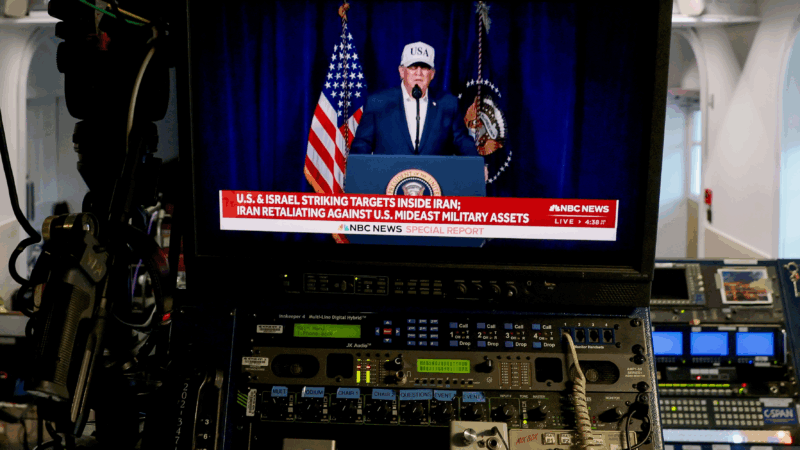
Iran strikes were launched without approval from Congress, deeply dividing lawmakers
Top lawmakers were notified about the operation shortly before it was launched, but the White House did not seek authorization from Congress to carry out the strikes.
Political science expert weighs in on Iran’s nuclear program in light of U.S. strikes
NPR's Scott Simon speaks to Ariane Tabatabai, the Public Service Fellow at Lawfare, about U.S. attacks on Iran and how President Trump's calls for regime change might be received there.
Week in Politics: Does Trump have political support for his actions in Iran?
We look at what President Trump's decision to attack Iran means, what kind of support he has in Iran and what this moment means for his administration.
