
Brutality and humanity at the Angola Prison Rodeo in Louisiana
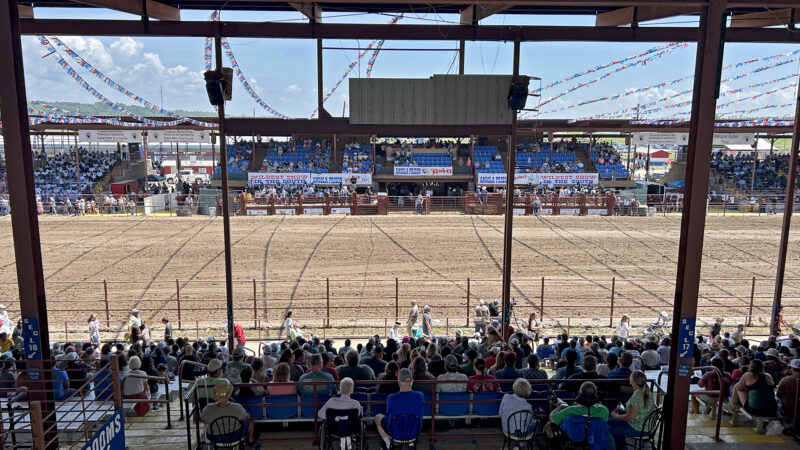
The crowd awaits the next event in the arena at the Angola Prison Rodeo held at Louisiana State Penitentiary in Angola, Louisiana, on April 26, 2025.
The Angola Prison Rodeo is the only rodeo in the country where incarcerated men compete in bull riding, buck breaking and other controversial, dangerous events.
The Gulf States Newsroom’s Drew Hawkins attended the rodeo at Louisiana State Penitentiary in late April. But while the event is criticized for its brutality, it also offers participants a chance to earn money while making a connection to the outside world.
The following transcript has been edited for clarity.
ANGOLA RODEO ANNOUNCER: Ladies and gentlemen, this is the only place in the whole wide world you’ll see that.
DREW HAWKINS, BYLINE: Four men incarcerated at the prison commonly known as Angola sit at a table in the center of a muddy arena. They’re volunteers in an event called “Convict Poker.” The last man at the table wins.
A massive bull is released from the gates. It charges right at them, slamming into the men, sending them flying and smashing the table to pieces.
The angry bull is lassoed and pulled away. The men get up and limp off. The crowd includes Louisiana’s governor, Jeff Landry. They eagerly await for the next event.
Landry called it a “beautiful day” on social media, but events like Convict Poker illustrate the brutality of the rodeo for Norris Henderson. He’s executive director of Voice of the Experienced (VOTE), an organization that works to restore the voting rights of formerly incarcerated people.
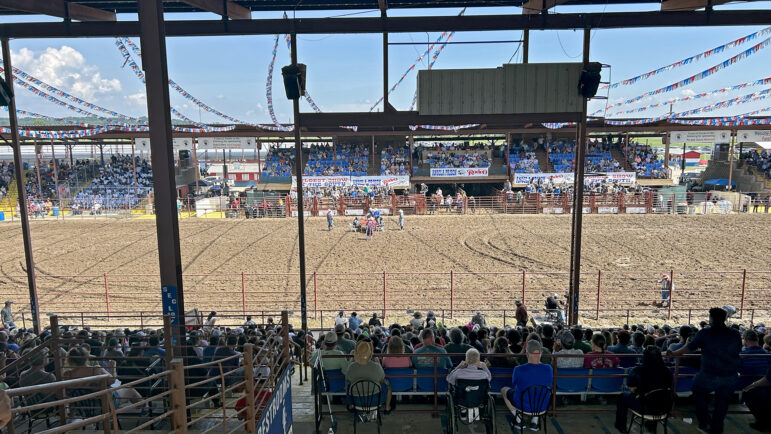
NORRIS HENDERSON: This is kind of like the Roman Colosseum, where people come to cheer, not the humans in the arena, they come to cheer the animals.
HAWKINS: Henderson says even when he was incarcerated at Angola for 27 years, he didn’t support the rodeo. The lack of training puts the men’s lives at risk for the sake of entertainment and the chance to win a few hundred dollars in a place without any other opportunities.
HENDERSON: To me, the rodeo was just this form of exploitation.
HAWKINS: But for many of the men incarcerated at Angola, it’s something they look forward to every year. Andrew Hundley is executive director of Louisiana Parole Project, which advocates for reentry support for incarcerated people. He’s also the first “juvenile-lifer” to be paroled from Angola.
ANDREW HUNDLEY: I think if there was an outcry from the public to end the rodeo tomorrow, the biggest pushback would be from the prison population at Angola. It’s truly a part of the prisons fabric and the economy of the prison.
HAWKINS: This time during “Convict Poker,” nobody seems to be seriously hurt. They’re not always so lucky.
DONALD COOK: The bull just picked me out, and when he hit me, he broke seven ribs and collapsed my left lung.
HAWKINS: That’s Donald Cook. He’s been at Angola since 1991, serving a life sentence for murder. He knows the risk, but even at 58, he still signs up for the rodeo, every time.
COOK: It gets to me, you know, for what I did and I got to live with that. The rodeo has showed me a purpose and a life in here.
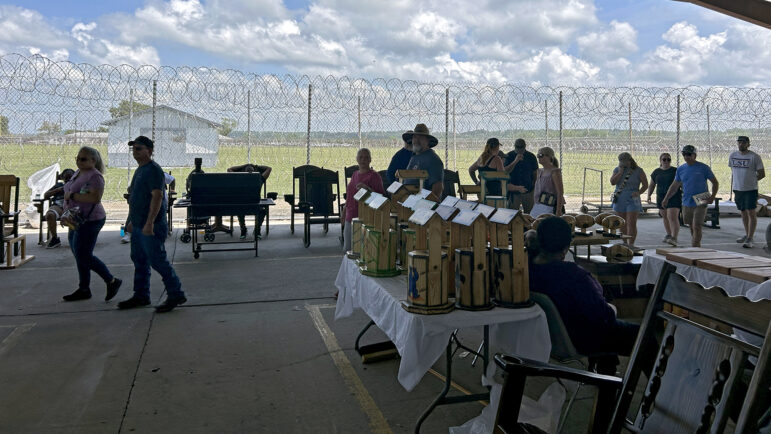
HAWKINS: Outside the arena, it’s more like a county fair. There’s a food court, carnival rides for children, and rows of booths where incarcerated men sell handicrafts.
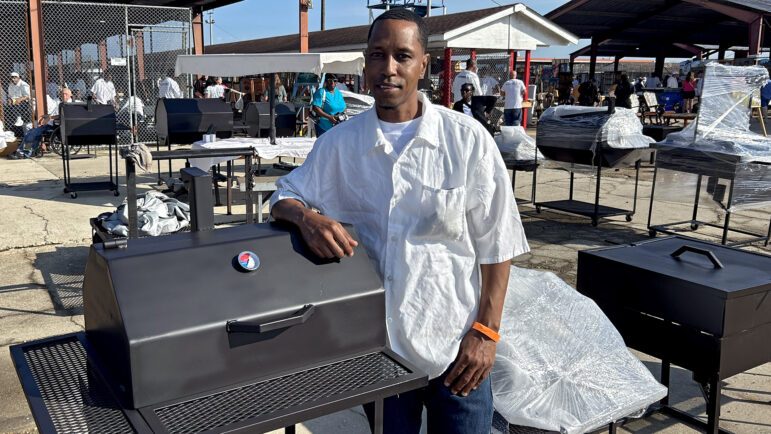
Charles Grace is selling barbecue pits he shaped and welded himself. They look professional grade, like something straight off the floor at Lowe’s or Home Depot.
CHARLES GRACE: So you want to get the same quality, you know what I’m saying, or a better quality. So that’s what I try to do, I try and give them that look.
HAWKINS: Grace makes about five grand on a good day at the rodeo. That’s before the prison deducts taxes and fees. But the job is still more lucrative than other work at Angola that is the subject of a lawsuit criticizing pay and labor conditions at the prison. Grace says he uses the money to help his family, who can also come to the prison to visit during the rodeos.
GRACE: I try to still be a father and a grandfather, even with my situation. That’s my motivation, to still make sure that whenever they need something more, Christmas, holidays, birthdays, I can still be that person for them.
HAWKINS: So far efforts to shut down the prison rodeo haven’t made it to the state legislature and the prison says ticket sales have been used to fill budget cuts and pay for things like GED classes and trade schools.
And the opportunity to make money and visit with loved ones will likely bring many of these men back when the rodeo returns in October.
For the Gulf States Newsroom, I’m Drew Hawkins at Angola.
Piper Hutchinson of Louisiana Illuminator contributed to this report. This story was produced by the Gulf States Newsroom, a collaboration between Mississippi Public Broadcasting, WBHM in Alabama, WWNO and WRKF in Louisiana and NPR.
Forget the State of the Union. What’s the state of your quiz score?
What's the state of your union, quiz-wise? Find out!
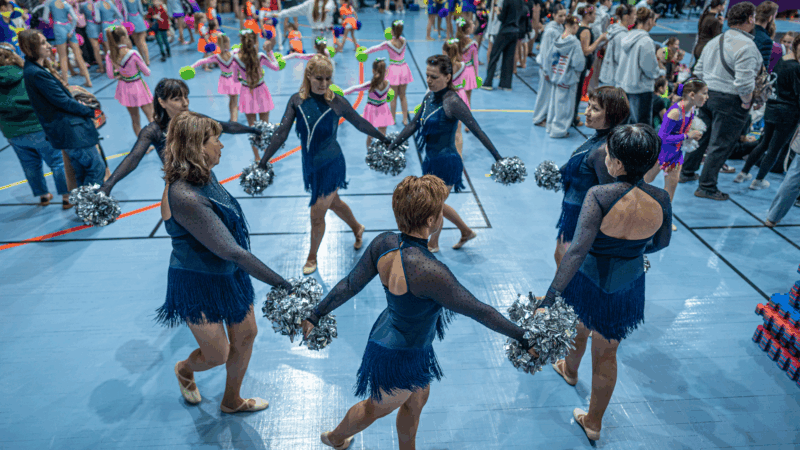
A team of midlife cheerleaders in Ukraine refuses to let war defeat them
Ukrainian women in their 50s and 60s say they've embraced cheerleading as a way to cope with the extreme stress and anxiety of four years of Russia's full-scale invasion.
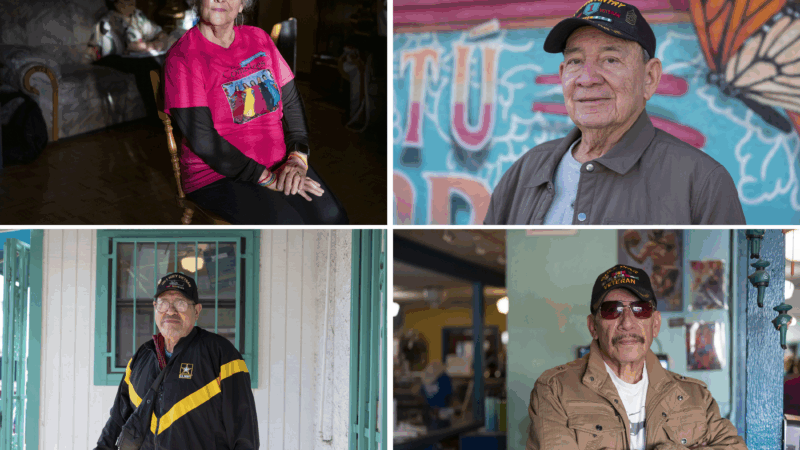
As the U.S. celebrates its 250th birthday, many Latinos question whether they belong
Many U.S.-born Latinos feel afraid and anxious amid the political rhetoric. Still, others wouldn't miss celebrating their country
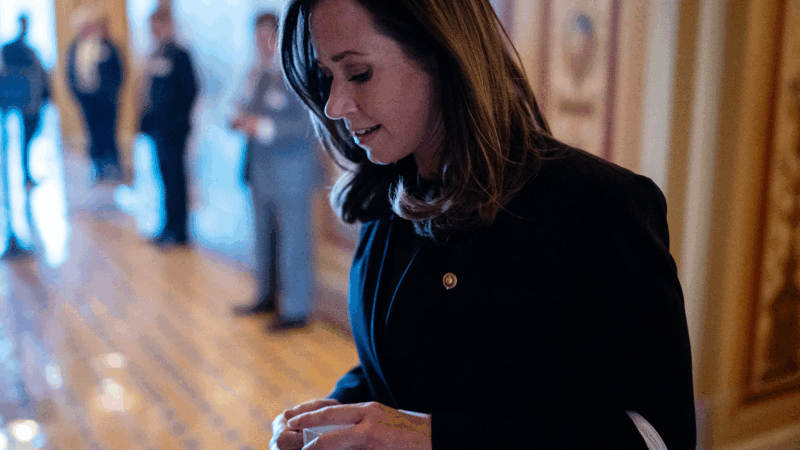
SNL mocked her as a ‘scary mom.’ In the Senate, Katie Britt is an emerging dealmaker
Sen. Katie Britt, Republican of Alabama, is a budding bipartisan dealmaker. Her latest assignment: helping negotiate changes to immigration enforcement tactics.
Nancy Guthrie case: How do families of missing people cope with the uncertainty?
When a loved one goes missing, relatives can feel guilty simply for eating, says Charlie Shunick, whose sister was kidnapped. Shunick now helps others navigate a nightmare "nobody is prepared for."
This community festival embraces the joys of a frozen lake — while it still has one
As climate change accelerates, local experts say the date Wisconsin's Lake Mendota freezes over is getting later, making safe conditions for activities that rely on snow and ice harder to predict.
