
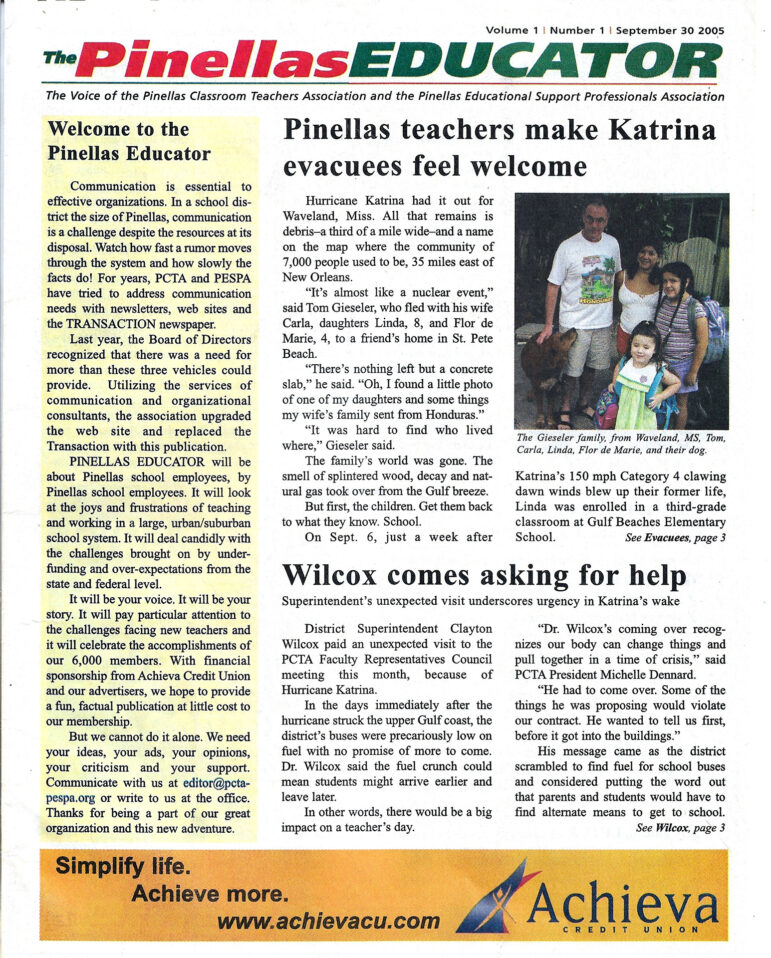
20 years later, Waveland’s letters to Santa tell stories of recovery from Hurricane Katrina
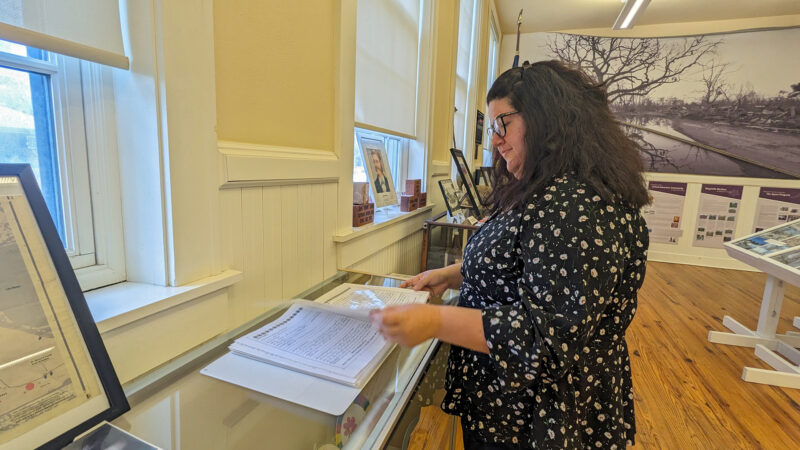
Linda Gieseler, whose letter to Santa is on display at the Ground Zero Hurricane Katrina Museum, flips through a binder of other letters.
By Elise Catrion Gregg, Gulf States Newsroom
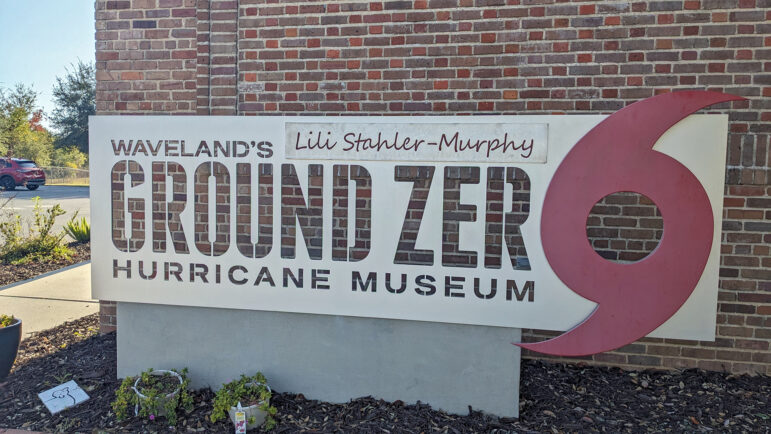
Waveland, Mississippi, is home to the Ground Zero Hurricane Katrina Museum, the only permanent museum dedicated to archiving the aftermath of the 2005 storm’s impact on the Gulf Coast.
Inside, photos and videos document the immediate days after Katrina; cases filled with people’s personal belongings just rescued from the rain and floods.
In one room at the end of the hall, nestled on a small shelf along a wall, is a far less eye-catching exhibit, but it tells some of the most moving stories from this era.
It’s a stack of binders, filled with about a thousand letters to Santa. As the holidays approached in the months after the storm, the Waveland mayor’s office created the “Dear Santa” Letter Program.
The letters documented what folks from the area needed — both those who stayed and families who had to leave. They were then shared with volunteers around the country who could get people what they needed.
One of those letters belongs to Linda Gieseler, who was in third grade when Katrina hit.
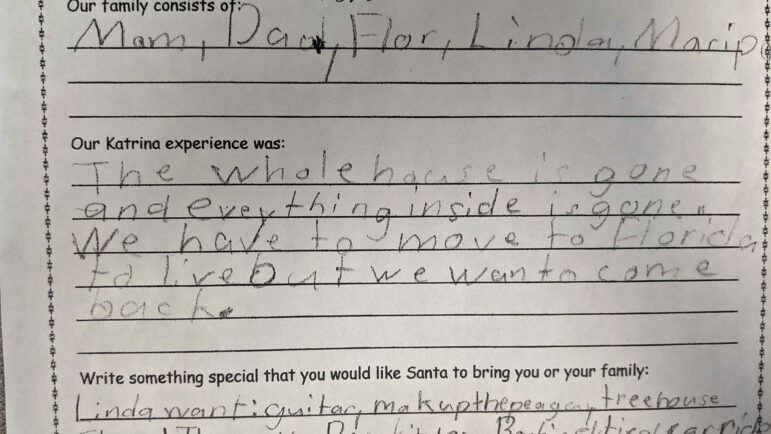
Her letter included requests for her whole family. She wanted a guitar and makeup. Her sister, Flor, wanted a Dora the Explorer kitchen set.
Her parents asked for a new home after Katrina completely obliterated theirs.
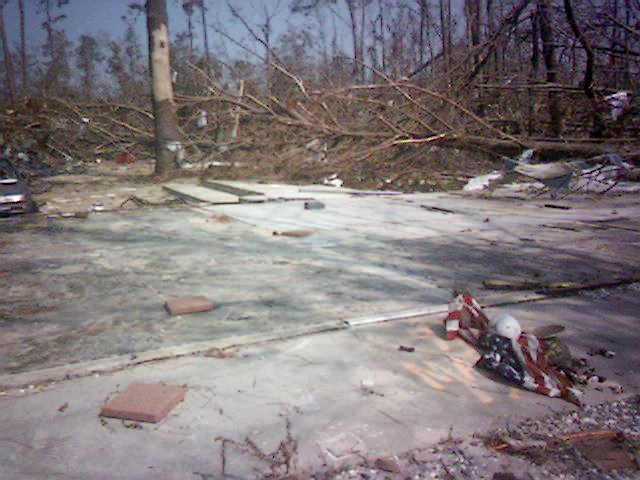
“Our Katrina experience was that the whole house is gone and everything inside is gone,” said Gieseler, reading from her letter at the museum in November. “We have to move to Florida to live, but we want to come back.”
Gieseler and her family did move to Florida, staying in St. Petersburg for several months before the whole family could return.
“My dad was the one who came here first while my mom, my sister and I were still in Florida, trying to live a normal life there,” she said. “But he was the one who first saw the devastation, and he described it as like a nuclear bomb.”
Twenty years later, it all still weighs on Gieseler.
“I just can’t believe I wrote this as a kid,” she said. “I literally said, ‘The whole house is gone, everything inside is gone.’ And I was, like, nine or something?”
Gieseler had completely forgotten about that letter until she came with her mom and sister to Waveland’s Ground Zero Hurricane Katrina Museum several years ago.
“We saw the binders and there were several binders with thousands of pages. Something told me to pick this binder, and I flipped it to the exact page, and it was my letter that I wrote to Santa,” she said.
‘A key part of Mississippi history’
Gieseler’s letter and hundreds of others are looked after by Claire Gray, the museum’s assistant director.
Gray takes a lot of pride in the museum being the only permanent Hurricane Katrina museum, and the only one she knows of that displays these letters for the public.
She wants them to be available outside of the museum, though. So, she’s going through these hundreds of letters to transcribe and digitize them.
“This is a key part of Mississippi history that is neglected a lot,” Gray said. “Seeing these stories just from regular people in Mississippi, talking very candidly about what they went through, is very touching.”
Gray said that kids and adults alike wrote these letters to Santa, and they paint a vivid picture of Mississippi’s coast.
“Some people, they told very short stories: sometimes just a couple of words. There are ones that are even one word talking about their experience,” she said. “And then some of them were several pages. We have one that’s about nine pages long… full front to back pages.”
Gray, who moved to Waveland several years ago, said it shows the resilience and generosity of people in that area.
“Some people even said, ‘We don’t need anything, please give this to someone who needs it more,’” Gray said. “A lot of people just kind of use these letters as a space, I think to just share their feelings and experiences.”
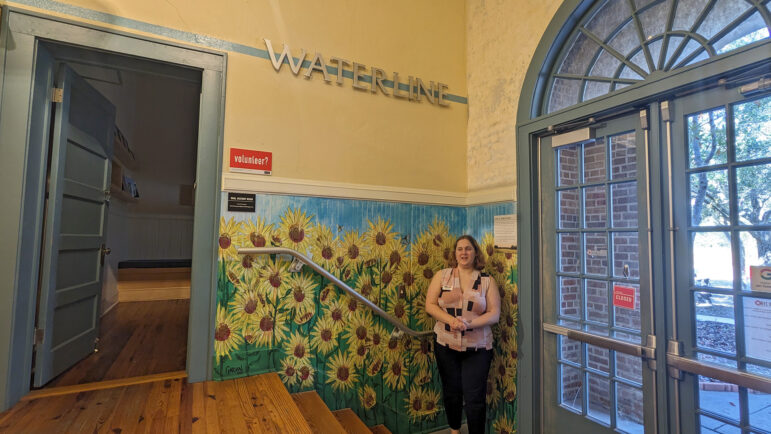
Going through all these letters is a labor of love for Gray, who said they’re key to preserving parts of Mississippi’s history that weren’t always well-documented.
In her research, she found that most Katrina archives focus more on New Orleans and less on Mississippi’s coast, which was hit hardest.
“It’s also been daunting, I would say, psychologically, emotionally,” she said. “You have to read through page after page of ‘I lost my mother, I lost my sister.’”
With a grant from the Center for Digital Humanities, Gray hopes to also use mapping software to show the geographic history of Waveland’s residents who wrote in and even use text analysis to find common emotions across letters.
“You can see as many numbers as you want but seeing, like we’ve mentioned before, someone saying, ‘I lost my pets, my mommy cries every night, I lost everything and we don’t know where to start.’ That’s what really resonates with people,” Gray said.
Small gesture, big impact
In the aftermath of Katrina, Waveland didn’t even have the paper for people to write these letters, much less a thousand of them.
That’s where Project GIFT stepped in — a volunteer program with Georgia power company Southwire.
“Project GIFT was really formed out of Hurricane Katrina and the disaster that followed that horrific storm that hit South Mississippi,” said Jason Pollard, one of the founding members of Project GIFT and Southwire’s current vice president of communications and giving back.
GIFT stands for Giving Inspiration For Tomorrow, and volunteers with Project GIFT did a variety of volunteer work on the coast after Katrina, like Christmas on the Coast, where they gave out toys and supplies at Buccaneer State Park.
The letters were, in a way, more of a side project for Project GIFT. When the city didn’t have what they needed to get letter templates out to people, Pollard and the other volunteers made it happen.
“They had no way to print these letters to give out,” said Pollard. “So what we did was we took that one copy back, and we provided the publication for three thousand plus letters and then took them back to them for them to give out in the community.”
About a third of those letters were filled out, and those are all in the museum now.
Pollard got to see those letters documented at the museum when he visited earlier this year as part of the 20th anniversary of Katrina.
“In the bigger picture, it seemed small when you thought about us bringing supplies and bringing help,” he said. “The letters seemed small, but it seemed like something we could do.”
He hopes that the memories preserved through what Project GIFT started allow folks to remember the endurance and community on the coast — not just the hard parts.
“It was small at the time, but look at what it is today,” Pollard said. “These were kids, and now they’re young adults, and Katrina will forever be in their memories. Hopefully, this makes it a little bit better.”
Better, Pollard hopes, for those kids who have grown up into adults like Linda Gieseler.
She’s got a daughter of her own now, who she hopes to take to the museum someday when she’s old enough to understand what Gieseler went through.
“I hope that she never goes through something like we did,” Gieseler said. “Each storm that comes through here, whether it’s minor or major, I always take it very seriously because I don’t want her to lose a home.”
Gieseler’s all grown up now, living in the area but with a home in Hattiesburg away from the water. But she still remembers herself, 9 years old, faced with a brand new life in a new place.
“I wish I could give her a big old hug, like my whole entire family then, a big old hug, saying ‘It’s gonna be okay, everything’s gonna come back, our life will be better,’” said Gieseler. “And it really has. Even though my dad is not here, I know he’s looking over us, and he’s really proud.
“We have a house now: that’s what he always dreamed of. And now he has a granddaughter.”
This story was produced by the Gulf States Newsroom, a collaboration between Mississippi Public Broadcasting, WBHM in Alabama, WWNO and WRKF in Louisiana and NPR.

Live Nation and Justice Department reach settlement in antitrust case
The trial, which began a week ago in a New York City courtroom, aimed to break up Live Nation and its subsidiary, Ticketmaster.
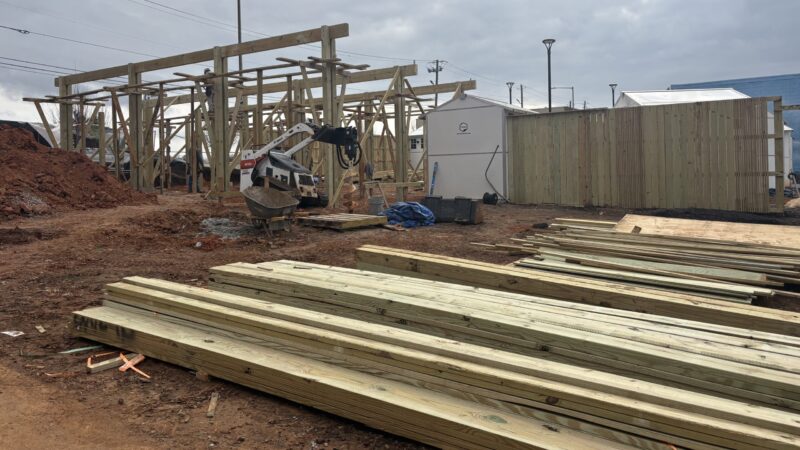
Microshelters for Birmingham’s unhoused set to open soon
The pilot program called Home For All involves building 14 small pallet homes to house those who would otherwise be living on the streets.
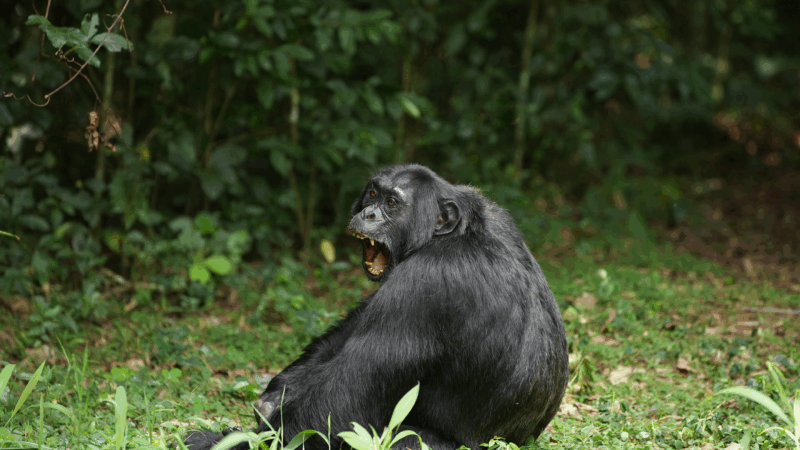
Chimps’ taste for fermented fruit hints at origins of human love of alcohol
Scientists analyzed the urine of wild chimpanzees who'd feasted on fallen fruit to see how much alcohol they consumed from the fermented sugars.
Iran attacks Israel, Gulf states, after naming new leader on Day 10 of war
The price of crude oil briefly neared $120 a barrel Monday as Iran named Mojtaba Khamenei the supreme leader and then launched new attacks at Israel and Gulf states.

World shares tumble as Iran war pushes crude prices over $110 a barrel
World shares tumbled on Monday, with Japan's benchmark Nikkei 225 index plunging more than 5%, after oil prices spiked at nearly $120 a barrel.
Come along with some geese as they migrate back from their southern winter havens
Geese's iconic "V" formations and trademark squawks can be seen and heard overhead as they go back and forth to the south through the year. But what does it take for such a long trip?
