
Supreme Court lets Alabama use GOP-backed map of the state’s congressional districts
 ========= Old Image Removed =========1Array
(
    [_wp_attached_file] => Array
        (
            [0] => 2022/01/AP22025127146691-scaled-e1643125557182.jpg
        )

    [_wp_attachment_metadata] => Array
        (
            [0] => a:6:{s:5:"width";i:2560;s:6:"height";i:1440;s:4:"file";s:50:"2022/01/AP22025127146691-scaled-e1643125557182.jpg";s:5:"sizes";a:12:{s:6:"medium";a:4:{s:4:"file";s:50:"AP22025127146691-scaled-e1643125557182-336x189.jpg";s:5:"width";i:336;s:6:"height";i:189;s:9:"mime-type";s:10:"image/jpeg";}s:5:"large";a:4:{s:4:"file";s:50:"AP22025127146691-scaled-e1643125557182-771x434.jpg";s:5:"width";i:771;s:6:"height";i:434;s:9:"mime-type";s:10:"image/jpeg";}s:9:"thumbnail";a:4:{s:4:"file";s:50:"AP22025127146691-scaled-e1643125557182-140x140.jpg";s:5:"width";i:140;s:6:"height";i:140;s:9:"mime-type";s:10:"image/jpeg";}s:12:"medium_large";a:4:{s:4:"file";s:50:"AP22025127146691-scaled-e1643125557182-768x432.jpg";s:5:"width";i:768;s:6:"height";i:432;s:9:"mime-type";s:10:"image/jpeg";}s:9:"1536x1536";a:4:{s:4:"file";s:51:"AP22025127146691-scaled-e1643125557182-1536x864.jpg";s:5:"width";i:1536;s:6:"height";i:864;s:9:"mime-type";s:10:"image/jpeg";}s:9:"2048x2048";a:4:{s:4:"file";s:52:"AP22025127146691-scaled-e1643125557182-2048x1152.jpg";s:5:"width";i:2048;s:6:"height";i:1152;s:9:"mime-type";s:10:"image/jpeg";}s:9:"wbhm-icon";a:4:{s:4:"file";s:48:"AP22025127146691-scaled-e1643125557182-80x80.jpg";s:5:"width";i:80;s:6:"height";i:80;s:9:"mime-type";s:10:"image/jpeg";}s:13:"wbhm-featured";a:4:{s:4:"file";s:50:"AP22025127146691-scaled-e1643125557182-800x450.jpg";s:5:"width";i:800;s:6:"height";i:450;s:9:"mime-type";s:10:"image/jpeg";}s:20:"wbhm-featured-square";a:4:{s:4:"file";s:50:"AP22025127146691-scaled-e1643125557182-600x600.jpg";s:5:"width";i:600;s:6:"height";i:600;s:9:"mime-type";s:10:"image/jpeg";}s:18:"wbhm-featured-home";a:4:{s:4:"file";s:50:"AP22025127146691-scaled-e1643125557182-553x311.jpg";s:5:"width";i:553;s:6:"height";i:311;s:9:"mime-type";s:10:"image/jpeg";}s:22:"wbhm-featured-carousel";a:4:{s:4:"file";s:50:"AP22025127146691-scaled-e1643125557182-470x265.jpg";s:5:"width";i:470;s:6:"height";i:265;s:9:"mime-type";s:10:"image/jpeg";}s:14:"post-thumbnail";a:4:{s:4:"file";s:50:"AP22025127146691-scaled-e1643125557182-125x125.jpg";s:5:"width";i:125;s:6:"height";i:125;s:9:"mime-type";s:10:"image/jpeg";}}s:10:"image_meta";a:12:{s:8:"aperture";s:3:"3.5";s:6:"credit";s:2:"AP";s:6:"camera";s:10:"NIKON D810";s:7:"caption";s:410:"FILE - Sen. Rodger Smitherman compares U.S. Representative district maps during a special session on redistricting at the Alabama Statehouse in Montgomery, Ala., Nov. 3, 2021. Federal judges have blocked Alabama from using newly drawn congressional districts in upcoming elections. A three-judge panel issued a preliminary injunction Monday, Jan. 24, 2022. (Mickey Welsh/The Montgomery Advertiser via AP, File)";s:17:"created_timestamp";s:10:"1635952013";s:9:"copyright";s:0:"";s:12:"focal_length";s:3:"116";s:3:"iso";s:4:"4000";s:13:"shutter_speed";s:5:"0.008";s:5:"title";s:21:"Alabama Redistricting";s:11:"orientation";s:1:"1";s:8:"keywords";a:0:{}}s:14:"original_image";s:20:"AP22025127146691.jpg";}
        )

    [_wp_attachment_image_alt] => Array
        (
            [0] => FILE - Sen. Rodger Smitherman compares U.S. Representative district maps during a special session on redistricting at the Alabama Statehouse in Montgomery, Ala., Nov. 3, 2021. Federal judges have blocked Alabama from using newly drawn congressional districts in upcoming elections. A three-judge panel issued a preliminary injunction Monday, Jan. 24, 2022. (Mickey Welsh/The Montgomery Advertiser via AP, File)
        )

    [_media_credit] => Array
        (
            [0] => Mickey Welsh
        )

    [_navis_media_credit_org] => Array
        (
            [0] => The Montgomery Advertiser via AP
        )

    [_navis_media_can_distribute] => Array
        (
            [0] => 1
        )

    [_wp_attachment_backup_sizes] => Array
        (
            [0] => a:13:{s:9:"full-orig";a:3:{s:5:"width";i:2560;s:6:"height";i:1706;s:4:"file";s:27:"AP22025127146691-scaled.jpg";}s:14:"thumbnail-orig";a:4:{s:4:"file";s:28:"AP22025127146691-140x140.jpg";s:5:"width";i:140;s:6:"height";i:140;s:9:"mime-type";s:10:"image/jpeg";}s:11:"medium-orig";a:4:{s:4:"file";s:28:"AP22025127146691-336x224.jpg";s:5:"width";i:336;s:6:"height";i:224;s:9:"mime-type";s:10:"image/jpeg";}s:17:"medium_large-orig";a:4:{s:4:"file";s:28:"AP22025127146691-768x512.jpg";s:5:"width";i:768;s:6:"height";i:512;s:9:"mime-type";s:10:"image/jpeg";}s:10:"large-orig";a:4:{s:4:"file";s:28:"AP22025127146691-771x514.jpg";s:5:"width";i:771;s:6:"height";i:514;s:9:"mime-type";s:10:"image/jpeg";}s:14:"1536x1536-orig";a:4:{s:4:"file";s:30:"AP22025127146691-1536x1024.jpg";s:5:"width";i:1536;s:6:"height";i:1024;s:9:"mime-type";s:10:"image/jpeg";}s:14:"2048x2048-orig";a:4:{s:4:"file";s:30:"AP22025127146691-2048x1365.jpg";s:5:"width";i:2048;s:6:"height";i:1365;s:9:"mime-type";s:10:"image/jpeg";}s:14:"wbhm-icon-orig";a:4:{s:4:"file";s:26:"AP22025127146691-80x80.jpg";s:5:"width";i:80;s:6:"height";i:80;s:9:"mime-type";s:10:"image/jpeg";}s:18:"wbhm-featured-orig";a:4:{s:4:"file";s:28:"AP22025127146691-800x450.jpg";s:5:"width";i:800;s:6:"height";i:450;s:9:"mime-type";s:10:"image/jpeg";}s:25:"wbhm-featured-square-orig";a:4:{s:4:"file";s:28:"AP22025127146691-600x600.jpg";s:5:"width";i:600;s:6:"height";i:600;s:9:"mime-type";s:10:"image/jpeg";}s:23:"wbhm-featured-home-orig";a:4:{s:4:"file";s:28:"AP22025127146691-467x311.jpg";s:5:"width";i:467;s:6:"height";i:311;s:9:"mime-type";s:10:"image/jpeg";}s:27:"wbhm-featured-carousel-orig";a:4:{s:4:"file";s:28:"AP22025127146691-398x265.jpg";s:5:"width";i:398;s:6:"height";i:265;s:9:"mime-type";s:10:"image/jpeg";}s:19:"post-thumbnail-orig";a:4:{s:4:"file";s:28:"AP22025127146691-125x125.jpg";s:5:"width";i:125;s:6:"height";i:125;s:9:"mime-type";s:10:"image/jpeg";}}
        )

)
1674042420 
1644225660
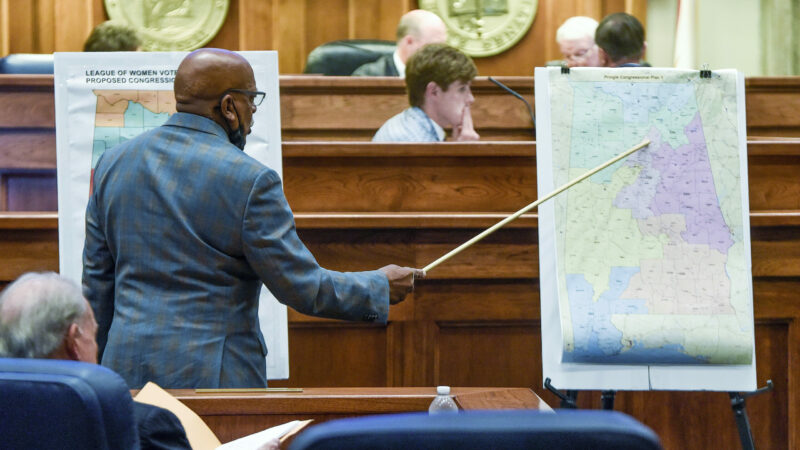
FILE - Sen. Rodger Smitherman compares U.S. Representative district maps during a special session on redistricting at the Alabama Statehouse in Montgomery, Ala., Nov. 3, 2021. Federal judges have blocked Alabama from using newly drawn congressional districts in upcoming elections. A three-judge panel issued a preliminary injunction Monday, Jan. 24, 2022. (Mickey Welsh/The Montgomery Advertiser via AP, File)

Sen. Rodger Smitherman compares U.S. Representative district maps during a special session on redistricting at the Alabama Statehouse in Montgomery, Ala., Nov. 3, 2021.

Mickey Welsh, The Montgomery Advertiser via AP

By Nina Totenberg, NPR

The U.S. Supreme Court further undercut the Voting Rights Act on Monday, blocking, for now, the creation of a second majority-Black congressional district in Alabama for the 2022 election.

The court’s action came on an emergency appeal from Alabama, which challenged a decision by a three-judge federal court panel that included two Trump appointees. The lower court concluded that under the Voting Rights Act, Alabama, a state with a population that is more than one-quarter Black, could reasonably, and therefore must, create two majority-Black districts out of seven congressional districts.

The Supreme Court vote was 5-4, with Chief Justice John Roberts joining the court’s three liberals in dissent. All four would have refused to intervene now, thus allowing the 2022 election to go forward with a map calling for two majority-Black districts. In contrast, the five-justice majority decision means that for at least another election cycle, Alabama will have just a single majority-Black congressional district, because the primaries are set to take place in May.

While the court has said that outright racial gerrymanders are unconstitutional, it has long interpreted the Voting Rights Act as requiring race to be a major factor in redistricting under certain circumstances — namely when white voters vote as a bloc against Black candidates and when a compact-enough majority-minority district or districts can be drawn so that minorities have a good chance to elect the candidates of their choice.

In the case from Alabama, the state doesn’t dispute that there is bloc voting. But it contests the creation of a second majority-Black district because it would divide the suburbs of Mobile. That argument was rejected by the lower court, which noted that the school districts in that area were divided in precisely the same way as the proposed second majority-Black congressional district.
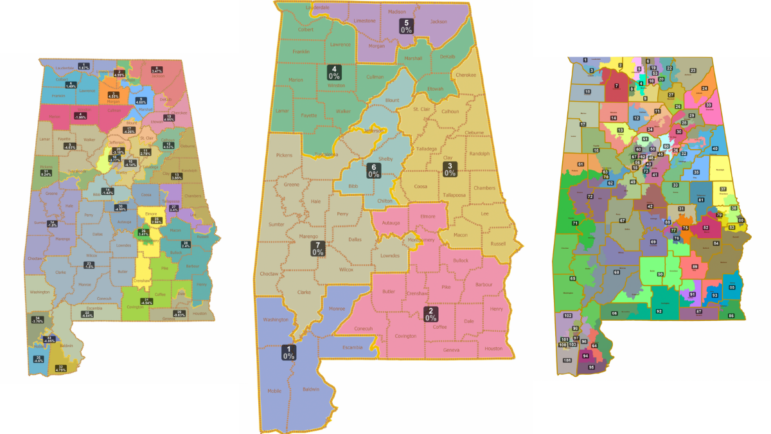
These redistricting maps were finalized during the 2021 special legislative session. The state Senate map is far left, the congressional district map is in the center, and the state House map is on the right.

But the Supreme Court stopped the lower court’s order from going into effect.

Alabama Attorney General Steve Marshall proclaimed victory for now, declaring that the creation of a single majority-Black district is all that the Constitution demands.

Needless to say, the Black plaintiffs were disappointed. Plaintiff Evan Milligan said in a statement on Monday: “We are disappointed by today’s decision. The fight for fair representation for Black voters in Alabama has been a winding road, generations long. However, during a month set aside to honor Black American history, we are reminded of the strength and dignity displayed by our ancestors who routinely confronted a wide variety of disappointments.”

Once again, the court’s action came in an unsigned order, without full briefing or argument, though the court will eventually hear arguments in the case, either later this term or, more likely, next fall.

“Accepting Alabama’s contentions would rewrite decades of this Court’s precedent” about the Voting Rights Act, wrote Justice Elena Kagan in a dissent joined by Justices Stephen Breyer and Sonia Sotomayor. “Here the district court applied established legal principles to an extensive evidentiary record. It’s reasoning was careful — indeed exhaustive — and justified in every respect,” and to do this on the court’s “shadow docket” without full briefing and argument first “does a disservice to Black Alabamians who … have had their electoral power diminished — in violation of a law this Court once knew to buttress all of American democracy.”

Chief Justice Roberts dissented separately, saying that because the lower court followed established precedents, he would not intervene to block the order. But he also suggested that the existing precedents are ambiguous and confusing, and he therefore voted to hear arguments on the wisdom of those precedents.

In a concurring opinion, Justice Brett Kavanaugh sought to justify the majority’s position, maintaining that the “stay order does not make or signal any change to voting rights law.”

Election law expert Rick Hasen, of the University of California, Irvine, however, saw the decision as telegraphing what “could be a radical reworking of the Voting Rights Act that would decrease minority representation, especially in the South.”

The court did not say when it will hear arguments in the case — and so the current GOP-drawn map, which has only one majority-minority district, will almost certainly remain in effect at least for the 2022 election and very likely beyond that as well.

Copyright 2022 NPR. To see more, visit https://www.npr.org.
 

Amid ICE clashes, New Hampshire bishop urges clergy to prepare their wills

The Episcopal bishop of New Hampshire told priests protesting ICE to get their wills and affairs in order. Some praise the bishop, while other priests say they never signed up to be martyrs.

New York Giants hire John Harbaugh as coach after identifying him as their top choice

Harbaugh joins the Giants 11 days after he was fired by the Baltimore Ravens. The Super Bowl champion is now tasked with turning around a beleaguered franchise.

US launches new retaliatory strike in Syria, killing leader tied to deadly Islamic State ambush

A third round of retaliatory strikes by the U.S. in Syria has resulted in the death of an Al-Qaeda-affiliated leader, said U.S. Central Command.

NASA rolls out Artemis II craft ahead of crewed lunar orbit

Mission Artemis plans to send Americans to the moon for the first time since the Nixon administration.

Trump says 8 EU countries to be charged 10% tariff for opposing US control of Greenland

In a post on social media, Trump said a 10% tariff will take effect on Feb. 1, and will climb to 25% on June 1 if a deal is not in place for the United States to purchase Greenland.

‘Not for sale’: massive protest in Copenhagen against Trump’s desire to acquire Greenland

Thousands of people rallied in Copenhagen to push back on President Trump's rhetoric that the U.S. should acquire Greenland.

More 2022 Election Coverage