
What You Need To Know About The COVID Vaccine Rollout In Alabama
As of Monday afternoon, Alabama has distributed more than 87,000 doses of coronavirus vaccines, about one-third of the roughly 270,000 doses allocated to the state. Next week, the state is expanding the list of who is eligible to receive the vaccine. But many residents have questions about the process. Here are some answers about where Alabama stands in the effort to distribute the COVID-19 vaccine.
Who can get a vaccine?
Eligibility criteria and prioritization is set by the Alabama Department of Public Health (ADPH), which is organizing vaccine distribution at most county health departments. At the same time, local health officials can decide to vaccinate additional groups if they have capacity, so some counties are ahead of others.
Statewide, health care workers and people who live or work in long term care facilities are currently eligible to receive the vaccine. Beginning Monday, January 18, the state will broaden that criteria to include residents who are aged 75 and older and additional first responders, such as law enforcement officers and firefighters.
I fit one of those categories. How do I get a vaccine?
If you live or work in a long term care facility, the vaccine should come to you via a federal program partnering with CVS and Walgreens pharmacies. This program, which started in Alabama on December 28, sends pharmacy employees to long term care facilities to administer the vaccine.
If you are a health care worker and you work at a hospital or clinic that received a vaccine allotment, your employer will likely notify you when it is your turn.
All eligible Alabama residents, except for those who live in Jefferson County, can schedule an appointment through the ADPH. The state established a hotline on Friday to schedule appointments at county health departments. That toll-free phone number is 1-855-566-5333. Telephone calls are answered from 8 a.m. until 5 p.m. seven days a week, although ADPH employees are struggling to keep up with massive call volume, having received more than one million calls the first day.
State officials urge residents to only call the scheduling hotline if they are eligible or about to become eligible for a vaccine. For general questions about vaccination, residents can all 1-800-270-7268.
What is the process for people who live in Jefferson County?
The Jefferson County Department of Health (JCDH) has its own system to register residents for vaccination. If you live or work in the county, you can go online or call 205-858-2221 to ask questions and sign up to receive a vaccine. The hotline is available Monday through Friday, 8 a.m. to 5 p.m.
After you call or fill in the online form, JCDH officials will contact you when you become eligible and an appointment is available.
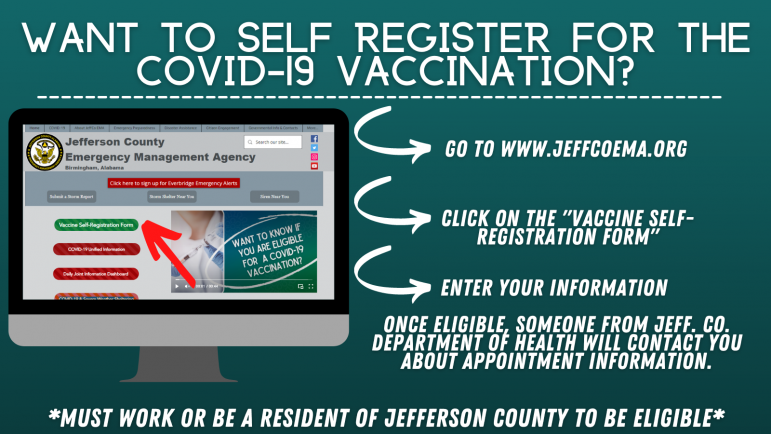
Vaccine distribution is going slower in Alabama than in most states, and officials have distributed about 32% of the doses that have been allotted to the state. What is causing delays?
State health officials said a big challenge has been figuring out the logistics of distribution. Local hospitals, clinics and health departments have varying amounts of resources and manpower to establish and operate vaccination sites. There are hundreds of thousands of people included in each eligibility group and up until now, the state has not had a centralized system to schedule vaccines for the general public.
Jefferson County’s health officer, Dr. Mark Wilson, said Monday during a news conference that the process is complex and county employees are learning as they go.
“We’re just getting started with this, with a limited supply, with very limited number of vaccination providers,” Wilson said. “But we are going to see it really mushroom overtime with more and more providers, more vaccine.”
Wilson said JCDH is working to establish additional vaccination sites to speed up the rollout. On a state level, ADPH officials are developing an online portal for people to schedule appointments, which should ease demand for the hotline.
What’s next? When can people know when they can get vaccinated?
The state’s priority list of who is eligible is divided into different phases, but officials are not opening up all of a phase at once.
On Monday, the state is moving on to the next phase, which includes residents aged 75 and older and additional first responders. But other groups in that phase, including teachers and people who live in congregate housing, are not yet eligible. They are next on the list.
Some counties may be able to move forward and expand eligibility criteria before others. In general, state officials said there is no timeline for the rollout because it is not clear when more vaccine doses are coming and supply is limited. They expect the pace to pick up in coming weeks, but they said distribution to all state residents will take many months.
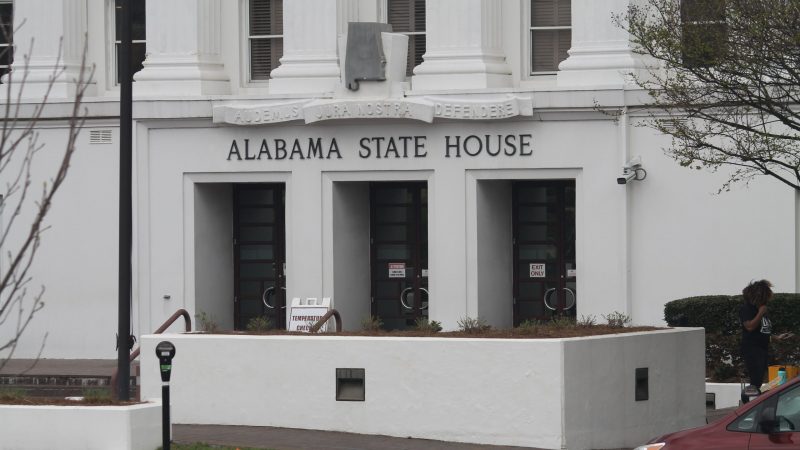
Bill making the Public Service Commission an appointed board is dead for the session
Usually when discussing legislative action, the focus is on what's moving forward. But plenty of bills in a legislature stall or even die. Leaders in the Alabama legislature say a bill involving the Public Service Commission is dead for the session. We get details on that from Todd Stacy, host of Capitol Journal on Alabama Public Television.
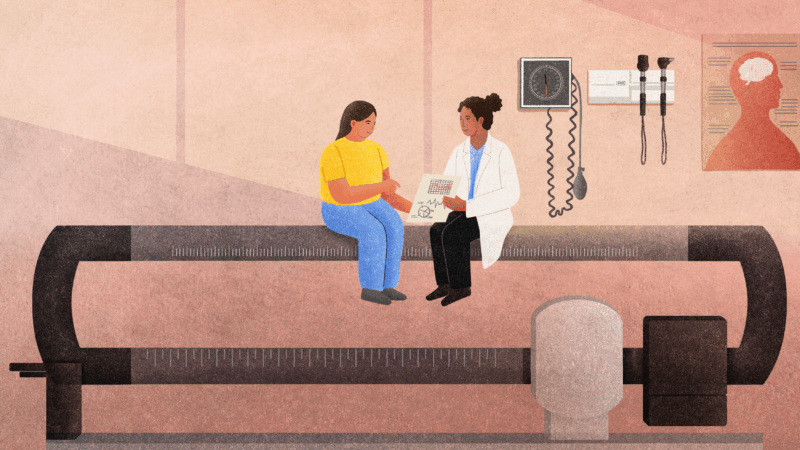
My doctor keeps focusing on my weight. What other health metrics matter more?
Our Real Talk with a Doc columnist explains how to push back if your doctor's obsessed with weight loss. And what other health metrics matter more instead.
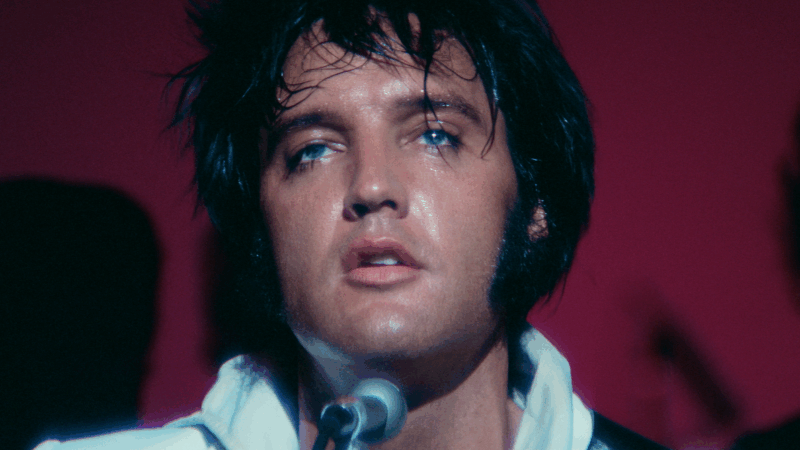
Baz Luhrmann will make you fall in love with Elvis Presley
The new movie is made up of footage originally shot in the early 1970s, which Luhrmann found in storage in a Kansas salt mine.

Forget the State of the Union. What’s the state of your quiz score?
What's the state of your union, quiz-wise? Find out!

A team of midlife cheerleaders in Ukraine refuses to let war defeat them
Ukrainian women in their 50s and 60s say they've embraced cheerleading as a way to cope with the extreme stress and anxiety of four years of Russia's full-scale invasion.
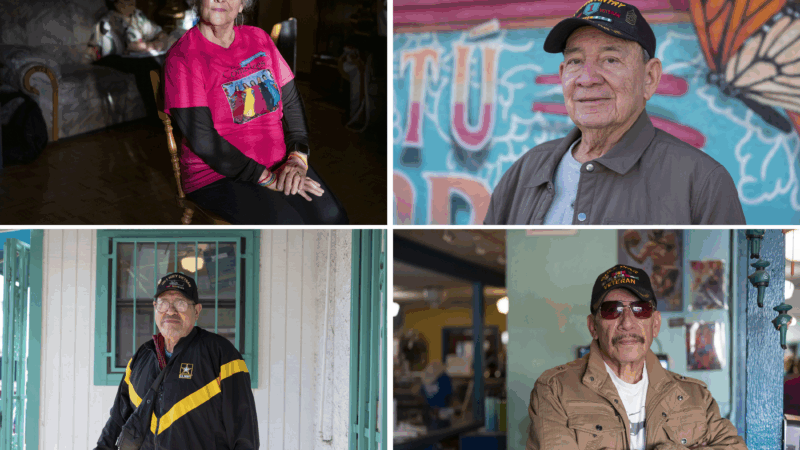
As the U.S. celebrates its 250th birthday, many Latinos question whether they belong
Many U.S.-born Latinos feel afraid and anxious amid the political rhetoric. Still, others wouldn't miss celebrating their country
