
Offering A Carrot Won’t Get People Vaccinated, Maybe It’s Time To Talk About The Stick, Health Official Tells Birmingham Council
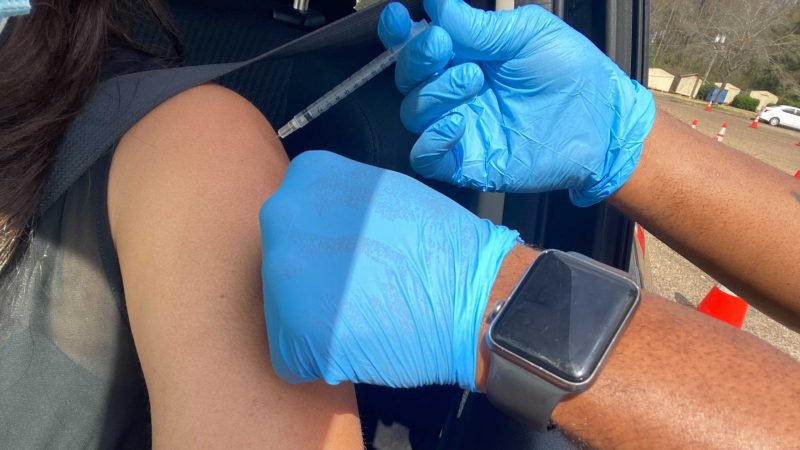
COVID-19 cases are on the rise in Jefferson County, and offering incentives to persuade people to get vaccinated does not seem to be working, a public health official warned the Birmingham City Council on Tuesday.
Dr. David Hicks, deputy health officer and COVID-19 incident commander at the Jefferson County Department of Health, said new daily coronavirus cases had increased fivefold in the past month.
“In our county, we’re averaging 75 new COVID cases per day,” he said. “If you go back a month ago, we were averaging 13 cases a day … The trajectory is troubling. Every week we’re seeing a doubling of the cases of COVID-19 being identified.”
Thirty-six percent of Jefferson County residents are fully vaccinated, Hicks said, while 45% have received at least one dose of the vaccine. According to the Alabama Department of Health, 94% of all COVID hospitalizations and 96% of all COVID deaths have been among people not fully vaccinated. About 20% of Jefferson County’s population is reluctant to get the vaccine, Hicks said.

Dr. David Hicks' LinkedIn Page
Dr. David Hicks, deputy health officer and COVID-19 incident commander at the Jefferson County Department of Health
The council has mulled incentivizing vaccines, though some officials have dismissed such programs as unnecessary. Councilors have offered concert tickets and tickets to a soccer game as incentives for people to get vaccinated. On Tuesday, Hicks told councilors that he thought incentive programs would have limited effectiveness.
“I’m not sure we can move people who have dug in their heels and said, ‘I’m not getting vaccinated no matter what you do,’” he said, suggesting that businesses may need to begin mandating vaccinations for their workers.
“I don’t have the answer for what else to do,” he said. “You have the carrot approach and the stick approach. The carrots are those incentives, and the stick approach is, does a business say you have to [be vaccinated to work there]? … That’s a national conversation now: do we have to try that stick approach?”
The Alabama Department of Public Health did recently launch an incentive program to get 13- to 29-year-olds to take vaccines and create Tik Tok videos for a chance to win $250 gift cards.
COVID cases are on the rise across the country, largely due to the virus’ Delta variant, which studies say is stronger and more contagious than the original.
In Alabama, the state with the lowest percentage of fully vaccinated residents, the daily number of new cases is nearly seven times higher than it was on July 5. Tuesday, the number of new cases jumped even more.

Trump warns Iran not to retaliate after Ayatollah Ali Khamenei is killed
The Iranian government has announced 40 days of mourning. The country's supreme leader was killed following an attack launched by the U.S. and Israel on Saturday against Iran.

Iran fires missiles at Israel and Gulf states after U.S.-Israeli strike kills Khamenei
Iran fired missiles at targets in Israel and Gulf Arab states Sunday after vowing massive retaliation for the killing of Supreme Leader Ayatollah Ali Khamenei by the United States and Israel.
House Dem. Leader Jeffries responds to air strikes on Iran by U.S. and Israel
NPR's Emily Kwong speaks to House Minority Leader Hakeem Jeffries (D-NY), who is still calling for a vote on a war powers resolution following a wave of U.S.- and Israel-led airstrikes on Iran.
Iran’s Ayatollah Ali Khamenei is killed in Israeli strike, ending 36-year iron rule
Khamenei, the Islamic Republic's second supreme leader, has been killed. He had held power since 1989, guiding Iran through difficult times — and overseeing the violent suppression of dissent.

Found: The 19th century silent film that first captured a robot attack
A newly rediscovered 1897 short by famed French filmmaker Georges Méliès is being hailed as the first-ever depiction of a robot in cinema.
‘One year of failure.’ The Lancet slams RFK Jr.’s first year as health chief
In a scathing review, the top US medical journal's editorial board warned that the "destruction that Kennedy has wrought in 1 in office might take generations to repair."
