
Echoes Of The Past As Overwhelmingly-White Mountain Brook Debates Diversity
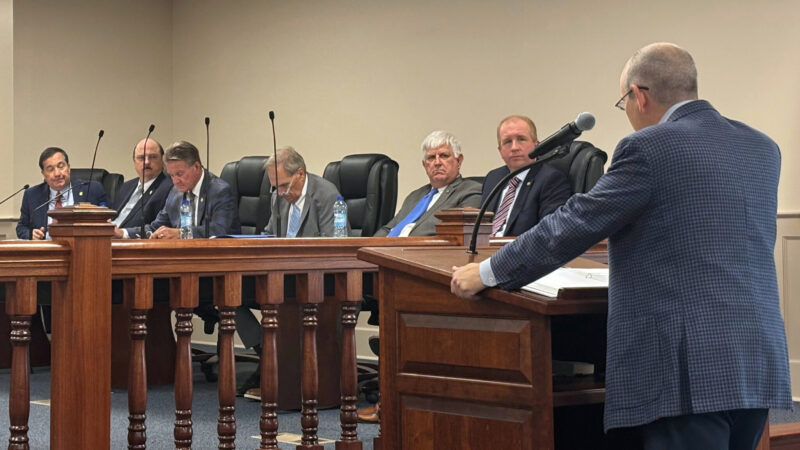
This July, during summer vacation, over a hundred parents and residents crowded into the Mountain Brook school board meeting.
About half of the attendees were wearing green, a show of solidarity between parents who disagree with what they call politics in the classroom. Others in the room saw that as a threat against diversity in Mountain Brook City Schools.
“We are simply trying to support those who have been marginalized because of their identity,” Kevin Cornes said at the meeting.
It was the latest flashpoint in a controversy that’s consumed the Mountain Brook community over the last several months. At issue: how to address diversity in the classroom in the overwhelmingly white community.
The most recent controversy started in early 2021 when Mountain Brook schools partnered with the Anti-Defamation League for diversity training. Soon after the board’s decision, 600 parents signed a petition calling the board to cut ties with the ADL, saying the organization was partisan. Subsequent petitions from Mountain Brook alumni called for the opposite. The board eventually cut ties with the ADL, but now they’re looking for a different way to address diversity and anti-bias training in the classroom, potentially through local diversity committees.
The largely partisan debate boils down to some parents’ concerns over politics in schools and indoctrination of their children. But some students in Mountain Brook say that this issue goes deeper.
“Parents are worried that the ADL or the diversity committee is going to indoctrinate their children with all of these radical new beliefs,” said Jane Grey Battle, who is 17 years old and starting her senior year at Mountain Brook High School. “Learning to respect others is not radical.”
Jane Grey transferred to the school for the debate program, but she said she immediately noticed a lack of respect for religious and racial differences.
“Our school is 97% white. And there’s a reason that people who are part of minority groups don’t come to our school, and it’s because they don’t feel welcome here,” Jane Grey said. “The culture at Mountain Brook is not one of real acceptance, and incidents like the one in 2020 are reminders that our school has a long way to go.”
In May 2020, a video was taken on Snapchat of some Mountain Brook students painting a Nazi swastika on another student’s back. The video sparked outrage in the community, which has a significant Jewish population. Some families of color in Mountain Brook don’t even feel comfortable talking about their experiences in Mountain Brook for fear of ostracization.
“For members of our community to then turn down, however many years later, efforts to promote diversity and inclusion—the implication of those statements is that they want to maintain that segregation that their ancestors created Mountain Brook for in the first place,” Jane Grey said.
Frank McPhillips has lived in Mountain Brook for decades and was a young boy in the 1960s when Alabama schools were forced to desegregate. He lived through the civil rights movements in Birmingham and saw harsh consequences of racial inequality.
“I think because I’m so aware of that, I felt strongly that we cannot repeat those same mistakes 60 years later,” McPhillips said. “It is time for us to move on and to welcome everyone.”
Founding Days
Mountain Brook was founded in the 1920’s as a whites-only town by Robert Jemison Jr., a real-estate developer. He imagined a peaceful retreat for residents from the busy downtown Birmingham. He was also the great-nephew of a senator in the Confederate government. In the 1950’s, in order to avoid federal desegregation, Mountain Brook created its own school district. Alabama passed a law allowing that after Brown vs. the Board of Education of Topeka, Kansas.
The impacts of this secession are still affecting students in Mountain Brook today, according to Dana Thompson Dorsey. She’s a professor at the University of South Florida and examines educational equity and cultural biases.
“There is no way that we should be educating students to live in a world that looks like Mountain Brook when that’s not where the rest of the world looks like or is going to look like,” Dorsey said.
In the United States, Jim Crow laws through the 1940’s and 50’s kept Black people out of white communities. Dorsey said even after the Civil Rights Act of 1964, white families still found ways to self-segregate when Black families started moving into the suburbs.
“You had white people then fleeing the city and fleeing some of these suburbs and going even further out to more rural areas,” Dorsey said. “So a place like Mountain Brook was created over these time periods to create their own white enclave.”
Research compiled by the Century Foundation shows that all students, regardless of their race or background, perform better in racially and economically diverse schools. They tend to have higher test scores and better social-emotional skills.
“This is not about diluting the success of the children and their experiences in Mountain Brook,” Dorsey said. “This is going to make Mountain Brook better.”
Data over the past 10 years shows that racial segregation between cities in the United States has gotten worse. Consider Mountain Brook City Schools again. It is over 90% white and only 4 miles down the road from Birmingham City Schools, which is 92% Black.
But Mountain Brook hasn’t gotten better fast enough for Chris Girkin, a white parent who decided to pull his kids out of Mountain Brook Schools this school year, partly due to the lack of diversity.
“I think Mountain Brook is at a crossroads,” Girkin said. “And we have to really think— I hope they really examine themselves and make the right choice or the community will be labeled a racist community.”
Mountain Brook still has policies in place that some say limit diversity in the classroom. The district does not have public school buses and doesn’t allow employees who live outside of the city to bring their kids to Mountain Brook schools. The community has also faced criticism for redlining and housing discrimination, which has added to its reputation for preserving its predominantly white demographics. Girkin said that damages the community.
“Something is still sustaining it,” Girkin said. “And, you know, if it’s not systemic racism, what is it? “
The Mountain Brook school district has said they will continue diversity training and are creating local diversity committees to address these issues, but they still haven’t figured out exactly how.
“We believe together, we can achieve a structure for respecting students so that all can feel included in an environment conducive to learning and future success,” the school board said in a statement.
The board has said that they’ll work to ensure all “input will be heard and respected.”
Kyra Miles is a Report for America Corps Member reporting on education for WBHM.

Israeli soldiers fire on family car in occupied West Bank, killing 4
Israeli soldiers fired on a car carrying a family in the northern West Bank, killing four people including two children, the Palestinian Authority's Health Ministry said.

U.S. military names six killed in plane crash as Iran war enters third week
The conflict in the Middle East has entered a third week, with Israel announcing a barrage of new strikes on western Iran on Sunday, while the U.S. defense department released the names of six service members who died when their military refueling aircraft crashed.
Alabama poised to drastically overhaul utility regulation. Will it lower electric bills?
The Alabama Senate unanimously voted to expand the public service commission, and create a Secretary of Energy to address rising electricity prices. A bill in the House would go even further, requiring rate case hearings and limiting utility profits.

Acclaimed 20th century philosopher Jürgen Habermas dies at 96
Associated with the Frankfurt School, Habermas was a world-renowned thinker on modernity and democracy who helped shape German post-war and post-reunification political discourse.

Why the Chicago Bears could be moving to Indiana
While Illinois is trying to keep the team in Chicago's suburbs, Indiana lawmakers are offering a plan to finance a new stadium

Pentagon tightens controls over Stars and Stripes after calling it “woke”
The new rules for the independent military newspaper are the Defense Department's latest effort to put extraordinary restrictions on journalists covering the agency.
