
Jefferson County Clears Hurdle to Working out an Agreement With UAB for a Health Care Authority
By Solomon Crenshaw Jr.

The Jefferson County Commission voted 3-2 for a resolution that executes an amended master agreement to establish the framework for UAB to form an authority to operate Cooper Green Mercy Health System.
Commissioners Jimmie Stephens, Joe Knight and Steve Ammons voted for the measure. Lashunda Scales and Sheila Tyson voted no.
“I think this is really a defining moment for our indigent health care system,” Stephens, the commission president, said immediately following the vote. “Moving forward, I believe our indigents will be able to see a noticeable difference. I believe we’ll improve the quality of our health care and our efficiencies.”
Whether current Cooper Green employees who are hired to continue to work with the health care authority may remain in the county retirement system has been a point of concern for Tyson, the chair of the commission’s committee governing Cooper Green, and Scales. Stephens said those employees will have the option to remain in the county’s retirement system or go under a retirement system offered by the authority.
Scales said she voted no because all of the commissioners have not been given information during the negotiations.
“In my opinion, (that) did not occur,” she said. “Because it did not occur, it made me very uncomfortable with voting on a master agreement. I asked several questions I believe went unanswered.”
Scales provided Birmingham Watch with a list of concerns she offered during an executive session on the issue. Among them:
- She was concerned that extra maintenance costs for Cooper Green might fall back on the county’s general fund.
- She questioned an extension of UAB’s option to buy the Cooper Green property from five years to 10 years.
- Scales questioned language in the master agreement that said UAB would make an “earnest effort” to absorb existing employees, which has been a concern of Scales, Tyson and employees.
- She questioned a section that says funding for Tasc (Treatment Accountability for Safer Communities) and inmate care would be limited to $250,000 a month. Among other things, Tasc provides drug screens for persons who have been released from jail.
- Scales is concerned about how much the county may have to pay as the indigent clinic transfers from the county to the health care authority.
After Tuesday’s meeting, Stephens said that, during the nearly hour-and-a-half long executive session, questions asked “were very pertinent that needed to be answered before we could make a decision.”
“We asked our management team, we asked our attorneys and the answers we received were satisfactory,” he said. “We feel that we have a model in place now where our indigent citizens of Jefferson County will receive a quality of health care that is far greater than what they had been receiving.”
Knight, the commission’s representative on the group hammering out the health care authority agreement, called the approval of the resolution the final hurdle in getting to a general overall agreement between the county and UAB.
Solomon Crenshaw Jr., BirminghamWatch
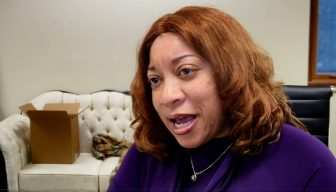
Jefferson County Commissioner Lashunda Scales.
“We have several other agreements that we’ll have to look at and some of them you can’t write until you get the health care authority in place,” Knight said. “I think the health care authority will now form and we’ll have that board in place. Then we’ll start making some further decisions.”
Scales said the contract on which commissioners voted today had nothing to do with health care.
“This was a business contract and that is the way I went about it,” she said. “This is the business of the county and how we engage the health care authority.”
Knight noted the creation in 1888 of the Hospital of United Charity, the mission of which was to take care of the county’s sick poor. He said the mission is unchanged.
“I think the health care authority, in partnership with UAB, offers the best chance of delivering quality health care to our citizens, regardless of their ability to pay,” he said. “I think we’ve got a lot of work to do, getting this word out to the people who will receive the care and the people who will provide the care. We have a lot of work to do to assure our employees that there will be a transition period but we need them.”

Oil prices rise sharply in market trading after attacks in Middle East disrupt supply
The high prices came as U.S. and Israeli attacks on Iran and retaliatory strikes against Israel and U.S. military installations around the Gulf sent disruptions through the global energy supply chain.
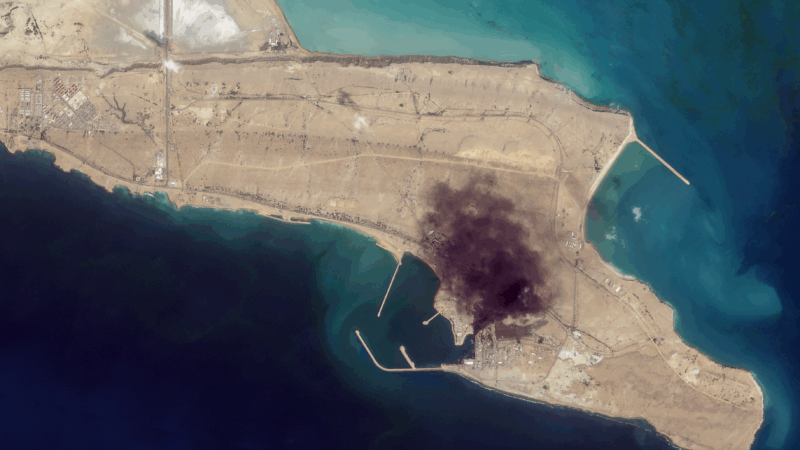
Satellite images provide view inside Iran at war
Satellite images from commercial companies show the extent of U.S. and Israeli strikes, and how Iran is responding.
Mideast clashes breach Olympic truce as athletes gather for Winter Paralympic Games
Fighting intensified in the Middle East during the Olympic truce, in effect through March 15. Flights are being disrupted as athletes and families converge on Italy for the Winter Paralympics.

A U.S. scholarship thrills a teacher in India. Then came the soul-crushing questions
She was thrilled to become the first teacher from a government-sponsored school in India to get a Fulbright exchange award to learn from U.S. schools. People asked two questions that clouded her joy.

Sunday Puzzle: Sandwiched
NPR's Ayesha Rascoe plays the puzzle with WXXI listener Jonathan Black and Weekend Edition Puzzlemaster Will Shortz.
U.S.-Israeli strikes in Iran continue into 2nd day, as the region faces turmoil
Israel said on Sunday it had launched more attacks on Iran, while the Iranian government continued strikes on Israel and on U.S. targets in Gulf states, Iraq and Jordan.
