
With an ACA fix uncertain in the Senate, Republicans replay old health care fights
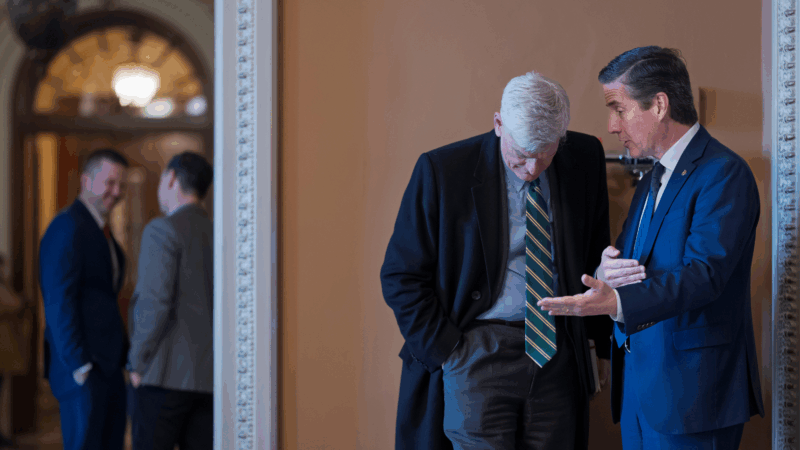
At the beginning of the year, it seemed like a bipartisan deal to extend the Affordable Care Act enhanced subsidies was within reach. A three-year extension passed in the House, but talks have sputtered in the Senate.
Many Republicans in Congress assert the reason for those stalled talks goes all the way back to the passage of the Patient Protection and Affordable Care Act in 2010.
“You gotta remember, Democrats created Obamacare,” Sen. Bernie Moreno, R-Ohio, told reporters on Thursday. “It’s been an abject failure in terms of lowering costs.”
Moreno helped lead bipartisan talks in the Senate to come up with a solution to the sudden absence of enhanced subsidies that caused many people’s premiums to double or triple. Most people affected by this live in states that Trump won, and Moreno is among the Republicans who have tried to come up with a deal to cushion the blow of these high premiums.
But even as the parties tried to work together to solve a present-day problem, anger over the original passage of the ACA keeps coming up.
“Congressional Republicans can’t seem to quit the Obamacare repeal fight, even though the politics of the Affordable Care Act have changed a lot over the past 15 years,” says Jonathan Oberlander, a political scientist focused on health care at University of North Carolina at Chapel Hill. “It is, on balance, now a very popular program. Its main coverage policies, including the enhanced subsidies, have been in place for many years and helped tens of millions of Americans.”
That makes letting the enhanced subsidies expire politically hazardous, he says.
“It is a terrible political look for congressional Republicans, and it’s a terrible reality for many of their constituents who are going to face these skyrocketing premium payments,” Oberlander says.
Republicans are “likely to pay a price” in the upcoming midterm elections, he adds.
That view is supported by a poll published Thursday by the nonpartisan health research organization KFF, which found two thirds of Americans think that Congress did the “wrong thing” by failing to extend the enhanced subsidies.
The survey, which was fielded earlier this month and included 1,400 people, also found that health care costs were Americans’ top affordability concern, more than the cost of groceries or utilities.
“What our poll is showing is that health care costs are something that voters want to see candidates address,” says Ashley Kirzinger, KFF’s director of survey methodology. “A significant share of them say that health care costs are going to play a major role in their decisions to vote in the midterms and in which candidates they vote for.”
Even before open enrollment on Healthcare.gov and the state marketplaces began in November, the intense political debate about the future of the enhanced subsidies has hung over the normal sign up process. Some enrollees didn’t know if they would end up with a premium that was $400 a month or $2,000 a month. Although the chances for a bipartisan deal seem slim, there is still some negotiating happening in the Senate.
“All of this uncertainty is leading to a lot of understandable stress among patients who have relied on the marketplace and saw real gains in affordability at a time when we’re also seeing downward economic trends,” says Miranda Yaver, professor of health policy at the University of Pittsburgh.
If Congress did manage to revive the enhanced subsidies, marketplace directors said in a press call last month that they would be ready to move quickly to implement the change and reopen enrollment, but that some consumers may be lost from the market for good. Hilary Schnieder, the director of the Maine marketplace coverME, says her team would try to win people back, but adds: “When you lose consumers, getting them back is twice as hard as retaining them and it’s really costly.”
So far, according to the Department of Health and Human Services, 23 million people signed up for an ACA plan. That’s down more than a million from last year, and health policy experts predict that more people will drop coverage over the coming months if they can’t afford the premiums.
The Congressional Budget Office estimates that 4 million people could ultimately become uninsured due to the expiration of the enhanced subsidies, and that number could ultimately grow to 15 million because of people losing Medicaid coverage due to cuts in the Big Beautiful Bill, which kick in next year.
“That is the largest increase in the uninsured population we have ever had in a short period of time, and it would wipe out about two-thirds of the gains of Obamacare,” says Oberlander.
“One of the larger frames here is in 2017, President Trump and congressional Republicans tried to repeal and replace the Affordable Care Act and they failed, and, of course, it cost them politically in the 2018 midterm elections,” Oberlander says “This time around, they did not launch a frontal assault on Obamacare. They did not try to repeal and replace the law. But what they are doing, in effect, is rolling back many of its core provisions.”
Yaver agrees that, this time around, Republicans are “finding more subtle ways to undermine [the ACA’s] effectiveness” than launching another repeal effort.
Oberlander thinks even if they’re more subtle, these moves are still going to prove unpopular with voters.
“I think they’ve probably bought some thin political insulation by rolling back instead of repealing, but ultimately, I still think it’s going to be very unpopular to do these things,” he says. “A lot of Americans are not going to welcome the news that Congress is making their health insurance less affordable.”
Transcript:
LEILA FADEL, HOST:
At the beginning of the year, it seemed like a bipartisan health care deal was in reach. A three-year extension for enhanced Affordable Care Act subsidies passed the House, but there hasn’t been an agreement in the Senate. NPR’s Selena Simmons-Duffin reports, to hear Republicans in Congress explain their position sometimes feels like time travel.
SELENA SIMMONS-DUFFIN, BYLINE: In 2010, Democrats in Congress passed the Patient Protection and Affordable Care Act without any Republican votes. This is a fact you hear current Republicans in Congress bring up constantly. Here’s Senator Bernie Moreno of Ohio talking to reporters on Thursday.
(SOUNDBITE OF ARCHIVED RECORDING)
BERNIE MORENO: You got to remember, Democrats created Obamacare. It’s been an abject failure in terms of lowering costs.
SIMMONS-DUFFIN: Moreno helped to lead bipartisan talks in the Senate to come up with a solution to the sudden absence of enhanced subsidies that caused many people’s premiums to double or triple. Most people affected by this live in states that Trump won, and Moreno is among the Republicans who’ve tried to come up with a deal to cushion the blow of these high premiums. But anger over the original passage of the ACA keeps coming up.
JONATHAN OBERLANDER: Congressional Republicans can’t seem to quit the Obamacare repeal fight, even though the politics of the Affordable Care Act have changed a lot over the past 15 years.
SIMMONS-DUFFIN: Jonathan Oberlander is a political scientist focused on health care at the University of North Carolina, Chapel Hill. He says relitigating the ACA hurt the effort to agree on a bipartisan solution to extend the enhanced subsidies.
OBERLANDER: It is a terrible political look for congressional Republicans, and it’s a terrible reality for many of their constituents who are going to face these skyrocketing premium payments.
SIMMONS-DUFFIN: A poll published by the nonpartisan health research organization KFF this week, found health care costs were American’s top affordability concern, more than the cost of groceries or utilities. Ashley Kirzinger, KFFs director of survey methodology, says their team surveyed 1,400 people earlier this month.
ASHLEY KIRZINGER: A significant share of them say that health care costs are going to play a major role in their decisions to vote in the midterms and which candidates they vote for.
SIMMONS-DUFFIN: Open enrollment on HealthCare.gov and the state marketplaces is now officially over practically everywhere. In a press call last week, Hilary Schneider, director of CoverME, the marketplace in Maine, said her team would try to win people back if Congress did manage to revive the enhanced subsidies, but it would be challenging.
HILARY SCHNEIDER: When you lose consumers, getting them back is twice as hard as retaining them, and it’s really costly.
SIMMONS-DUFFIN: So far, according to the Department of Health and Human Services, 23 million people signed up for an ACA plan. That’s down more than a million from last year, and health policy experts predict that more people will drop coverage over the coming months if they can’t afford the premiums. Oberlander says those people priced out of ACA plans, along with the cuts to Medicaid and the Big Beautiful Bill, could cause about 15 million people to become uninsured in the coming years.
OBERLANDER: That is the largest increase in the uninsured population we have ever had in a short period of time, and it would wipe out about two-thirds of the gains of Obamacare.
SIMMONS-DUFFIN: In other words, even though it’s not being called a repeal of the ACA this time – that effort failed in President Trump’s first term – what’s happening now is a rolling back of key parts of the law that congressional Republicans love to hate.
Selena Simmons-Duffin, NPR News, Washington.
(SOUNDBITE OF SOULS OF MISCHIEF’S “93 ‘TIL INFINITY (LP INSTRUMENTAL)”)

Grammys 2026: 10 takeaways from a historic, chaotic night
The Grammy Awards were full of milestone wins, chaotic performances and viral moments, as well as speeches that frequently addressed this moment in American history.

Hemp and marijuana are the same species. So why all the different laws?
Farmers in the U.S. have grown cannabis since the 1600s — but policymakers are still figuring out how to regulate two famous types of Cannabis sativa. A historian calls the plant "incredibly cryptic."
After being hit by a car, she was saved by a lavender bunny
Eight years ago, Joann Moschella was injured after her bicycle was hit by a car. That's when her unsung hero appeared, dressed in a furry lavender bunny suit.
The Education Department’s efforts to fire staff cost over $28 million, watchdog says
A new report from the U.S. Government Accountability Office calculates the cost of efforts to fire civil rights staff, and questions the department's ability to enforce federal civil rights laws.
Refugees relive the trauma they fled as ICE targets them in Minnesota
The Trump administration says it's reviewing thousands of cases to look for potential fraud. A judge ordered a temporary pause, saying refugees cannot be arrested "without warrants or cause."

From the dumpster to the aisle: This wedding dress restorer brings gowns back to life
During the coronavirus pandemic, TikTok and Instagram creator Hobby Bobbins taught herself how to restore vintage dresses. Now, she's brought dozens of old wedding dresses back to life.
