
White House unveils TrumpRx website for medication discounts
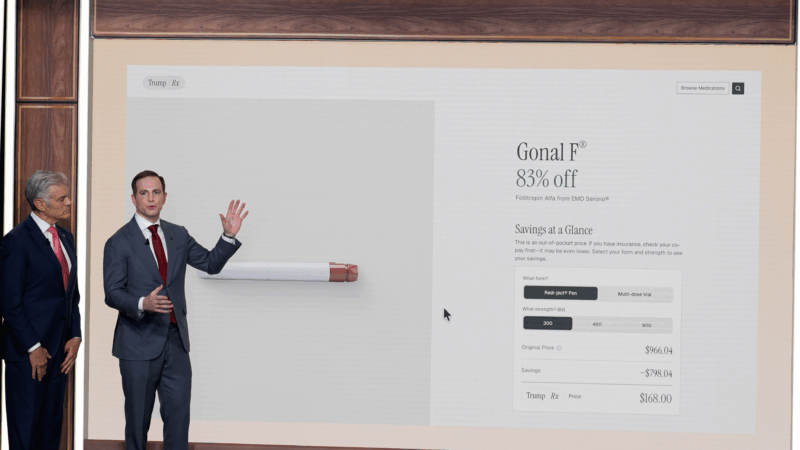
The Trump administration finally has unveiled TrumpRx.gov, a website for consumers to find discounts on brand-name drugs if they pay cash instead of using their health insurance.
It launched Thursday evening with 43 drugs from five companies that made deals with the Trump administration: AstraZeneca, Eli Lilly, EMD Serono, Novo Nordisk and Pfizer. Discounts from the other 11 companies that made agreements with the administration will be available in the coming months, the White House said.
“It’s the biggest thing to happen in health care, I think, in many, many decades,” President Trump said during a launch event.
The discounts ranged from 33% off Pfizer’s Xeljanz, which treats autoimmune disorders such as ulcerative colitis, to 93% off Cetrotide, a drug made by EMD Serono that is used in fertility treatments.
In order to get some discounts, customers must click a button stating that they aren’t enrolled in a government insurance program, such as Medicare, and won’t seek insurance reimbursement for out-of-pocket costs or count them toward a deductible. Then, they can get a coupon to take to a pharmacy for a discount. Some offers, such as the discount for AstraZeneca’s Bevespi inhaler for COPD, require consumers to go to the company’s website.
Trump and administration officials announced their plan for TrumpRx in the fall as part of deals with drug companies to get lower prices for American consumers. In exchange for exemptions from certain tariffs, the drugmakers agreed to lower prices for Medicaid, to launch future new drugs at prices no higher than those paid in other wealthy countries and to offer discounts through TrumpRx to patients paying cash for their medicines.
Drug policy experts say that the site will likely only be helpful for a limited number of patients.
“This is a website that has undergone a lot of hype, but it’s not clear exactly how much it’s going to help those people who use prescription drugs,” says Dr. Ben Rome, a health policy researcher at Brigham and Women’s Hospital in Boston. “And for the vast majority of people, it’s going to continue to be less expensive for patients to purchase their medicines using their insurance than it is to pay cash prices for the medicines, even if those cash prices are highly discounted below the manufacturer prices.”
For people with insurance, co-pays are likely to be cheaper than the cash prices. The TrumpRx site acknowledges that in summaries of the savings by drug: “This is an out-of-pocket price. If you have insurance, check your co-pay first—it may be even lower.”
Also, some of the drugs are already available as inexpensive generics, such as Protonix for heartburn and gastroesophageal reflux disease, which is available for $200 on TrumpRx. The generic version, called pantoprazole, costs $30 with a coupon from GoodRx, a drug discount website.
But for people whose drugs aren’t covered by their insurance plans — such as those who need to undergo fertility treatments or need an obesity drug — TrumpRx and other cash-pay discounts can help, Rome says.
“So for those types of medicines, there is a market for patients who want to access those medicines and don’t really have an option or insurance,” he says. “And for them, it absolutely makes sense that they would shop around and find the best price available, either from TrumpRx or GoodRx or Mark Cuban’s website or … Costco or many other different sites.”
Rome noted that the site’s offerings, though more limited with only a few dozen drugs, aren’t dissimilar from other drug discount sites like GoodRx. (GoodRx announced it is a “key integration partner” for companies offering discounts on TrumpRx.)
Some Democrats have questioned the legality of the TrumpRx program. On Jan. 29, three Senate Democrats sent a letter to the inspector general of the Department of Health and Human Services, saying they don’t think his office has “adequately addressed whether TrumpRx and affiliated DTC platforms will be compliant with federal law.” In the letter, the lawmakers expressed concerns about illegal kickbacks, conflicts of interest and unnecessary medication use.

These major issues have brought together Democrats and Republicans in states
Across the country, Republicans and Democrats have found bipartisan agreement on regulating artificial intelligence and data centers. But it's not just big tech aligning the two parties.

Feds announce $4.1 billion loan for electric power expansion in Alabama
Federal energy officials said the loan will save customers money as the companies undertake a huge expansion driven by demand from computer data centers.
Mortgage rates fall below 6% for the first time in years
The average home loan rate has dropped below 6% for the first time since 2022. Will that help thaw the frozen housing market?

Baby Keem’s boulevard of broken dreams
Ca$ino, the rapper's second album for his cousin Kendrick Lamar's label, is whiplash embodied, a mirror for the extreme highs and lows of his Sin City hometown.

Pentagon shifts toward maintaining ties to Scouting
Months after NPR reported on the Pentagon's efforts to sever ties with Scouting America, efforts to maintain the partnership have new momentum

Why farmers in California are backing a giant solar farm
Many farmers have had to fallow land as a state law comes into effect limiting their access to water. There's now a push to develop some of that land… into solar farms.
