
White House envoy Witkoff meets with Putin as deadline looms for Russia to end war
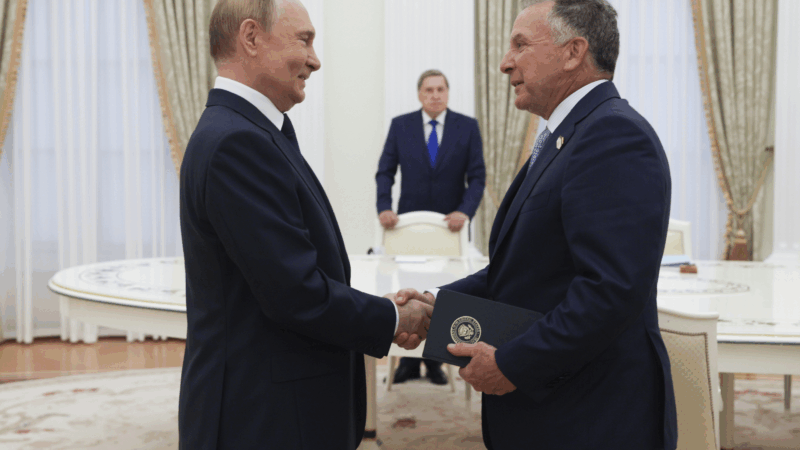
MOSCOW — White House envoy Steve Witkoff met Russian President Vladimir Putin in Moscow on Wednesday, part of a last-ditch effort by the Trump administration to convince the Kremlin leader to make peace in Ukraine ahead of a U.S.-imposed deadline Friday, or face new economic penalties.
It was not immediately clear if the two sides had made progress in the Kremlin meeting, which lasted three hours, according to Putin’s press team.
U.S. Secretary of State Marco Rubio told reporters he had spoken with Witkoff after the meeting and expected the administration would make “some announcements” later in the day — “maybe positive, maybe not,” he said.
But in a sign that some new penalties over Russia’s war were already underway, President Trump on Wednesday signed an executive order saying he would slap an extra 25% tariff on India over its purchases of Russian oil.
The Kremlin released a video showing Putin greeting Witkoff with a warm handshake. It was the two men’s fifth meeting this year.
Yuri Ushakov, an adviser to Putin, was quoted by state media as calling the discussions “useful” and “constructive.”
Ushakov added that while the two sides had exchanged “signals” on the “Ukraine issue,” they also discussed “perspectives for possible strategic cooperation” between the U.S. and Russia.
Trump is frustrated
The meeting came as President Trump has grown increasingly frustrated with Putin over his failure to suspend attacks on Ukrainian cities despite months of U.S.-led peace efforts.
Trump had campaigned to return to office vowing he could leverage his personal relationship with Putin developed over his first term in office to end the war in “24 hours.”
But Trump says his patience has grown thin with daily reports of Ukrainian civilian casualties from Russian attacks.
“I go home, I tell the first lady, ‘You know, I spoke to Vladimir today. We had a wonderful conversation.’ And she said, ‘Oh really? Another city was just hit,'” said Trump in a July 15 meeting with NATO Secretary-General Mark Rutte in the Oval Office.
That same day Trump announced a stark shift in his policy toward Russia.
He said the U.S. had reached a deal to sell American-made weapons to NATO allies in Europe, which would then send U.S. weapons to Ukraine.
He also warned that Russia had 50 days to end the war or face “severe” new economic penalties. He said this included “secondary tariffs” on countries buying Russian goods.
Soon Trump upped his ultimatum, announcing last week that Russia had just “10 or 12 days” before to make peace. Eventually, he set this Friday as the deadline.
Trump has explained that the plan is to starve the Russian war machine of fuel revenue.
When asked later if there was a way for Russia to avoid the additional economic pressure, Trump told reporters Tuesday: “Yeah, get a deal where people stop getting killed.”
Trump also questioned whether any penalties could push Russia to change course. “You know, they’re wily characters and they’re pretty good at avoiding sanctions,” Trump said.
Russia shrugs
Putin has largely avoided addressing Trump’s threats and criticism in public, only breaking his silence last week with a brief, veiled reference to the U.S. leader.
“All disappointments stem from inflated expectations, as the saying goes,” Putin told reporters last Friday following a visit to a monastery in northwest Russia.
“In order to solve the issue in a peaceful way,” continued Putin, “we need deep conversations, and not in public, but in the calm quiet of the negotiating process.”
After Trump announced the shortened deadline for a peace deal, Kremlin spokesman Dmitry Peskov said that Moscow had “taken note” of the U.S. leader’s comments.
Peskov downplayed the economic threats, claiming the Russian economy had grown largely “immune” to Western pressure following more than three years of sanctions.
Trump warms to Ukraine
While President Trump has increasingly criticized Russia, his relationship with Ukrainian President Volodymyr Zelenskyy has improved dramatically since they had an on-camera argument in the White House back in February.
In the latest sign, Zelenskyy said Tuesday on social media that he had a “productive conversation” with Trump on the eve of Witkoff’s trip to Moscow.
“Of course, we spoke about sanctions against Russia,” Zelenskyy said. “Their economy continues to decline, and that’s exactly why Moscow is so sensitive to this prospect and President Trump’s resolve.”
Zelenskyy also announced that four European countries have agreed to buy U.S. weapons and send them to Ukraine under the arrangement Trump announced last month.
“We already have commitments from the Netherlands, Sweden, Norway, and Denmark – over one billion dollars for American weapons that Ukraine will receive. Thank you! This cooperation with NATO countries will continue,” Zelenskyy said.
The Netherlands said it will send American missiles and other parts for U.S. Patriot air defense systems already in Ukraine, valuing the assistance at more than $500 million.
The Patriot batteries are Ukraine’s most effective means of shooting down incoming Russian missiles. The Ukrainians say they urgently need additional missiles for the Patriot batteries to defend against escalating Russian airstrikes.
“This helps Ukraine to defend itself and the rest of Europe against Russian aggression,” Dutch Defense Minister Ruben Brekelmans wrote on X.
Sweden, Norway and Denmark say they’ve collectively agreed to support a package of U.S. weapons as well, this one for a little under $500 million. There was no immediate word on which U.S. arms they would send to Ukraine.
Trump came into office in January saying he opposed additional U.S. military aid for Ukraine. But at the White House meeting with Rutte, Trump said he supported NATO countries buying U.S. weapons and then sending them on to Ukraine.
NPR’s Greg Myre contributed reporting from Kyiv, Ukraine.
Pentagon puts Scouts ‘on notice’ over DEI and girl-centered policies
After threatening to sever ties with the organization formerly known as the Boy Scouts, Defense Secretary Hegseth announced a 6-month reprieve

President Trump bans Anthropic from use in government systems
Trump called the AI lab a "RADICAL LEFT, WOKE COMPANY" in a social media post. The Pentagon also ordered all military contractors to stop doing business with Anthropic.

HUD proposes time limits and work requirements for rental aid
The rule would allow housing agencies and landlords to impose such requirements "to encourage self-sufficiency." Critics say most who can work already do, but their wages are low.
Paramount and Warner Bros’ deal is about merging studios, and a whole lot more
The nearly $111 billion marriage would unite Paramount and Warner film studios, streamers and television properties — including CNN — under the control of the wealthy Ellison family.

A new film follows Paul McCartney’s 2nd act after The Beatles’ breakup
While previous documentaries captured the frenzy of Beatlemania, Man on the Run focuses on McCartney in the years between the band's breakup and John Lennon's death.

An aspiring dancer. A wealthy benefactor. And ‘Dreams’ turned to nightmare
A new psychological drama from Mexican filmmaker Michel Franco centers on the torrid affair between a wealthy San Francisco philanthropist and an undocumented immigrant who aspires to be a dancer.
