
TSA workers miss a full paycheck, while travelers keep paying airport security fees
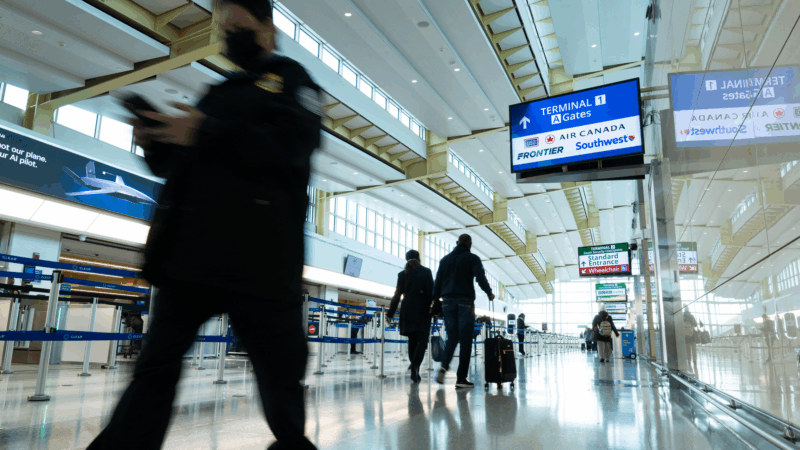
Millions of spring break travelers are heading to the airport this month, and Johnny Jones was hoping to be one of them. But the ongoing shutdown at the Department of Homeland Security forced his family to cancel its vacation plans.
“I won’t be traveling anywhere, but I’ll be helping out getting people to where they’re going,” said Jones, a TSA security officer at Dallas Fort Worth International Airport. He also serves as the Secretary-Treasurer of the American Federation of Government Employees Council 100, which represents about 45,000 TSA officers nationwide.
Those TSA officers have been working without pay since funding for the Department of Homeland Security lapsed on February 14th. They’ve already missed part of one paycheck, and many security officers received no money at all in their paychecks on Friday as the partial shutdown approached the one-month mark.
“They’re panicking, they’re scared, they’re afraid. And they don’t know what they’re going to do,” Jones said in an interview. The majority of TSA employees work paycheck to paycheck, Jones said, and don’t have enough savings to cover their expenses. “They’re just flat-out not paying their bills because they don’t have any money,” he said.
Passengers have encountered hours-long security lines at major airports in Houston, Atlanta, New Orleans, Austin, and elsewhere, as many TSA officers have called out sick. Some officers have taken on second jobs in order to make ends meet, Jones said.
“The officers can’t afford to come to work. The gas is expensive right now,” said Suzette, a security officer at Hartsfield-Jackson Atlanta International Airport who’s worked for TSA for more than two decades. She requested we only use her middle name because she is not authorized to speak to the media.
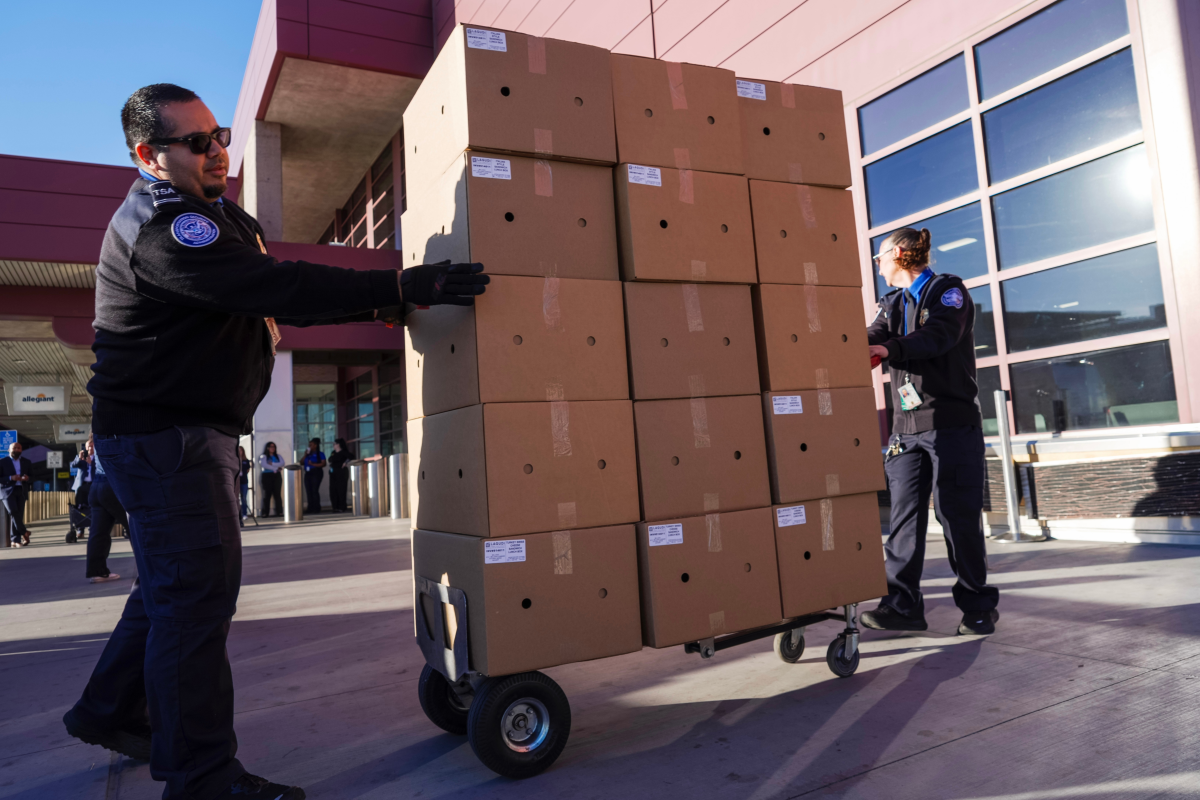
“People have childcare. You have a mortgage that you have to pay,” Suzette told NPR’s Morning Edition. “Where are you getting the money from to pay?”
DHS has blamed the long lines on Democrats in a series of social media statements over the weekend, though Democrats say Republicans are also to blame.
Democrats have refused to approve DHS’s budget unless GOP lawmakers and the White House agree on changes to how immigration officers operate after the fatal shooting of two American citizens in Minneapolis. Senate Democrats introduced bills to fund TSA and other components of DHS instead, but Republicans blocked them.
More than 100,000 DHS workers will miss their first full paycheck Friday, according to the White House, including employees at the Federal Emergency Management Agency (FEMA), Cybersecurity and Infrastructure Security Agency (CISA), and the TSA.
Meanwhile, airline passengers are still paying the security fees that help to fund the TSA’s budget, even as the partial shutdown drags on. The passenger fee, also known as the aviation security fee or the September 11 security fee, was enacted when the TSA was created after the terrorist attacks on September 11th, 2001.
“That fee has underwritten part of the TSA budget for all those years,” explains former TSA administrator John Pistole. Airlines collect $5.60 for each one-way segment on a domestic flight, Pistole says. And that money has continued to accrue, even though none of it is finding its way into the bank accounts of TSA workers.
Security officers also went more than 40 days without a paycheck last year during the partial government shutdown last year. The back-to-back shutdowns have only made it harder for the agency to attract and retain workers, Pistole said, as more than 1,000 security officers resigned from TSA during October and November of last year.

“The longer it went, the more officers who resigned,” Pistole said. “Not knowing how long the shutdown will continue, [they] will basically look for other work, because surprise, they have bills to pay.”
An additional 300 TSA officers have quit during the current shutdown, according to the White House.
Travel and aviation industry leaders say all of this is creating unnecessary stress and confusion for passengers.
“Travelers should be concerned that Congress has created unpredictability in the system. They’ve created a system where we don’t know whether we should show up at the airport one hour ahead, four or 5 hours ahead,” said Geoff Freeman, the CEO of the U.S. Travel Association.
Freeman had urged the Trump administration to restart Global Entry, a program that allows pre-approved, low-risk travelers to get expedited processing when they enter the U.S. from abroad. DHS moved to reopen the program this week.
Now Freeman is hopeful that a change in leadership at DHS will help to break the stalemate over funding for the department. Last week, President Trump announced that he is removing DHS Secretary Kristi Noem, and wants Sen. Markwayne Mullin, R.-Okla., to take over.
“The politics of the shutdown are complicated,” Freeman said in an interview. “Changes at the Department of Homeland Security create additional opportunities for compromise,” he said, though he expects the shutdown to continue into next week at a minimum.
NPR’s Milton Guevara contributed reporting.

And the Oscar goes to — wait, why is it called an Oscar?
The Academy Awards officially adopted the "Oscars" nickname in 1939. But who is Oscar, and who started calling them that? We may never know. But here are four enduring legends to consider.

How Italy became the darlings (and contenders, too) of the World Baseball Classic
With espresso shots, kisses on the cheek and Andrea Bocelli singalongs, Team Italy has charmed the baseball world. But their mission is more ambitious: Turn Italy into a bona fide baseball factory.
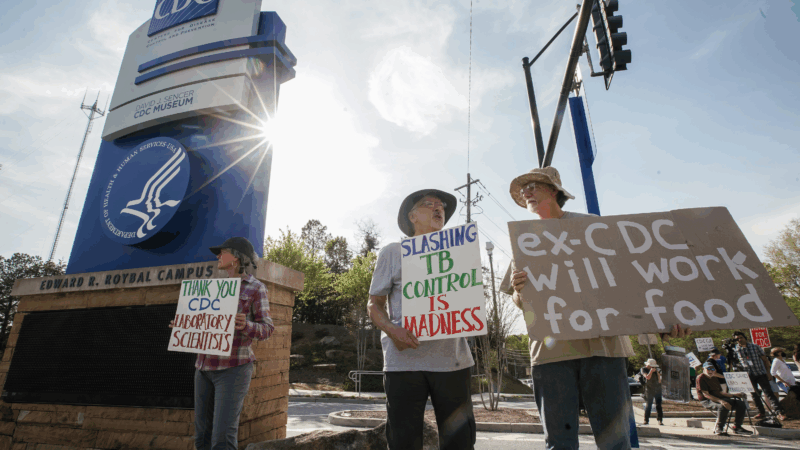
After firings, funding cuts, and a shooting, can a demoralized CDC workforce recover?
It's been a year since mass firings began at the CDC, the federal public health agency. Then came a shooting, and the government shutdown. Atlanta is still feeling the economic and emotional effects.

‘Scarpetta’ is a captivating murder mystery — and a high-wire balancing act
Based on a series of novels by best-selling author Patricia Cornwell, Scarpetta follows two different mysteries from two different timelines. It's structurally complicated — but it all holds up.

‘Derry Girls’ creator returns with a gleeful riff on the murder mystery
In the hilarious Netflix series How to Get to Heaven from Belfast, three women learn that a long estranged school friend has died in a suspicious manner — and take it upon themselves to investigate.

Giant robots battle it out in Detroit’s Robowar
Fighting robots is a cultural fantasy going back at least to Richard Matheson's 1956 story "Steel." One Detroit impresario is now bringing the idea to the stage — and real audiences.
