
Trump wants more apprenticeships. An Arkansas manufacturer is giving it a try
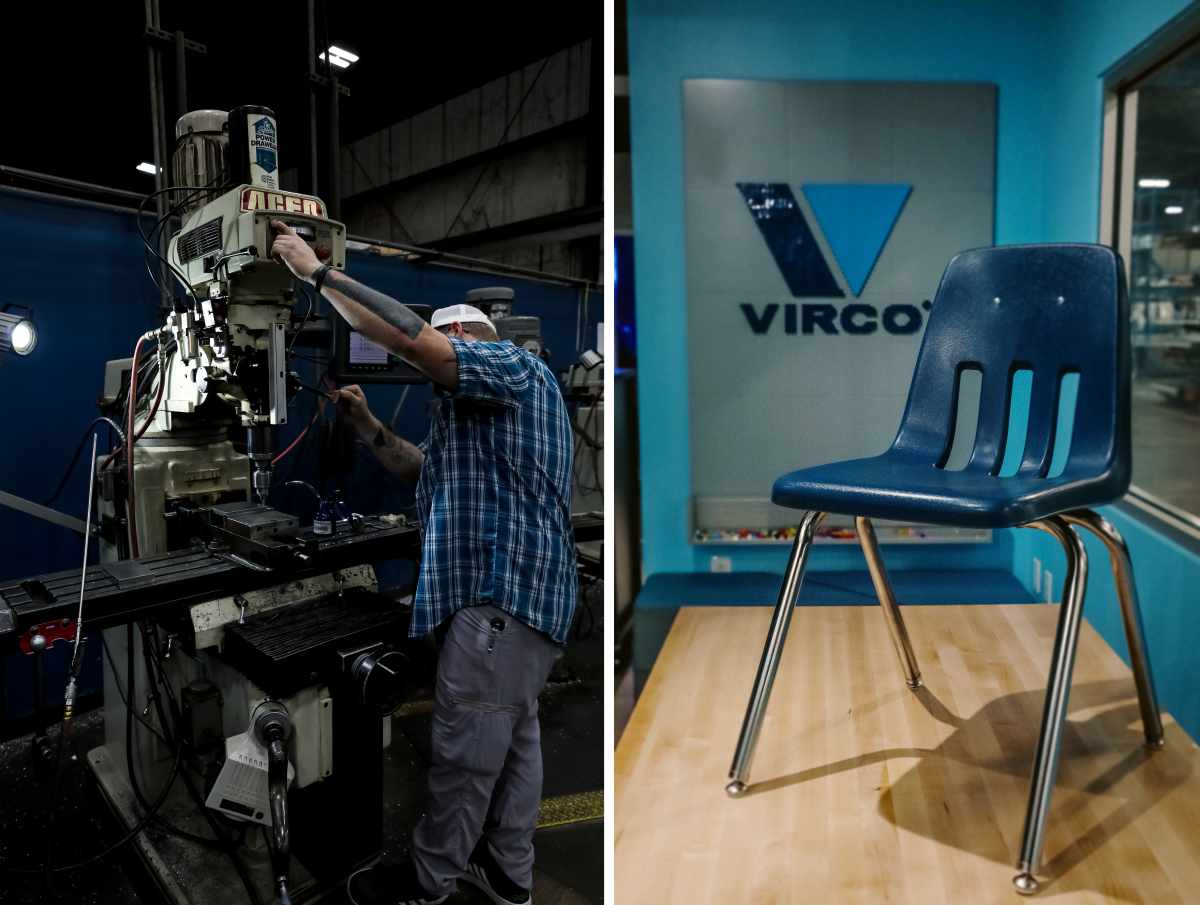
CONWAY, Ark. – Caleb Moss’s workday starts early on Tuesdays and Thursdays, before the sun comes up. At 4:30 a.m., he reports to his post in tool and die at Virco Manufacturing. Under the guidance of a mentor, he turns steel into high-precision tools and molds used throughout the plant.
At 9:00 a.m., Moss leaves the plant and heads to Pulaski Technical College in North Little Rock, Ark., for a full day of instruction, beginning with math class and moving on to hands-on training on machines similar to those Moss uses on the job.
He finishes his day at 4:30 p.m. and will be paid for the hours spent in both locations.
Moss is one of two employees that Virco, a school-furniture maker known for its colorful plastic classroom chairs, plucked from other departments for three-year apprenticeships in tool and die. It’s a strategy the manufacturer has embraced as it seeks to fill critical gaps in its workforce, and one the Trump administration has made the centerpiece of its promise to bring American workers into a golden age.

Having spent a decade in lower-skilled positions at Virco, including in shipping and receiving, Moss is excited to have this chance.
“I didn’t get the opportunity to go to school because I had kids really early,” he says. “This allows me to be able to go back to school to further my education, to do better things for this company. So it’s been a really awesome thing.”
A goal of 1 million apprenticeships
More than two decades after his show The Apprentice topped the ratings chart, President Trump is betting on apprenticeships for big economic wins. Through an executive order issued last April, Trump set a goal to increase the number of active apprenticeships to 1 million, up from the current level of about 700,000.
It’s one of the few policies embraced by former President Joe Biden that Trump appears to wholeheartedly support. In his executive order, Trump writes of building on the success of apprenticeships “to seize new opportunities and unlock the limitless potential of the American worker.”
In a video on Instagram, the Labor Department went as far as to proclaim: “The new era of American dominance will be forged not by woke universities, but by the grit of our skilled workers.”
The basic idea behind apprenticeships is simple: By combining on-the-job training with classroom instruction, employers can nurture talent to fill skills gaps and give workers not just jobs but long-lasting careers. What the Trump administration and past administrations have promoted are registered apprenticeships, which meet strict government standards for training hours, formal mentorship structures, and progressive wage increases for the apprentices.

Other developed economies including Germany and Switzerland have used this “earn while you learn” model to fill workforce needs in a variety of industries. But in the U.S., the model hadn’t really taken off outside the construction trades.
That’s now changing. Federal funding has helped to grow the number of registered apprenticeships in the U.S. by close to 80% over the past decade, according to the Labor Department, with rapid expansion happening in sectors such as health care and IT.
The messaging out of the Trump administration last year gave longtime apprenticeship advocates and policy wonks hope for even brisker growth.
“If we want to build data centers, if we want to build semiconductor plants, if we’re going to invest in these huge infrastructure projects, we need the skilled workforce to do it,” says Zach Boren, who worked on apprenticeships at the Labor Department under the Obama and first Trump administrations.
But almost a year after Trump signed the executive order, there are questions, even doubts, about his level of commitment.
“We’re seeing a lot of rhetoric and not a lot of action,” says Boren, now a senior vice president with the nonprofit advocacy group Apprenticeships for America.
In fact, Boren says, some things have gone in the wrong direction. Last year, amid DOGE cuts, the Trump administration canceled millions of dollars’ worth of contracts with organizations working to grow apprenticeships in clean energy and other sectors, and also canceled grants aimed at measuring the effectiveness of apprenticeship programs.
Moreover, Trump has not asked for more money from Congress to support his goal of 1 million active apprenticeships. Appropriations have remained at $285 million every year since 2023.
Boren says to be on par with Germany and Switzerland, the U.S. should be investing billions and aiming for a far loftier goal of 4 million apprenticeships, quadruple Trump’s goal.
It would be worth it, Boren argues. A 2022 study commissioned by the Labor Department found apprenticeships yield a 144% return on investment, as employers enjoy increased productivity and lower turnover. And, he adds, the government wins too. Investments in apprenticeships have been shown to reduce workers’ reliance on social assistance programs.
“That’s really the goal of this administration and many administrations — to get people into good work and sustainable work,” Boren says. “You just can’t spend enough on giving someone purpose.”
The Trump administration’s push begins in Arkansas
In December, the Trump administration announced its first major investment in apprenticeships — $35.8 million for the American Manufacturing Apprenticeship Incentive Fund, with the bulk of that money going to employers. In a move that surprised many, the Labor Department, through a noncompetitive process, put the state of Arkansas in charge of administering the nationwide fund.
Asked about the choice, Labor Department spokesperson Courtney Parella told NPR: “Arkansas has demonstrated its experience, capacity, and strong track record needed to help administer the Department’s manufacturing apprenticeship initiative.”
In fact, Arkansas has seen a boom in registered apprenticeships since 2019, when the state created a blue-ribbon commission to address a talent gap in IT, cyber security and data analytics, combining federal and state dollars to speed the effort. More recently, Arkansas’ Republican governor, Sarah Huckabee Sanders, has supported expanding apprenticeships into other industries.

Now tasked with jumpstarting manufacturing apprenticeships nationwide, state officials have been busy fielding calls from all over the country.
“West Coast to East Coast, South, North, Midwest — all across the board,” says Cody Waits, executive director of Arkansas’ Division of Workforce Connections.
On offer to manufacturers anywhere in the U.S. is a $3,500 incentive for every new registered apprentice they bring on, paid to the company once the apprentice passes the 90-day mark.
“The question is, is this money enough?” says Nick Beadle, who tracked workforce dollars at the Labor Department for a decade and now works as a consultant. “The response I heard immediately from people as soon as the dollars hit the street in early February was, ‘Yeah, this isn’t going to cut it.'”
In a statement, the Labor Department stood by its approach, telling NPR: “We are confident that leveraging the recently announced pay-for-performance funding models will maximize the impact of appropriated funding and drive unprecedented growth in the number of active apprentices.”
While $3,500 covers little of the actual cost of an apprenticeship, Waits believes even a modest sum of money may be just the thing a company needs to get on board.
“Every little bit of interest helps,” says Waits. “And what we’ve recognized is when companies do adopt apprenticeship, they tend to keep it as part of their overall workforce strategy.”
Helping companies cut through the bureaucracy
There’s a big reason many companies have been reluctant to engage in apprenticeships, despite a decade of prodding from the federal government: For many employers, the phrase “registered apprenticeships” conjures up red tape. It involves a lot of paperwork, recordkeeping and possible audits by the Labor Department.
That’s where people like Lonnie Emard come in. He works for the nonprofit Apprenticely, which has helped to create some 2,500 registered apprenticeships in Arkansas since 2019, handling all the bureaucratic pieces and drawing on state, federal and private grants to bear most of the costs.

Over the past six years, Emard has worked to convince employers from Walmart to Arkansas Children’s Hospital to the wood pellet manufacturer Highland Pellets to take a chance on job candidates who don’t check all the boxes, who might not have the right degree — or any degree.
“If they’ve got the kinds of essential skills, but they don’t have some technical pieces, that’s what an apprenticeship is so good at,” he says.
Emard’s goal is getting employers to see that they’re not settling for less. In fact, they stand to gain more productive, more loyal employees.
“They’re going to have a future, and they’re going to stay,” he says.
With new technology comes new workforce needs
Among those Emard has won over in recent months is Steve Presley, Virco’s vice president and general manager. Following on the initial success of Moss’ apprenticeship in tool and die, Presley now plans to create 20 more apprenticeships in other parts of the plant.
Inside the manufacturer’s 1.2 million-square-foot production facility, Presley is excited about all the fancy new machines: A $1.5 million saw. Thirty robots that weld steel. An electrostatic powder coat booth.

The new technology is already making the plant more efficient. But with it comes a big concern.
“We’ve got to really make up a big learning curve on how to operate this equipment, maintain this equipment,” says Presley. “That’s where we’re really behind the eight ball.”
The problem is exacerbated by a wave of retirements at Virco – Presley says he’s lost 250 years’ worth of experience since the start of the year – and intense competition for skilled workers in Arkansas, including from the steel industry in the north of the state and defense contractors in the south.
“It’s a really strong economy here. And with a strong economy, there’s a lot of competition for labor,” says Presley.
Working with Apprenticely, Presley has come up with a plan to train more employees to operate the high-tech machines, so that if one employee is out and a robot crashes, downtime can be minimized. Moss, the tool and die apprentice, will have a role there, too. Once he finishes his training, Presley says, he’ll be able to disassemble the robot, diagnose the problem, remake the broken part, and get the robot running again.
“He was already a valuable employee,” says Presley. “But … this is honestly more critical than what he was doing before.”

The road to 1 million
The total number of active apprenticeships in the U.S. fluctuates as apprentices start and finish their training. According to Labor Department data, the pace of growth in fiscal year 2025 dipped slightly from the year before. Still, the White House projects growth under the Trump administration to accelerate as more investments are made.
Currently, the Labor Department is running a competitive process to award $145 million aimed at growing apprenticeships in key sectors such as IT, artificial intelligence, health care, shipbuilding and defense.
At best, Boren believes those funds might create somewhere between 35,000 and 50,000 apprenticeships.
“That’s not going to get us to a million,” he says.
And much could depend on the economy. A disappointing February jobs report showed employers shed 92,000 jobs over the month, including in both manufacturing and construction.

“Historically, when layoffs begin, training and workforce development are often the first items cut from company budgets,” Boren notes.
From his perch overseeing the manufacturing incentive fund, Waits is more optimistic. He points to Virco’s plan to grow from two apprenticeships to 20.
“Think about how many Vircos there may be across the country, right?” he says. “You do that enough times, you get a million apprentices.”
Transcript:
JUANA SUMMERS, HOST:
President Trump has promised a golden age for American workers, a renaissance for U.S. manufacturing. He says the road to get there is through apprenticeships. One Arkansas manufacturer is embracing the idea. NPR’s Andrea Hsu paid them a visit.
ANDREA HSU, BYLINE: My trip starts with a ride on a golf cart.
STEVE PRESLEY: Is everybody on? All right.
HSU: I’m with Steve Presley, vice president and general manager of Virco Manufacturing. Their headquarters are in California, but we are cruising through the company’s giant factory in Conway, Arkansas, half an hour outside Little Rock. This is where they make a lot of the furniture you see in American schools. It all starts with flat sheets of steel.
PRESLEY: We’re going to bend it, manipulate it, spot weld it to make case goods – teachers desks, office administration desks, vertical, lateral file cabinets, all-metal bookcases, things like that.
HSU: Presley’s been working at Virco for 37 years. He and his brother both started at 16 when their dad was the plant manager.
PRESLEY: My dad drug our butt in here, and we worked every Saturday and Sunday, and we worked in maintenance department.
HSU: Doing grunt work, cleaning up wet paint and sawdust. At one time, Presley says, Virco had 1,500 employees in Arkansas.
PRESLEY: We were so labor-intensive ’cause we could just throw labor at it.
HSU: Those were the days before the company had to compete with cheaper imports. Today, Virco has about 500 employees here. Technology has made the plant more efficient. They’ve got a new million-and-a-half-dollar saw, 30 robots that weld steel and a fancy new paint system.
PRESLEY: It’s a little noisy, but this is an electrostatic powder coat booth.
HSU: Automated paint guns shoot gray powder onto table legs that come through on an overhead conveyor. Someone has to program this system to identify the different parts and move the paint guns accordingly.
PRESLEY: Whether it’s up and down, in and out.
HSU: With all this advanced technology, Steve Presley’s concern is building up a workforce that can operate and maintain it.
PRESLEY: That’s where we’re really behind the eight ball.
HSU: And trying to hire people with those skills is hard here in Arkansas. Not for the reasons you might be thinking.
PRESLEY: You know, everybody can make fun of Arkansas, say what they want to say, but this is a really strong economy here, and with a strong economy, there’s a lot of competition for labor.
HSU: Especially skilled labor. Adding to the problem is the fact that here at Virco and across manufacturing, the workforce is aging. They’ve lost a lot of collective experience.
PRESLEY: We’ve probably had 250 years retire since the first of the year.
HSU: Presley knows, in order for Virco to survive and thrive, he needs a deeper bench. Already last year, the company reached out to Pulaski Tech, a community college, who, in turn, reached out to a nonprofit called Apprenticely. Together, they created two apprenticeships in tool and die. They’re training up machinists to make highly customized tools that can handle measurements down to ten-thousandths of an inch.
PRESLEY: That requires skill sets that you can’t buy.
HSU: So Virco plucked two promising workers from other parts of the plant and pledged to give them three years of training. Caleb Moss (ph) had worked in shipping and receiving and in the flat metal department. He was game to learn something new.
CALEB MOSS: I didn’t get the opportunity to go to school because I had kids really early.
HSU: Straight out of high school, he went to work, first in construction, then in wastewater management, and later to the oil fields before landing at Virco a decade ago. Now, as an apprentice, he works here at the plant part of the week, and on Tuesdays and Thursdays he’s at Pulaski Tech. It’s where I find him the next day, planning out a project with his instructor.
MATT WALROND: What do you think? Quarter-20? We know we got a bunch of those.
MOSS: A lot of quarter-20.
HSU: In this safe space, Moss gets to try different approaches to tasks he may already be doing at work.
MOSS: So I’m always learning something new somehow.
HSU: His instructor, Matt Walrond says in manufacturing, you have to learn how to roll with the punches. That means improvising, if necessary.
WALROND: You can make anything with anything. And that’s the goal by the time they get through the Machining 3 course.
HSU: That’s next semester. Out of this apprenticeship, Moss will get a sizable pay bump, and Steve Presley says Virco gets an even more valuable employee.
PRESLEY: This is honestly more critical than what he was doing before.
HSU: Presley is so pleased with how Moss’ journey has gone so far, he is now committed to creating more apprenticeships at Virco.
PRESLEY: I would love to get a minimum of, like, 20 more.
HSU: It’s not the easiest thing. They have to find the right people and give them substantial time off the job for training. But as part of President Trump’s push for apprenticeships, there are now federal incentives for companies like Virco to help a little bit with the cost. And the bigger thing Presley believes Virco is gaining is a plan for the future. He says one thing’s for certain.
PRESLEY: We’re going to be American-made.
HSU: He knows that can’t happen if he doesn’t have the right workers in place. Andrea Hsu, NPR News, Conway, Arkansas.
(SOUNDBITE OF MUSIC)

Bill would move Alabama to closed primaries
Right now, any Alabama voter can participate in a primary election. Lawmakers in Montgomery took up a bill this week that would change that system.

Why ‘Sinners’ should win best picture (but probably won’t) — and more Oscar predictions
NPR critics share their hopes and predictions for the 2026 Academy Awards, which air on Sunday.

Countries are negotiating rules to mine the deep sea. The U.S. is pushing ahead alone
With growing interest in mining critical metals from the seafloor, countries are now negotiating international rules. The Trump administration is forging ahead on its own, speeding up environmental review for mining the fragile ecosystem.
4 confirmed dead after U.S. military aircraft goes down in Iraq
The U.S. Central Command confirmed that at least four of six crew members on the KC-135 aircraft were dead, after the refueling plane went down in western Iraq on Thursday.

It’s Chalamet vs. ballet in this week’s news quiz. Are your answers en pointe?
Meanwhile, if you've been paying attention to medicine, basketball and the British Parliament, you'll get at least three questions right this week.
At the Winter Paralympics, some athletes have found business opportunities
At the Winter Paralympics, athletes with prosthetics often modify them to fit their bodies more precisely. That has led to some competitors starting their own businesses to help fellow amputees.
