
Trump vs. U.S. allies: How will this end?
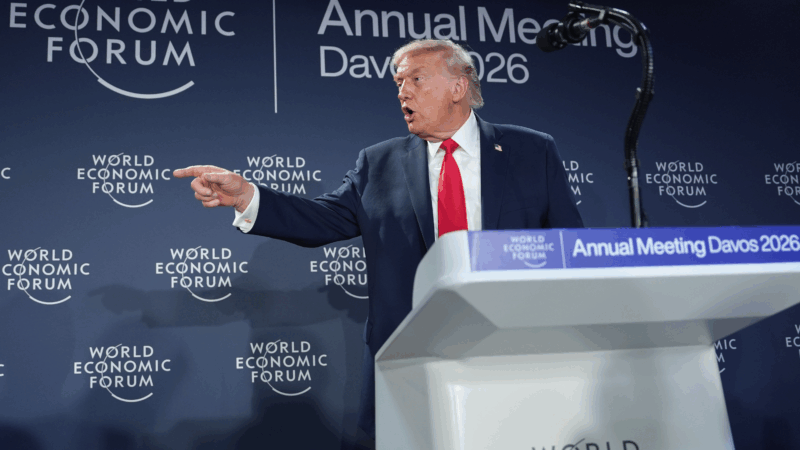
President Trump has backed off his threat to take Greenland by force.
Yet Trump still delivered a fresh round of highly inflammatory remarks at the World Economic Forum on Wednesday that once again rattled U.S. allies and threatened to tear down the pillars of the world order constructed by Washington 80 years ago.
“I don’t have to use force. I don’t want to use force. I won’t use force,” Trump said of Greenland in a lengthy speech to the world leaders and other prominent figures assembled for the annual event in Davos, Switzerland.
The president made clear he still wants to the territory. Later, he took to social media and claimed there was a “framework of a future deal with respect to Greenland and, in fact, the entire Arctic Region.”
Greenland was the crisis of the day. Yet it also reflected how Trump’s demands have created an increasingly hostile relationship with U.S. allies, leading to head-spinning changes to these long-standing partnerships.
U.S. allies have often tried to appease Trump to avoid open confrontation. However, his demand for territory belonging to Denmark, a close U.S. partner and a founding member of NATO, has crossed a line and prompted blunt responses from some.
Canadian Prime Minister Mark Carney’s speech Tuesday at Davos went viral when he said the global order, built by the U.S. out of the ashes of World War II, is now tumbling down.
“Today I will talk about a rupture in the world order, the end of a pleasant fiction and the beginning of a harsh reality, where geopolitics, where the large, main power, geopolitics, is submitted to no limits, no constraints,” he said.
Carney didn’t mention Trump by name, but the implication was clear.
In a sign of the times, the Canadian leader visited China last week where he signed an economic agreement that calls for China to sell electric vehicles to Canada. The move comes as Trump’s tariffs on Canada have caused trade tensions over the past year. To drive home that point, Carney said China was now a more reliable partner than the U.S.
Trump undermines global networks
Prior to Trump, nearly all U.S. presidents since World War II have worked largely from the same playbook based on a global network of military alliances, an emphasis on free trade and calls for greater democracy.
The U.S. and its allies have hugely benefited from this system, though as the world has changed, many of these institutions have not kept pace. Trump often describes them as burdens that inhibit his desire for swift, decisive action.
Trump has taken aim at military alliances such as NATO. He has tossed out long-standing trade arrangements in favor of punishing tariffs. He frequently dismisses political, diplomatic, and cultural ties built up over decades.
“The American-dominated liberal world order is over,” Robert Kagan, of the Brookings Institution, wrote in a recent essay in The Atlantic.
“This is not because the United States proved materially incapable of sustaining it. Rather, the American order is over because the United States has decided that it no longer wishes to play its historically unprecedented role of providing global security. The American might that upheld the world order of the past 80 years will now be used instead to destroy it,” Kagan said.
Trump says his actions fall under the broad banner of “America First.” And in his first term, Trump consistently sought to keep U.S. forces out of foreign conflicts.
But in his second term, Trump has often turned to the military. In the past year, the U.S. has bombed four countries in the Middle East (Iran, Iraq, Syria and Yemen) and two in Africa (Nigeria and Somalia). Trump has threatened others, both friends and foes. And the U.S. recently ousted Venezuela’s President Nicolás Maduro.
An argument based on false statements
In his speech at Davos, and in many other remarks, Trump makes his case with statements that are demonstrably false.
“NATO has treated the U.S. very badly. We’ve never asked for anything. We’ve never got anything,” Trump said on Wednesday.
After the al-Qaida terrorist attacks in 2001, NATO countries rushed to join the U.S. in the war in Afghanistan. This was the first and only time that NATO’s Article 5 was triggered –- the section saying an attack on one is an attack on all.
More than 1,000 troops from other NATO countries were killed in Afghanistan supporting the U.S.-led war (The U.S. lost more than 2,400 troops in Afghanistan).
Trump repeatedly portrays Europe as weak and in decline, unable to carry its weight on the global stage. But Europe and other allies still have ways to push back against the U.S. For starters, the U.S. has more than 700 military bases outside the U.S., with many in Europe.
Italy’s Prime Minister Giorgia Meloni — who generally has good relations with Trump –- recently criticized his approach to Greenland, which has included threats of tariffs against her country.
“This strategy is wrong,” she said. “So what do you mean, that we must leave NATO? That we must close U.S. bases, we must sever trade relations, we must storm McDonald’s?”
Iranian civilians are now fleeing the relentless bombing for neighboring Turkey
As the U.S. military broadens its strikes in Iran, traumatized Iranians are reaching the border with Turkey.
A split Senate votes against measure to constrain Trump’s authorities in Iran
Democrats in the Senate were facing an uphill climb Wednesday in their push to restrain President Trump's ability to wage war against Iran.
WATCH: How traffic dried up in the Strait of Hormuz since the Iran war began
The effective closure of the Strait of Hormuz is "about as wrong as things could go" for global oil markets. Iran achieved it not with a naval blockade, but with cheap drones.

As Mississippi waits to spend opioid settlement funds, children and families suffer
Mississippi will receive more than $400M to fight the opioid epidemic. So far, officials haven't directed it toward programs that support addiction recovery.

Alabama’s new state climatologist takes the reins
The controversial John Christy is retiring as Alabama’s state climatologist. Lee Ellenburg now assumes the role and is already making a few changes, including declaring that climate change is real and caused by humans.

Colossal Biosciences breeds controversy while trying to revive mammoths
A Texas biotech company is trying to bring mammoths and other extinct creatures back to life. The science is as intriguing as the ethical questions are thorny.
