
Trump plans to share new tariff rates this week as deadline for deals approaches

President Trump’s administration says it will be sending letters Monday informing countries of the tariffs the U.S. will impose on their exports beginning Aug. 1.
“We’re going to have a combination of letters, and some deals have been made,” Trump told reporters Sunday evening.
Trump has floated a wide range of tariff rates, leaving open the possibility for substantial jumps in the tariffs U.S. business and consumers will pay for goods from abroad. Trump has regularly said that these rates were meant as retaliation against other countries’ protectionist measures.
While Trump often frames tariffs as being paid by other countries, that is not the case. Tariffs are taxes paid to the U.S. government by companies in the U.S. for imported goods or components. As a result, the cost of tariffs is often passed on to consumers in the form of higher prices.
The new tariff letters are the result of months of uncertainty, stemming from an April 2 executive order in which Trump imposed tariffs on nearly every country worldwide. Trump announced those tariffs with a Rose Garden event, calling April 2 “Liberation Day.” The new taxes included high rates on goods from some of America’s biggest trading partners, such as Vietnam and Japan.
A week later, after stock markets plummeted and economists warned of dire consequences, Trump announced he was lowering the tariffs to 10% for 90 days. After that “pause,” as he called it, he set tariffs to jump back to those “Liberation Day” levels on Wednesday, July 9.
In the interim, the president repeatedly said he would make tariff deals with individual countries before July 9, at one point promising “90 deals in 90 days.” Only two deals have been announced to date, however, with the UK in early June and with Vietnam on July 2.
Since then, Trump and his team had been unclear on how firm that July 9 deadline was. Treasury Secretary Scott Bessent had at one point suggested tariff deals with individual countries might more realistically be done by Labor Day.
This represents a highly unorthodox and potentially risky approach to trade. Trump prefers bilateral trade deals over the multilateral deals that past administrations pursued, like the Trans Pacific Partnership, a trade agreement that would have included 12 Asia-Pacific countries. That deal was complex, the result of nearly a decade of negotiation — talks started in 2008, in the George W. Bush administration, and continued through Barack Obama’s two terms to when Trump took office in 2017, when he pulled the U.S. out of TPP talks.
That means Trump’s tariff deals also happen much more quickly than many past U.S. trade dealings, with the president using the size of the U.S. economy to pressure other countries to come to agreements. He also focuses on bilateral trade deficits as a measure of how positive a trade relationship is, though mainstream economists believe it to be a poor measure.
The potential benefits of these tariff deals include reducing other countries’ trade barriers, like tariffs and other regulations, giving U.S. exporters more consumers to sell to.
But the costs are real, and will be paid upfront by U.S. companies, who will likely pass some of those costs on to consumers.
The deal Trump struck with Vietnam, for example, sets tariff rates at 20% for Vietnamese goods. That is lower than the 46% Trump imposed on April 2, but it is also far higher than where tariffs were prior to Trump taking office. Back then, average U.S. tariffs on Vietnamese goods were around 3%.
That means the cost for U.S. consumers of goods from Vietnam — which include machinery, appliances, clothing, and shoes — may soon be markedly more expensive than they have been.
In addition, bilateral deals may not be the most efficient way to achieve Trump’s goals.
“U.S.-Vietnam trade restrictions would today be very, very low if Trump hadn’t walked away from TPP in 2017,” said Scott Lincicome, an expert in trade at the libertarian think tank Cato Institute.
Bernard LaFayette, Selma voting rights organizer, dies at 85
Bernard LaFayette, who died Thursday, laid the foundations of the Selma, Alabama, campaign that culminated in the passage of the Voting Rights Act. He was a Freedom Rider and helped found the Student Nonviolent Coordinating Committee.
Oil surges to its highest price since 2023, and stocks drop after U.S. jobs report
Stocks fell Friday on worries that the economy could become stuck in a worst-case scenario of stagnating growth and high inflation. Oil prices touched their highest levels since 2023 after surging again because of the Iran war.
No lawsuits required: U.S. Customs is working on a system to refund tariffs
U.S. Customs told the trade court it aims for a streamlined process in 45 days to return importers' money without requiring individual lawsuits.
Poll: A majority of Americans opposes U.S. military action in Iran
Most Americans disapprove of President Trump's handling of Iran, and a majority sees Iran as either only a minor threat or no threat at all, an NPR/PBS News/Marist poll finds.

Your Winter Paralympics primer: What, who and how to watch
Hundreds of para athletes are competing in Italy through March 15. Many Americans are defending past titles, with the U.S. sled hockey team hoping to fend off rival Canada for its fifth straight gold.
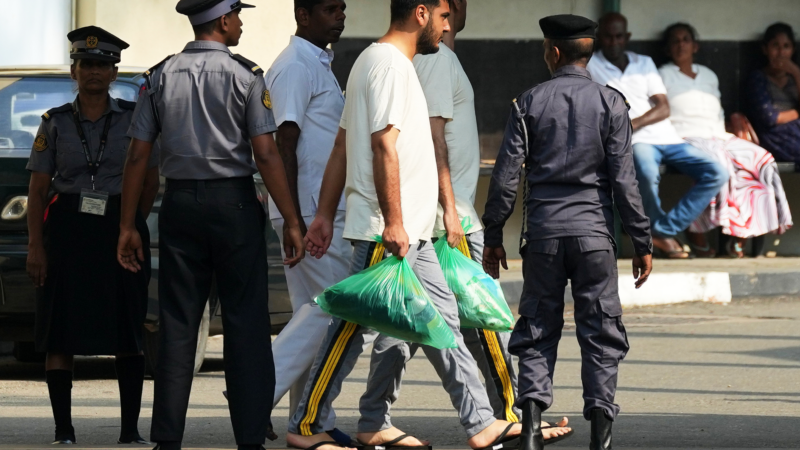
After the U.S. sinks an Iranian warship, Sri Lanka takes custody of an Iranian vessel
The move followed Wednesday's sinking of another Iranian warship by a U.S. submarine. Australia confirmed three Australians were on that submarine.
