
Trump administration cancels $679 million for offshore wind projects at ports
The Trump administration is cancelling $679 million in federal funding for ports to support the country’s offshore wind industry, the latest move in President Trump’s ongoing campaign against wind power.
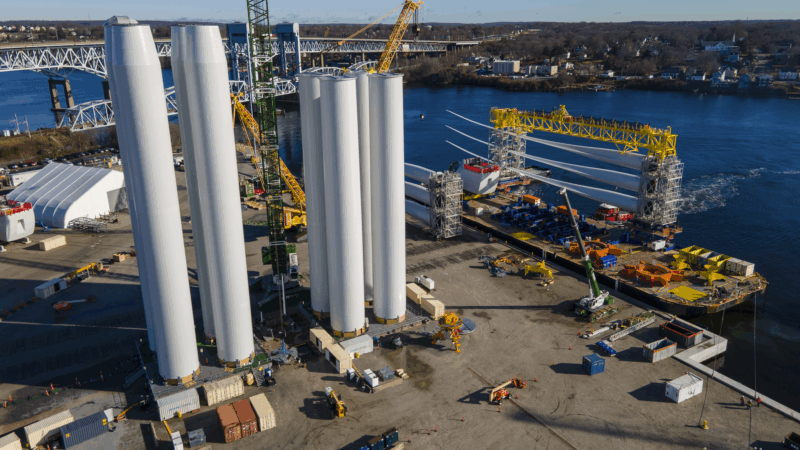
Offshore wind is still a developing industry in the U.S., while Europe already has thousands of wind turbines in deep ocean waters. Those offshore turbines are dramatically larger than ones on land and require substantial infrastructure at ports for construction, from large assembly facilities to deepwater docks for ships that carry turbines out to sea.
Ports around the country hoped to seize the economic opportunity to become hubs for the wind industry. Under the Biden administration, 12 port projects from California to Virginia were granted funds, all of which the Trump administration said on Friday it was either withdrawing or cancelling.
“Wasteful wind projects are using resources that could otherwise go towards revitalizing America’s maritime industry,” U.S. Transportation Secretary Sean Duffy said in announcing the decision. He said if possible, the funding would be redirected to “address critical port upgrades.”
Rep. Jared Huffman, D-Calif., who represents an area that lost funding, said in a statement, “This is a new level of idiocracy, where the Trump administration is trying to destroy an entire sector of clean energy, kill thousands of good paying jobs, and drive up electricity prices for American consumers.”
Just over a week ago, the Trump Administration ordered wind companies to stop construction on a wind farm off the Rhode Island coast. Trump is a long-time critic of wind power, claiming it’s expensive and kills birds. He has pushed for cuts to tax incentives for wind and solar, which analyses have shown could raise electricity prices around the country.
The wind industry is reeling from the recent decisions, a marked change from a few years ago when the growing demand for electricity spurred a surge in announcements for new wind projects.
“The federal [Trump] administration ran on rebuilding back America, building infrastructure, creating U.S. jobs, creating manufacturing – this project does all of that,” said Chris Mikkelsen, executive director of the Port of Humboldt Bay, one of the ports that had its project funding canceled.
Bringing industry to a rural port
The federal grants were directed at creating wind manufacturing and logistics hubs, including in Maryland, Massachusetts and Staten Island in New York. The project that took the biggest hit is in Humboldt Bay in Northern California, which is losing out on more than $426 million.
The port is located in a rural part of the state, five hours north of San Francisco. For decades, it supported the local timber industry, which has waned significantly over the years. In 2022, the federal government held the first offshore lease for wind power in California, a sign the industry would be poised to take off. Mikkelsen says it represents a huge economic opportunity for his area.
“It’s the biggest we’ve seen in the century, there’s no doubt about it,” Mikkelsen said. “We’re not talking about entry-level jobs. These are very skilled, very high-paying jobs. Jobs here in Humboldt County are in desperate need.”
The federal grant represented a significant part of funding needed for the Humboldt Bay Offshore Wind Heavy Lift Marine Terminal Project, which would also leverage private and state investment. The port planned to use it to clean up and remediate polluted areas, build facilities for handling the turbine parts, dredge the waterway and build a larger wharf capable of handling pieces of steel longer than a football field.
With the funding cancellation, Mikkelsen says he hopes it’s just a pause for the project, since California continues to push for renewable energy. The state has a goal of getting 100% of its electricity from zero-carbon sources by 2045. Offshore wind power is particularly useful for the state because it produces at night, when solar power goes away.
“This hurts a little bit, but it doesn’t change our focus and it certainly doesn’t change our outcome,” Mikkelsen said. “An administration can’t change the fact that the U.S. has incredible energy demands.”
Turmoil for the wind industry
Electricity demand is growing across the country, especially as new data centers are built for artificial intelligence. Solar and wind projects produce cheaper energy on average than fossil fuels projects that run on natural gas and coal, though the cost can vary greatly depending on the location and type of project. The Biden administration set a goal of getting 30 gigawatts of power from offshore wind by 2030, enough for around 10 million homes. An analysis found that plan could create 77,000 jobs, according to the National Renewable Energy Laboratory, a federal research lab.
President Trump put a moratorium on the development of new offshore wind projects on his first day in office. In cancelling the Rhode Island wind project, the administration stated it was for the “protection of national security interests,” but did not elaborate on what those are specifically.
“We’re not allowing any windmills to go up,” Trump said earlier this week. “Unless there’s a legal situation where somebody committed to it a long time ago, we don’t allow windmills.”
More than 80 gigawatts of offshore wind projects have been planned in the U.S., but their future has gotten murkier. Interest rates have gone up, making financing more challenging. Turmoil in the industry could also make it harder to attract investment. But many companies are hoping it’s a passing phase, given the overall demand for electricity.
“We will have an offshore wind industry in this country because it’s hard to imagine we can bring the kind of power we need to the coasts without it,” said Jason Grumet, chief executive officer of the American Clean Power Association, a renewable energy industry group. “But at the moment the industry is very worried because projects are being cancelled with virtually no rationale.”

Alabama’s new state climatologist takes the reins
The controversial John Christy is retiring as Alabama’s state climatologist. Lee Ellenburg now assumes the role and is already making a few changes, including declaring that climate change is real and caused by humans.

Colossal Biosciences breeds controversy while trying to revive mammoths
A Texas biotech company is trying to bring mammoths and other extinct creatures back to life. The science is as intriguing as the ethical questions are thorny.
Mundane, magic, maybe both — a new book explores ‘The Writer’s Room’
Why are we captivated by the spaces where where authors write? Katie da Cunha Lewin set out to explore "The Hidden Worlds That Shape the Books We Love."
GOP Rep. Tony Gonzales heads to a runoff in Texas amid a new ethics probe in the House
Texas Republican Rep. Tony Gonzales has faced increasing pressure from his party to resign or drop out of his race after allegations of an affair with a staffer.
Satellite images show Iran school strike hit more targets than earlier reported
The images suggest that precision munitions struck other buildings, including a clinic that was also inside the complex.

As live music becomes more inaccessible, most fans stay watching through screens
Now that it is becoming harder and harder to get a ticket to your favorite artist's show, watching indirectly is becoming a popular compromise. What is gained and lost in a tiered concert hierarchy?
