
TikTok bans #SkinnyTok. But content promoting unhealthy eating persists
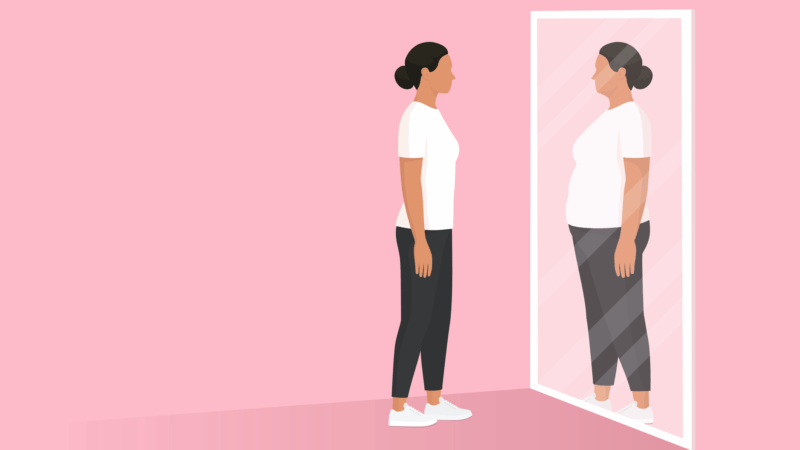
The social media platform TikTok recently banned a hashtag called #SkinnyTok after European regulators warned it was promoting unrealistic body images and extreme weight loss. The company had seen an onslaught of content featuring emaciated-looking young women peddling tips on how to drop weight quickly.
Now the hashtag may be gone, but eliminating this kind of harmful content is not that simple. There’s still no shortage of people — on TikTok and other social media platforms — spreading unhealthy information on how to eat fewer calories and get very, very thin.
Research shows that consuming this type of content on social media is correlated to a higher risk of disordered eating. Young women and girls are especially vulnerable.
But when it comes to nutrition and wellness, it can be hard to disentangle the unhealthy from the healthy.
“You have many kinds of content in the gray zones,” says Brooke Erin Duffy, who studies social media and culture at Cornell University. “Their regulation is much more difficult.”
Creators are good at taking advantage of this murky ground, says Duffy. “As soon as there is an attempt for platforms to regulate or thwart a hashtag, anyone using the platform is gonna develop a workaround,” she says.
A popular meme called “What I eat in a day,” for example, features people showing their daily food intake. Posts can either feature a balanced diet or one that could put someone in a dangerous calorie deficit. One young woman recently posted a video showing the single croissant she subsisted on in a day, whereas a different woman featured a balance of lean proteins and vegetables adding up to 1,800 calories.
Body-positive counterprogramming
Some creators on the front lines of the body image battle are making their own counterprogramming. Athlete and creator Kate Glavan — who has nearly 150,000 followers — urges her followers to take seriously the dangers of content that glamorizes undernourishment. She discusses her own struggle with an eating disorder in her videos.
“A lot of creators are explicitly promoting anorexia to their audience,” Glavan says in a recent TikTok video. “It’s dangerous. It’s misinformed,” she says, and she advises people to “block these creators.”
Research shows that anorexia has the highest mortality rate of any psychiatric disorder.
But researchers who study this issue say body-positive content doesn’t garner the same kinds of audiences — or profit. “Negative images that are unrealistic or show really thin people or really muscular people tend to have a more lasting impact than body-positive content,” says Amanda Raffoul, who researches eating disorders and social media at the University of Toronto.
Messaging that equates thinness with beauty is reinforced throughout society, Raffoul says.
Raffoul points to research that suggests consumption of body-positive content on social media does not necessarily provide protection against or counteract content that promotes unrealistic beauty standards or weight loss.
“The way that they structure content and the way that they code algorithms to amplify certain types of messaging and even target certain types of messaging to specific users puts that information in the hands of more vulnerable people,” Raffoul says.
Even though platforms aren’t creating content, says Raffoul, they are responsible for how aggressively they amplify different kinds of messaging or direct it at certain demographics.
TikTok declined a request for an interview for this story, but in an emailed statement stressed that they “regularly review safety measures to address evolving risks and have blocked search results for #skinnytok since it has become linked to unhealthy weight loss content.” Searches on the platform for this term are redirected to the National Alliance for Eating Disorders.
Among other safety strategies, the company says it continues to restrict videos for teen accounts and redirect searches to health experts, as well as partner with advocacy groups that offer strategies around recognizing and treating eating disorders.
A losing battle
Some body-positive warriors say the movement is having a low moment. “With the massive rise of GLP-1 drugs and their widespread use as a quick fix weight loss solution, we’ve seen this return of the narrative that thin is back in,” says Megan Jayne Crabbe, author of the recently published book We Don’t Make Ourselves Smaller Here. “The beauty standard has swung back towards extreme slimness,” Crabbe says.
While Crabbe still creates content on social media, she says it’s harder to break through with messaging that normalizes bigger bodies than it was a few years ago. She is glad to see #Skinnytok banned, but she says she sees a need for more soul searching on the question of beauty standards from Western culture. “I think banning the hashtag is a surface-level plaster to a very deep wound,” she says. “We are still deeply fat phobic as a society.”
Some content creators say the uphill battle against negative content around eating and skinny bodies is exhausting. “I don’t really claim it anymore,” says Nyome Nicholas-Williams, of the term “body positivity.” Nicholas-Williams — a Black woman and a plus-size model — says she feels pushed out of the movement that Black women started but she says has since been co-opted. “I’m more of like ‘body neutrality,'” she says.
In 2020, Nicholas-Williams publicly took on the social media platform Instagram, accusing the company of censoring content featuring Black plus-size models with different standards than those it used to police content featuring white, slim people. The company issued an apology and pledged to change its policies.
Nicholas-Williams says some of her public criticism of the social media platform has likely cost her business, but she thinks speaking out against dangerous content is an important strategy in combating it. “People speaking up and being brave,” she says, “that’s what it takes.”
Raffoul, who studies nutrition and social media at the University of Toronto, says the profit should not be overlooked. “Every second, every minute that we spend on these platforms is being monetized,” says Raffoul, who points out that eating disorders and ideals around unattainable thinness have been around for decades, but that social media platforms allow for a new delivery system.
Raffoul believes it will take lawmakers forcing change in order to create meaningful protection from dangerous content through these new channels.
Until that happens, she says, the best strategy to combat it is not to look at it at all.

Lack of transportation keeps many Alabamians from working. Rural public transit programs are trying to help
While lack of transportation is a major employment barrier in Alabama, few people take public transit to work. That dynamic is even more pronounced in rural areas.

When a horse whinnies, there’s more than meets the ear
A new study finds that horse whinnies are made of both a high and a low frequency, generated by different parts of the vocal tract. The two-tone sound may help horses convey more complex information.
Hundreds of American nurses choose Canada over the U.S. under Trump
More than 1,000 American nurses have successfully applied for licensure in British Columbia since April, a massive increase over prior years.
Trump’s many tariff tools mean consumer prices won’t go down, analysts say
The Supreme Court struck down President Trump's signature tariffs. But the president has other tariff tools, and consumers shouldn't expect cheaper prices anytime soon, economists say.

Tax credits for solar panels are available, but the catch is you can’t own them
Rooftop solar installers are steering customers toward leases instead of purchases. Federal tax credits for purchased systems have ended but are still available for leased ones.
5 takeaways from Trump’s State of the Union address
President Trump hit familiar notes on immigration and culture in his speech Tuesday night, but he largely underplayed the economic problems that voters say they are most concerned about.
