
This painting is missing. Do you have it?
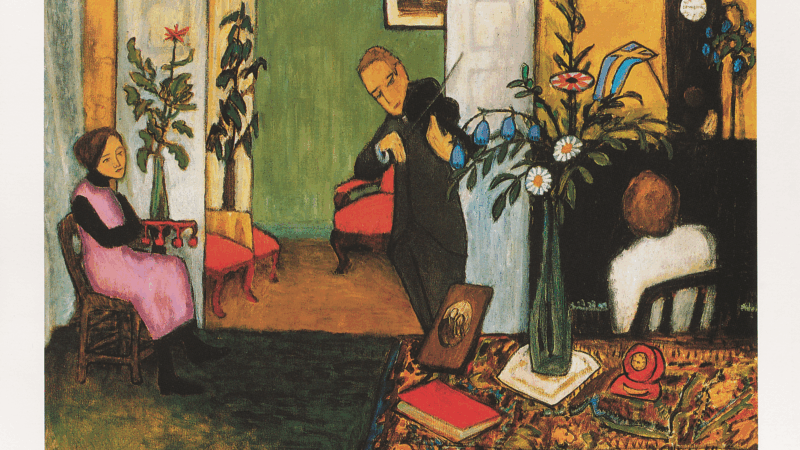
This is a story about a missing painting, from an artist you may never have heard of. Though she helped shape European modern art, German artist Gabriele Münter’s work was quickly overshadowed in the public’s mind by her 12-year relationship with noted abstract artist Wassily Kandinsky.
She met Kandinsky in Munich in 1902, and with his tutoring, she “mastered color as well as the line,” she told a German public broadcaster in 1957. Together with other artists, they founded an avant-garde arts collective called Der Blaue Reiter (The Blue Rider) in 1911.

At the time, most modern artists, like Kandinsky, were moving toward more and more abstract work. Not Münter. In her paintings, people look like people and flowers look like flowers. But her dazzling colors, simplified forms and dramatic scenes are startlingly fresh; her domestic scenes are so immediate that they feel like you’ve interrupted a crucial, private moment.
“Gabriele Münter was so pioneering, so adventurous in her adherence to life,” said Megan Fontanella, curator of modern art and provenance at the Guggenheim Museum in New York City. “She is revitalizing the still life, the landscape, the portrait genres, and presenting them in these really fresh and dynamic ways.”
Yet, perhaps due to her relationship with Kandinsky, her work was rarely collected by important museums after her death in 1962 (she herself said she was seen as “an unnecessary side dish” to him), and so her paintings largely disappeared from the public eye.
Now Münter is having a moment, with exhibitions this year in Madrid and Paris, as well as one currently at the Guggenheim in New York. The New York show is an expansive one and includes American street photography in the late 1890s, alongside over 50 paintings, from her dazzlingly colored European landscapes to portraits capturing the expressive faces of people she knew.

Yet, when Fontanella was putting “Gabriele Münter: Contours of a World” together, there was one painting she couldn’t find: Music, from 1916.
In it, a violinist is playing in the center of a yellow room, with two people quietly listening. It’s set in a living room — but because it uses her wild colors and flattened figures, it feels vibrant and dramatic, not cozy or saccharine.
Fontanella said this painting is important because it provides a window into Münter’s life after she separated from Kandinsky, who had gone on to marry someone else. She was struggling financially, and she was no longer the promising young person she once was. But Fontanella said the painting shows she had found a new creative circle.
“There’s something really uplifting about that. You know, it speaks to her resilience, her sense of adaptation,” Fontanella said. Instead of showing those years as dark and challenging, it is serene and warm, joyful. “I think that’s really important because especially with a woman artist, it’s so easy to get tripped up in her biography and really see it colored by her romantic relationships when, in fact, the paintings tell a different story.”
Fontanella said she used every tool available to her to find Music. She worked with Münter’s foundation and contacted owners of collections in Europe and the United States, from institutions to private collectors. She read correspondence and catalogs from past exhibitions.

It’s not unusual for art to vanish from public view if it’s not held at an institution. Private collectors often want to keep their holdings quiet. If they don’t sell a particular work at an auction or lend it to a museum, only a very small number of people might know that it still exists and where it is.
Fontanella was able to trace Music to its last known owner — a German collector named Eugen Eisenmann, who had the painting in 1977.
“There was a moment where the collection was starting to be broken apart and dispersed and no longer being held by subsequent relatives or family members,” she said.
Then the trail ended.
Not the end of the story
But just because the painting hasn’t surfaced yet doesn’t mean it never will. Take the story of a piece called There are combustibles in every State, which a spark might set fire to. —Washington, 26 December 1786, depicting Shays’ Rebellion, one of 30 works in the Struggle series by artist Jacob Lawrence. A 2020 traveling exhibition organized by the Peabody Essex Museum in Salem, Mass., had brought the works together for the first time in 60 years.
Five of the paintings couldn’t be located, and the curators put placeholders where those paintings should have been: black-and-white photographs of the canvases if they existed, blank spaces if they didn’t.
“We didn’t have any image of it. There really was no trace,” said Sylvia Yount, the curator in charge of the American Wing at the Metropolitan Museum of Art. She co-curated the Met’s presentation of the exhibition with curator Randall Griffey. “We had decided to leave the missing panels as kind of an absence, to really underline the absence. There was a blank on the wall.”
And, then, the miracle.
A visitor to the exhibition went home, contacted a friend “and said, ‘I think you might have one of these missing panels,'” Yount explained.
The friend did. When Yount, Griffey and art conservator Isabelle Duvernois went to see the painting — which was just across Central Park from the Met in an apartment on the Upper West Side — “we walked in and immediately knew it was right,” Yount said.
Within about two weeks, it was hanging in the exhibition. Incredibly, not long later, a second panel was found. Because that one needed some conservation work and a new frame, it didn’t join the series at the Met, but it did become part of the show later as it traveled across the United States.
That kind of thing “doesn’t happen every day,” Yount said, laughing.
Could it happen again?
But Fontanella hopes that it could happen for Münter’s painting. She included a photograph of it in the catalog so that people would know what to look for.
“What I always hope with stories like this is that the painting will resurface in its own time, you know, when it wants to be discovered,” Fontanella said. “But there’s been so much genuine interest in Gabriele Münter as an artist, as a person, that I feel it’s only just on the horizon that this painting will come to light.”
“Gabriele Münter: Contours of a World” is on view at the Guggenheim in New York through April 2026.
Ciera Crawford edited this story for broadcast and digital. Chloee Weiner mixed the audio.

Carney says he backs strikes on Iran ‘with some regret’ as world order frays
Canadian Prime Minister Mark Carney says he supports the strikes on Iran "with some regret" as they represent an extreme example of a rupturing world order.
Iranian civilians are now fleeing the relentless bombing for neighboring Turkey
As the U.S. military broadens its strikes in Iran, traumatized Iranians are reaching the border with Turkey.

A split Senate votes against measure to constrain Trump’s authorities in Iran
Democrats in the Senate were facing an uphill climb Wednesday in their push to restrain President Trump's ability to wage war against Iran.
WATCH: How traffic dried up in the Strait of Hormuz since the Iran war began
The effective closure of the Strait of Hormuz is "about as wrong as things could go" for global oil markets. Iran achieved it not with a naval blockade, but with cheap drones.

As Mississippi waits to spend opioid settlement funds, children and families suffer
Mississippi will receive more than $400M to fight the opioid epidemic. So far, officials haven't directed it toward programs that support addiction recovery.
Alabama’s new state climatologist takes the reins
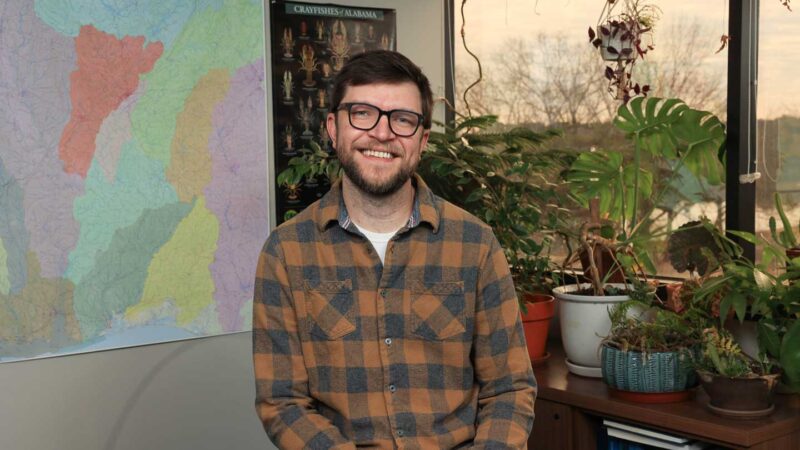
The controversial John Christy is retiring as Alabama’s state climatologist. Lee Ellenburg now assumes the role and is already making a few changes, including declaring that climate change is real and caused by humans.
