
These dogs can learn new words just by eavesdropping
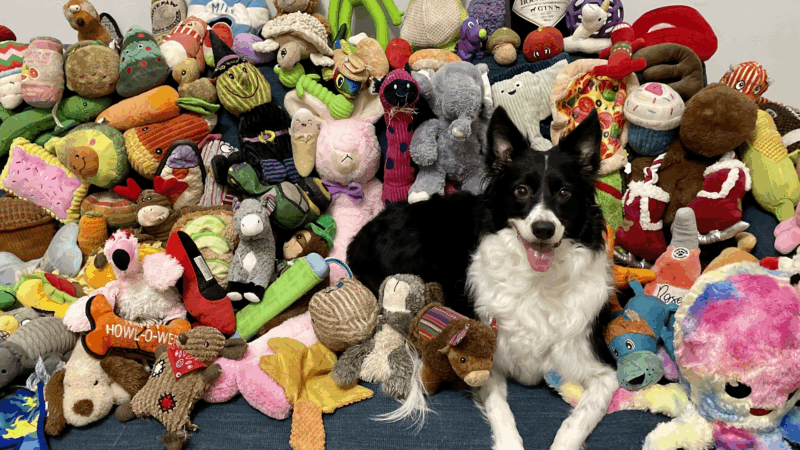
If you’ve ever had to spell out words like W-A-L-K or T-R-E-A-T around a dog, you know that some dogs listen in to humans’ chitchat and can pick out certain key words.
Well, it turns out that some genius dogs can learn a brand new word, like the name of an unfamiliar toy, by just overhearing brief interactions between two people.
What’s more, these “gifted” dogs can learn the name of a new toy even if they first hear this word when the toy is out of sight — as long as their favorite human is looking at the spot where the toy is hidden. That’s according to a new study in the journal Science.
“What we found in this study is that the dogs are using social communication. They’re using these social cues to understand what the owners are talking about,” says cognitive scientist Shany Dror of Eötvös Loránd University and the University of Veterinary Medicine, Vienna.
“This tells us that the ability to use social information is actually something that humans probably had before they had language,” she says, “and language was kind of hitchhiking on these social abilities.”
Fetch the ball — or the frisbee?
Figuring out how many spoken words are known by any particular dog can actually be pretty hard. That’s because words directed at dogs frequently get accompanied by a certain tone of voice, or patterns of behavior, so a dog may be responding to something like a hand movement rather than the word “sit.”
And while dogs may learn that a command like “fetch” means you want them to bring you something, says Dror, they generally are flummoxed by the difference between “fetch the ball” and “fetch the frisbee.”
“There’s only a very small group of dogs that are able to learn this differentiation and then can learn that certain labels refer to specific objects,” she says. “It’s quite hard to train this and some dogs seem to just be able to do it.”
For years, she and her colleagues have been working to find dozens of these rare dogs, through a search for genius canines that’s gotten a lot of media attention. (If your dog knows the names of five or more objects, by the way, they’d love to hear from you.) While many of the dogs are working breeds, especially Border collies, they’ve had other dogs like a Pekingese and mixed breeds as well.
“Normally, the owners contact us and tell us, ‘Oh, I’ve heard about your study,'” Dror says, explaining that these owners typically did not set out to have their dogs learn numerous words.
“It’s just they play with the dog, they give the dog a toy, and then one day they notice the dog knows the name of the toy and they start adding more and more toys,” says Dror, who explains that each toy gets called by its own unique name that the dog quickly learns. “I had one woman that told me that she doesn’t want to count, so her husband wouldn’t know how many toys the dog has. But they know a lot of toys.”
To explore the various ways that these dogs are capable of learning new words, Dror and some colleagues conducted a study that involved two people interacting while their dog sat nearby and watched. One person would show the other a brand new toy and talk about it, with the toy’s name embedded into sentences, such as “This is your armadillo. It has armadillo ears, little armadillo feet. It has a tail, like an armadillo tail.”
Even though none of this language was directed at the dogs, it turns out the super-learners registered the new toy’s name and were later able to pick it out of a pile, at the owner’s request.
To do this, the dogs had to go into a separate room where the pile was located, so the humans couldn’t give them any hints. Dror says that as she watched the dogs on camera from the other room, she was “honestly surprised” because they seemed to have so much confidence.
“Sometimes they just immediately went to the new toy, knowing what they’re supposed to do,” she says. “Their performance was really, really high.”
Regular pet dogs
She and her colleagues wondered if what mattered was the dog being able to see the toy while its name was said aloud, even if the words weren’t explicitly directed at the dog.
So they did another experiment that created a delay between the dog seeing a new toy and hearing its name. The dogs got to see the unfamiliar toy and then the owner dropped the toy in a bucket, so it was out of sight. Then the owner would talk to the dog, and mention the toy’s name, while glancing down at the bucket.
While this was more difficult for dogs, overall they still could use this information to learn the name of the toy and later retrieve it when asked. “This shows us how flexible they are able to learn,” says Dror. “They can use different mechanisms and learn under different conditions.”
It’s important to keep in mind, though, that these dogs were especially gifted, says Rochelle Newman, a language scientist at the University of Maryland.
“They did do a study with regular pet dogs and they didn’t find anything there,” she notes, so it’s not clear what an ordinary pet dog can learn from overhearing human speech.
Also, she says, the conversations that these genius dogs got to overhear in this experiment weren’t all that different from the kind of speech that people normally direct at dogs, only in this case it was directed at a person near the dog. That makes this scenario a bit different from the normal kinds of conversations that go on routinely between people at home.
“That said, this is still an impressive learning ability,” says Newman.
She says dogs’ language abilities are fascinating to study because they really share their lives with humans and can pick up elements of language without explicit training.
“I think one of the things that we don’t yet understand is all the factors that make one object deserving of a different name to a dog,” says Newman, noting that, to a dog, a ball that fits inside their mouth and a ball that doesn’t might seem like two dramatically different things.
All of this research, adds Dror, is ultimately about trying to learn how humans evolved to have unparalleled language abilities that make our species special.
“One of the ways that we can understand that,” she says, “is by looking at our closest friends.”

US military used laser to take down Border Protection drone, lawmakers say
The U.S. military used a laser to shoot down a Customs and Border Protection drone, members of Congress said Thursday, and the Federal Aviation Administration responded by closing more airspace near El Paso, Texas.

Deadline looms as Anthropic rejects Pentagon demands it remove AI safeguards
The Defense Department has been feuding with Anthropic over military uses of its artificial intelligence tools. At stake are hundreds of millions of dollars in contracts and access to some of the most advanced AI on the planet.

Pakistan’s defense minister says that there is now ‘open war’ with Afghanistan after latest strikes
Pakistan's defense minister said that his country ran out of "patience" and considers that there is now an "open war" with Afghanistan, after both countries launched strikes following an Afghan cross-border attack.

Hillary Clinton calls House Oversight questioning ‘repetitive’ in 6 hour deposition
In more than seven hours behind closed doors, former Secretary of State Hillary Clinton answered questions from the House Oversight Committee as it investigates Jeffrey Epstein.
Chicagoans pay respects to Jesse Jackson as cross-country memorial services begin
Memorial services for the Rev. Jesse Jackson Sr. to honor his long civil rights legacy begin in Chicago. Events will also take place in Washington, D.C., and South Carolina, where he was born and began his activism.

In reversal, Warner Bros. jilts Netflix for Paramount
Warner Bros. says Paramount's sweetened bid to buy the whole company is "superior" to an $83 billion deal it struck with Netflix for just its streaming services, studios, and intellectual property.
