
‘There’s no 911 for us’: Inside America’s elite urban search and rescue teams
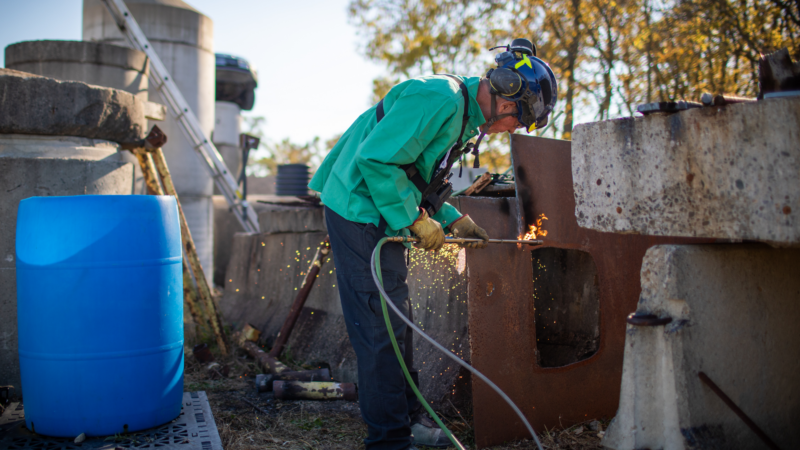
On a blustery morning in Dayton, Ohio, eight firefighters from around the country stand in front of a 20-foot concrete cylinder with the words “BELL TOWER” spray-painted on the front. They’re here for a search and rescue training course.
Instructor Grant Light holds up a blowtorch. “You’re going inside, and make a cut,” he explains, gesturing to the concrete cylinder. “Confined space cutting.”
A 6-foot-6-inch trainee from Virginia steps forward. “So, I’m going into the hole?” he asks, incredulously, pointing at a narrow-looking slot in the side of the tower. “Oh yeah!” Light says cheerfully.

The trainee looks dubiously at the opening and then stoops over, wiggling, grunting and cursing under his breath as he squeezes into the darkness with the torch.
The goal of the exercise, and of all the scenarios at this training, is to simulate the actual experience of rescuing people — whether it’s from a collapsed building or a pile of debris after a flood, hurricane or wildfire.
The members of the country’s urban search and rescue teams save lives and recover human remains after the biggest calamities. They were the ones who rescued people from rushing water during Hurricanes Helene and Milton last year. They searched through burned homes after wildfires in Lahaina, Hawaii, and Los Angeles, Calif. They sifted through the rubble after the catastrophic condominium collapse in Surfside, Fla., in 2021.

“The urban search and rescue program in the United States is by far the most extensive, most highly trained and probably most respected system in the entire world,” says Ken Pagurek, the former head of the Urban Search and Rescue branch at the Federal Emergency Management Agency (FEMA), which funds and oversees the national network of task forces.
But changes to FEMA proposed by the Trump administration are putting pressure on the country’s search and rescue system. The Trump administration has proposed eliminating FEMA as it currently exists, leaving the future of the agency’s search and rescue teams unclear. “Things are very in flux right now,” says Pagurek.
Thanks to chronic underfunding, the teams already operate on a shoestring budget. The search and rescue system as a whole receives about $40 million from Congress each year, which has not kept up with the cost of inflation, Pagurek says. He estimates the true cost to train and equip the teams is nearly twice as high.
Meanwhile, as climate change drives more extreme weather across the country, the teams are as busy as they’ve ever been. In 2024, search and rescue teams responded to a total of nine major disasters, according to FEMA. That is tied for the highest annual number going back to 1999, records maintained by the National Urban Search and Rescue Response System show.
“I don’t think there’s a tax-funded program in the United States that provides more return on investment for the public,” Pagurek says. “We’re going to do whatever we can to save that life.”

A sprawling system
There are 28 FEMA Urban Search and Rescue teams, also known as task forces, each with about 200 members, including paramedics, doctors and engineers. Most task force members come from a firefighting background, and the vast majority are men, which reflects the gender norms in firefighting more broadly.
It generally takes years for task force applicants to be accepted, according to Pennsylvania Task Force 1 team leader Ivan Lopez.
“They are supposed to be the elite. They are supposed to be the tip of the spear,” says Mike Muhl, who has served on Ohio Task Force 1 since its founding in 1998 and responded to the World Trade Center site in Manhattan after the Sept. 11, 2001, attacks. “We have a little saying, ‘It’s up to us.’ Because we don’t have anyone else to call. There’s no 911 for us. We can’t call another agency for help.”

In some ways, serving on a team is kind of like being in the National Guard: Most days, you just do your day job for a local fire department or other employer. Every month or so, depending on your role within the team, you do training exercises or enroll in special courses for skills such as handling search and rescue dogs or piloting boats in floodwaters. Each year, there are more than a dozen trainings offered by task forces all over the country.
Then, when there’s a major disaster, the federal government can deploy teams from anywhere in the country. When the call comes to deploy, team members must be on the road within about six hours.
All 28 task forces do the same training and have the same equipment, so they’re interchangeable and can work seamlessly with each other no matter where they’re deployed. A swift water rescue specialist from Texas can use a boat and lifesaving equipment that belongs to a team from Nebraska.

(Ryan Kellman | NPR)
Training to “be calm”
In October, about 40 people gathered in Dayton, Ohio, at the headquarters of Ohio Task Force 1, for a heavy equipment training. Over four days, they practiced cutting and moving giant slabs of concrete, vehicles and other debris using torches, cranes and excavators. One of the many exercises they did was the torch practice inside the “bell tower” cylinder.
The training mirrors real-world situations. Terrorism attacks, earthquakes, hurricanes and flash floods often trap people inside huge piles of debris, from collapsed buildings to mangled cars that were swept away by floodwaters.
“We have to train ourselves to be calm,” says instructor Ryan Hogsten, a 20-year veteran of the Ohio task force who has deployed to dozens of disasters, including the deadly flash floods that hit his home state of Kentucky earlier this year. “We gotta think clearly. They pay us to be calm. That’s our job.”
A calm demeanor is crucial because rescuers often work for hours on end. Frantic searching is ultimately less effective, Hogsten says.
One of the key skills they practice is math. Finding people in a debris pile requires a lot of arithmetic, geometry and even some light calculus, all done under enormous pressure and often with very little sleep.

Imagine that there is a person trapped under a large slab of concrete. In order to rescue that person, a crane must lift the slab. But different cranes and excavator machines are designed to lift different amounts of weight, depending on how the equipment is set up and how far away the load is. Picking up something that’s too heavy, or too far away, could cause a dangerous situation if the crane tips or breaks.
The search and rescue personnel must calculate the weight of the slab and measure how far it is from the crane. Then, they must calculate the center of gravity of the slab, so they can attach it to the crane in a way where it won’t fall, or spin wildly, as it’s lifted. Over the course of an hour, a search and rescue team can collectively do hundreds of high-stakes calculations.
“We give off one persona, because we like the rough-and-tumble rock-breaker image,” Muhl says. “But they’re actually doing math and algebra out there. There’s a true scientific component to what they’re doing.”

Federal dollars, local talent
Trainings like the one in Ohio are paid for with federal dollars, because FEMA sets the training standards for all 28 Urban Search and Rescue teams across the country.
That cooperative approach is what makes it possible for the U.S. to have a search and rescue system that covers the whole country, even rural areas that could never maintain such a force on their own.
And team members bring their training and experience back to their jobs as local firefighters as well, says John Morrison, a firefighter in Fairfax County, Va., who has served on Virginia Task Force 1 since 2003.
“It’s a pretty cool win-win situation,” says Morrison. “The same people responding to these disasters are the same people responding on your local fire engine back home.”
But the entire system is fragile, Pagurek warns. “The system is underfunded,” he explains. “This is an ongoing issue for at least 15 years, maybe 20.” Funding from Congress has stayed relatively flat, even as costs have risen, leading teams to struggle to pay for basic things like vehicle maintenance and rent for the warehouses to store their equipment.
For example, one of the trucks that Pennsylvania Task Force 1 uses to transport rescue equipment needs a new motor, but it’s unclear where that money would come from. There are too many more pressing needs, says Lopez. “The dollar is not going far enough,” he explains.

An uncertain future for FEMA
The Trump administration is moving to overhaul FEMA, which is part of the Department of Homeland Security (DHS). The president and DHS Secretary Kristi Noem have repeatedly said that FEMA should be eliminated as it currently exists. A presidentially appointed council of emergency management experts is expected to make recommendations about the future of FEMA in the coming weeks.
It’s unclear what those impending changes will mean for FEMA’s Urban Search and Rescue system. But the agency has struggled to deploy its resources since President Trump took office. Secretary Noem instituted a new policy that all spending above $100,000 must be personally approved by her, as NPR has reported.
That policy has created a severe bottleneck. It led to tens of thousands of unanswered calls to the agency from flood survivors in Texas after the deadly July 4 floods there. In a lengthy rebuttal posted on its website, DHS strenuously denied allegations that Noem did not authorize spending to deploy FEMA’s Urban Search and Rescue teams to the area until 72 hours after the floods occurred.
In response to questions about the Texas response, FEMA said in a statement to NPR, “Emergency response is locally executed, state managed and federally supported. As the state identified a need for additional search and rescue teams, FEMA quickly responded to the requests.” The agency did not respond to specific questions about when out-of-state teams were deployed, confirming only that FEMA activated the teams after Texas authorities requested help.

(Ryan Kellman | NPR)
Shortly after the floods, Pagurek resigned from his position at FEMA, where he had led the agency’s Urban Search and Rescue Branch for a year. He cited concerns that the administration’s policies are hurting the agency’s ability to respond to disasters. The reasons for his departure were first reported by CNN. In his resignation letter, Pagurek called his time at FEMA “the distinct honor and privilege of my life,” and wrote “This decision was not made lightly.”
FEMA has maintained both funding and staffing for the search and rescue system since President Trump took office, according to a statement from the agency.
Pagurek says he thinks everyone in the U.S. should understand the role that search and rescue teams play after disasters. “This is a resource available to anyone in the country,” he explains. “I think it’s incumbent on our political leaders to support that financially.”
NPR’s Ryan Kellman contributed to this story.

From Jesus to Jurassic Park: This year’s Super Bowl ads are playing it safe
Early Super Bowl spots show advertisers want lots of buzz but not controversy.
Suicide bombing at a Shiite mosque on Islamabad’s outskirts kills at least 31
It was a rare attack in the capital of Pakistan as its Western-allied government struggles to rein in a surge in militant attacks across the country.

Court records: Chicago immigration raid was about squatters, not Venezuelan gangs
In the documents the Department of Homeland Security said the raid "was based on intelligence that there were illegal aliens unlawfully occupying apartments in the building." There is no mention of criminal gangs or Tren de Aragua.

What does the CIA not want you to know? The quiz has the secret
Plus: ambiguous mascots, rodents with hard-to-spell names, and three boring photos of buildings.

Dog sled, ski ballet and other sports you could once see at the Winter Olympics
For many decades, Olympic Games included "demonstration sports." Some, like curling, became part of the permanent roster. But others, like skijoring, didn't stick around.

Minneapolis now has daily deportation flights. One man has been documenting them
A professional airplane enthusiast has been tracking the federally chartered deportation flights out of the Minneapolis airport as DHS sends immigration detainees to other states and, eventually, other countries.
