
The U.S. is a major importer of Indian products made from Russian oil
MUMBAI, India — Tariffs on many Indian-origin goods entering the United States have now been doubled to 50%. While India has long been seen by the U.S. as a bulwark against China, Indian goods now face some of the highest import taxes of products made anywhere in the world.
The Trump administration asserts that the additional tariff is punishment for India’s alleged funding and profiting off the Ukraine war by becoming a leading buyer of Russian crude oil at a discount and selling oil products the world over.
In a recent interview on Bloomberg Television, White House trade adviser Peter Navarro doubled down on the accusation that Indian Prime Minister Narendra Modi was financing the Kremlin’s “war machine,” even calling the Russia-Ukraine conflict “Modi’s war.”
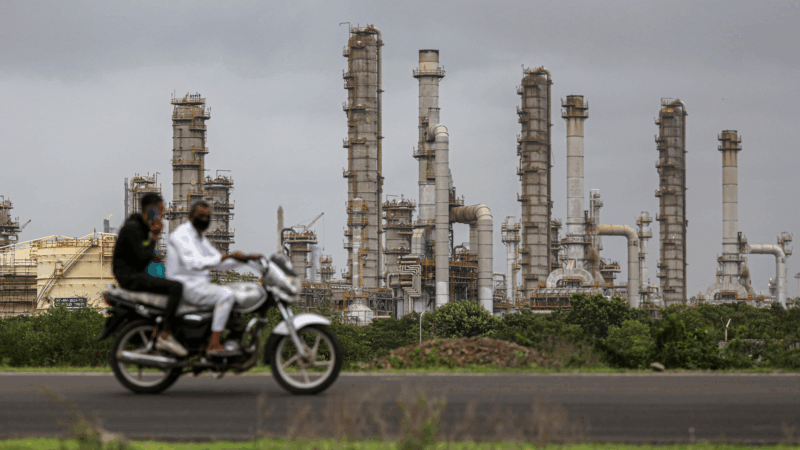
But while a majority of the oil that India imports is for its own use, Indian refineries also export oil products. An NPR analysis found that the U.S. is one of their biggest customers.
The U.S. bought oil products worth an estimated $1.4 billion from India between January and July of this year, says the Finnish think tank Centre for Research on Energy and Clean Air (CREA).
According to shipping data sourced by CREA, more than 90% of the Indian oil products imported by the U.S. came from the Reliance Industries refinery, owned by Asia’s richest man, Mukesh Ambani. The data also shows that the Reliance refinery gets nearly half its crude oil from Russia.
That means the U.S. is buying fuel made directly or indirectly from Russian oil, according to Isaac Levi, a researcher at CREA.
Loading…
Levi points out that the European Union recently banned imports of seaborne crude oil and refined oil products from Russia. He says, “The U.S. must follow suit if they want to stop sending hundreds of millions of dollars to the Kremlin war chest each year.”
Countries importing oil products, which can include gasoline and diesel, made from Russian oil include both allies and adversaries of the United States. Yet, none has faced penalties like India. (President Trump imposed a 50% tariff on Brazilian goods for different political reasons.)
China is the biggest importer of Russian crude, buying more than $4 billion worth of the fuel from Russia in July alone, according to CREA. Despite recent cutbacks, annual imports of Russian goods and fossil fuels by the U.S. and the EU run in the billions of dollars.
Indian Foreign Minister S. Jaishankar recently took issue with the U.S. decision to single out India, saying there were bigger trading partners with Russia to go after.
So far, India has projected defiance in the face of U.S. pressure, saying it will import from whichever country offers the best deal. It is also mending ties with rival China after years of tensions along their border. Last month, China’s ambassador to India said his country stands with New Delhi, telling reporters, “Silence only emboldens the bully.”
But in spite of its public stance, shipping data obtained from CREA suggests India’s imports from Russia declined after Trump’s threat of higher tariffs.
Impact of Trump’s penalty
Trump has been threatening for months to impose tariffs on countries importing Russian oil.
In mid-July, he gave Moscow an ultimatum to agree to a ceasefire, failing which its trade partners would face secondary tariffs.
Loading…
About a third of India’s oil imports are from Russia. According to CREA, average daily imports from Russia decreased 24% in July compared with June. They picked up in August, but the increase over July was only 5%.
Analysts, however, warn against seeing the dip as a direct consequence of Trump’s threats.
“Nearly 60% of the oil India buys is on long-term contracts,” says Lydia Powell, an analyst with the New Delhi-based Observer Research Foundation. Any disengagement from Russia can thus take months, if not longer, to kick in.
A possible explanation for July’s dip, says Powell, could be some refineries sourcing oil from spot markets where they got a better value. “While politics has a role in oil imports, most such decisions are influenced by economics,” says Powell.
Indian media quoted a senior official of the state-owned Bharat Petroleum Corp. as saying that the discount on Russian crude had contracted, which led to import volumes dipping in July. Days ahead of the fresh U.S. tariffs on India, Russia announced that it would offer a 5% discount to India on oil imports.
Powell says that the offer is “significant” but that one would need to track the oil procurement data for “at least a couple of months” before it could be said which is having a bigger impact: Trump’s threats or Russia’s inducements.
Loading…
No alternative to Russian oil
Most analysts, however, agree that even if India slashes its Russian imports, it will not be able to bring them down to zero. “Russia exports about 7.5 million barrels a day,” says Amit Bhandari, an energy expert at the Mumbai-based think tank Gateway House. Even though oil markets worry about an oversupply, Bhandari says, “There isn’t that much spare capacity in all of the world to frankly make that difference up.”
Any attempts to slash imports of Russian oil, says Bhandari, would spike up oil prices. “Say Russian oil miraculously stops coming into the world market. We are then probably looking at $150-a-barrel oil” — more than double the cost on world oil markets today. “That spike will be for every single consumer in the world, including the U.S., China and Europe.”
Ajay Srivastava, founder of the New Delhi-based Global Trade Research Initiative, says the combined U.S. tariffs on Indian goods are likely a ploy to get a better trade deal. Negotiations between the two countries have been stuck since July over India’s unwillingness to open up its dairy and agricultural sector to American companies.
The U.S. is India’s biggest export market. A 50% tariff is expected to hit India’s labor-intensive sectors the hardest, like textiles, gemstones and jewelry, seafood and automobiles. While there are tariff exemptions on Indian medicines and electronics, U.S. businesses and, potentially, customers buying shrimp, clothes and spices from India would end up paying a lot more.
The biggest casualty, says Srivastava, will be the goodwill between India and the United States, built after decades of bitterness over Washington’s support of India’s adversaries like Pakistan.
“The current generation of India’s youth grew up enamored with the U.S.,” he says. Trump’s actions will send them a message, he adds: “That the U.S. cannot be trusted.”

US military used laser to take down Border Protection drone, lawmakers say
The U.S. military used a laser to shoot down a Customs and Border Protection drone, members of Congress said Thursday, and the Federal Aviation Administration responded by closing more airspace near El Paso, Texas.

Deadline looms as Anthropic rejects Pentagon demands it remove AI safeguards
The Defense Department has been feuding with Anthropic over military uses of its artificial intelligence tools. At stake are hundreds of millions of dollars in contracts and access to some of the most advanced AI on the planet.
Pakistan’s defense minister says that there is now ‘open war’ with Afghanistan after latest strikes
Pakistan's defense minister said that his country ran out of "patience" and considers that there is now an "open war" with Afghanistan, after both countries launched strikes following an Afghan cross-border attack.
Hillary Clinton calls House Oversight questioning ‘repetitive’ in 6 hour deposition
In more than seven hours behind closed doors, former Secretary of State Hillary Clinton answered questions from the House Oversight Committee as it investigates Jeffrey Epstein.
Chicagoans pay respects to Jesse Jackson as cross-country memorial services begin
Memorial services for the Rev. Jesse Jackson Sr. to honor his long civil rights legacy begin in Chicago. Events will also take place in Washington, D.C., and South Carolina, where he was born and began his activism.

In reversal, Warner Bros. jilts Netflix for Paramount
Warner Bros. says Paramount's sweetened bid to buy the whole company is "superior" to an $83 billion deal it struck with Netflix for just its streaming services, studios, and intellectual property.
