
‘The Lost Bus’ brings you on board for a terrifying wildfire evacuation
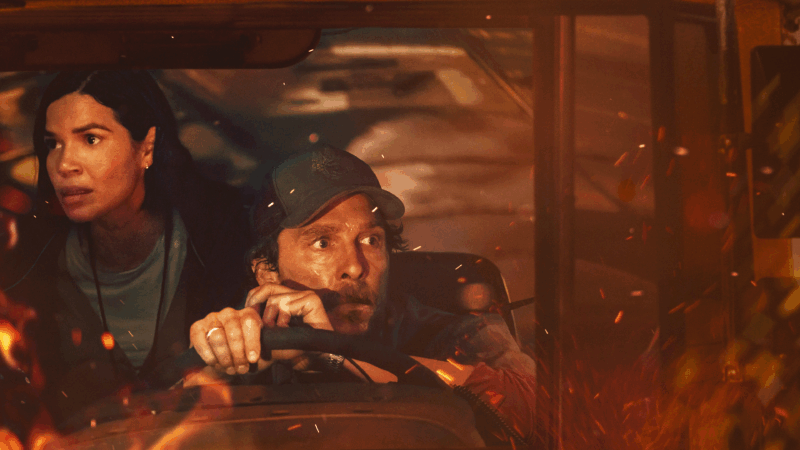
When I went to a screening of The Lost Bus at the Toronto International Film Festival last month, it was in a very big theater with a big screen and a big audience. The story of a bus driver and a schoolteacher getting a bus full of children to safety during California’s devastating 2018 Camp Fire, it stars Matthew McConaughey and America Ferrera, and there was quite a bit of curiosity about it. Its presentation of large fires is intense, to say the least. (The book the film is based on, Lizzie Johnson’s Paradise: One Town’s Struggle to Survive an American Wildfire, follows a number of stories, but the confined setting of the school bus makes this one an understandable choice to turn into a movie.)
I got on the elevator with a handful of other people to leave the theater, and as sometimes happens, there was a kind of a big exhale, just “whew,” as we unwound the tension. Someone muttered something about it being a lot to take in, and the woman standing opposite me told us that she’d just been through a fire like that recently, and she started to cry a little. By the time we got off the elevator, she seemed to have gathered herself, and she found her friends.
But I don’t know whether this experience of scale, of the intensity that we experienced in the theater, is going to be the way most people see The Lost Bus. That’s because after a couple of weeks of a fairly quiet limited theatrical release, it’s now available on Apple TV+. You can watch it on your TV, or on your laptop, or on your tablet, or on your phone.
I think we’re past general tooth-gnashing about people watching movies on non-theatrical screens having an inferior experience. It depends on the movie, it depends on the screen size you have, and it depends on the theater you’re comparing it to. There are real advantages to home viewing. You don’t have to get a babysitter, you can pause if you need to, you don’t get stuck next to people talking — we’ve had all these conversations. I don’t think it hurt CODA, Apple TV+’s best picture winner, to be seen mostly on screens in 2021. But CODA was not trying to convey the massive nature of anything in the way The Lost Bus conveys the power of fires. A disaster movie seen at home might be different from a family drama seen at home.
I don’t want to overstate the case, because home viewing is now how most people see Titanic and The Towering Inferno and Star Wars and even Lawrence of Arabia, all movies that you might think, “Well, a big viewing would be ideal.” It’s not necessary to be precious about this film above all others. But The Lost Bus is, like some of director Paul Greengrass’ other movies (United 93, 22 July) a story about a recent disaster. The Camp Fire was only seven years ago, and similar fires continue to happen. And for people who do not live in places where that threat has been prominent, the vastness of the challenge that fires create is worth reinforcing.
In a proper disaster movie, there are always character stories, and these are at least based on real life. McConaughey is good in the movie and well-suited to this character, and Ferrera is just right as the teacher responsible for steadying the kids on the bus. It doesn’t all work: Some of the dialogue between the two can be clunky, and the line where she points out that her name is Mary and not “ma’am” should have been pulled, because that line is in Speed, and you do not want in any way to make anyone think about Speed during this bus movie, because it is awkward in the extreme.
But it’s effective as a movie about fire itself, about its fierceness. It’s effective as a story about what a nightmare it is to traverse narrow little mountain roads with fire trucks (or school buses), and about the moments when the people responsible for fighting fires realize they have to surrender a particular area as lost and just try to evacuate as many people as they can. It shows some of the tension between the people responding to the fire and the representatives of Pacific Gas and Electric (PG&E), whose transmission lines started the fire, as the company later acknowledged.
In other words, I don’t think the woman on the elevator needed this movie; she already knows. It’s for people like me, who have not (so far) had to know about evacuation zones and safe routes. And I hope that even on smaller screens, the scale of it will translate.
This piece also appeared in NPR’s Pop Culture Happy Hour newsletter. Sign up for the newsletter so you don’t miss the next one, plus get weekly recommendations about what’s making us happy.
Listen to Pop Culture Happy Hour on Apple Podcasts and Spotify.

March for Life attendees may have been exposed to measles, DC Health warns
D.C. health officials are contacting people possibly exposed to measles at the March for Life in January, as confirmed cases rise nationwide.

U.S. gave Ukraine and Russia June deadline to reach peace agreement, Zelenskyy says
"The Americans are proposing the parties end the war by the beginning of this summer," Zelenskyy said, speaking to reporters on Friday.

U.K. leader’s chief of staff quits over hiring of Epstein friend as U.S. ambassador
British Prime Minister Keir Starmer's chief of staff resigned Sunday over the furor surrounding the appointment of Peter Mandelson as U.K. ambassador to the U.S. despite his ties to Jeffrey Epstein.

Trump administration lauds plastic surgeons’ statement on trans surgery for minors
A patient who came to regret the top surgery she got as a teen won a $2 million malpractice suit. Then, the American Society of Plastic Surgeons clarified its position that surgery is not recommended for transgender minors.

What you should know about Bad Bunny’s Super Bowl halftime show
Will the Puerto Rican superstar bring out any special guests? Will there be controversy? Here's what you should know about what could be the most significant concert of the year.

Sunday Puzzle: -IUM Pandemonium
NPR's Ayesha Rascoe plays the puzzle with KPBS listener Anthony Baio and Weekend Edition Puzzlemaster Will Shortz.
