
Supreme Court will weigh in on Trump’s tariffs. Here’s what to know about the case
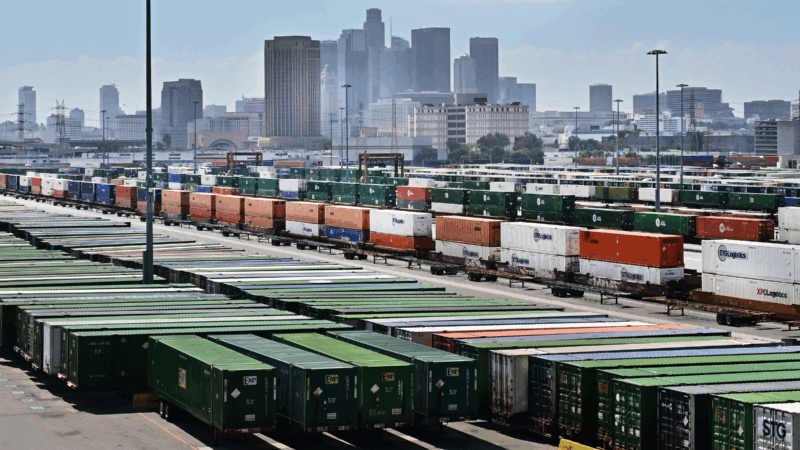
The Supreme Court said on Tuesday that it will examine whether President Trump acted lawfully when he used emergency powers to apply sweeping tariffs to a broad range of countries, a centerpiece of his economic agenda.
Earlier this year, a federal trade court and a federal appeals court found that some of Trump’s tariffs violated the law. The White House appealed to the Supreme Court, and now the high court has agreed to examine the appeal.
The court said it would hold arguments in the first week of November.
Which tariffs are at issue?
This case is about tariffs imposed using emergency powers under a law called the International Emergency Economic Powers Act, or IEEPA. That law gives the president a range of economic powers, including over imports and exports, “to deal with any unusual and extraordinary threat, which has its source in whole or substantial part outside the United States, to the national security, foreign policy, or economy of the United States, if the President declares a national emergency with respect to such threat.”
Trump used IEEPA powers for tariffs on individual countries first announced in April in a Rose Garden event where he held up large tables detailing the tariff rates he would impose on different countries’ goods. Since then, Trump has also announced these tariffs via letters posted on social media. Many of the tariffs went into effect last month.
This case is also about the tariffs on Canada, China and Mexico related to stopping fentanyl trafficking that Trump announced earlier this year.
But the case does not affect Trump’s sector-specific tariffs on products like steel and aluminum. Those tariffs are often called “Section 232 tariffs” after the section of the Trade Expansion Act of 1962 used to authorize them.

What will the court be considering?
Two separate lawsuits against the tariffs were brought by a group of small businesses and a group of state attorneys general. In May, the federal Court of International Trade ruled that IEEPA did not authorize the tariffs
In August, the Court of Appeals for the Federal Circuit agreed, noting in its opinion that “the core Congressional power to impose taxes such as tariffs is vested exclusively in the legislative branch by the Constitution.” The court added that IEEPA does not explicitly give the president the power to impose tariffs, and that it “seems unlikely” that Congress intended to give the president “unlimited authority” to do so.
The White House appealed, asking the Supreme Court to answer whether IEEPA in fact authorizes the tariffs Trump has imposed – and if so, whether that law “unconstitutionally delegates legislative authority to the President.”
What could the court decide?
The court could find that IEEPA authorizes these tariffs – in which case, they could stay in place, and Trump could keep using IEEPA to impose more tariffs.
Or, the court could find that the tariffs are entirely unlawful, and end them.
But there are a range of other possibilities. It could rule that some of Trump’s tariffs are legal and some are illegal. Or it could more specifically determine what types of tariffs – if any – are permitted under IEEPA.
“The Supreme Court could say these particular type of tariffs are not permitted, but other IEEPA tariffs are permitted,” said Kathleen Claussen, professor of law at Georgetown University. “So there’s a question of scope here.”
What happens if the court finds the tariffs are unlawful?
Experts say Trump could find other ways to use tariffs. “He wouldn’t be able to replicate the broad across-the-board nature of the tariffs that he’s imposed,” said Doug Irwin, professor of economics at Dartmouth College. “But he would be able to hit a lot of different countries and hit a lot of industries with tariffs using different parts of the tariff code.”
For example, the Section 232 tariffs on particular goods would remain in place, and there are other laws Trump could use. Not all of those laws would allow Trump to impose tariffs as quickly or as broadly as he has done under IEEPA, however. Some limit how high tariffs can be, or how long they can be imposed.
What would happen to the tariff revenue already collected?
The Trump administration has collected billions of dollars in IEEPA tariffs, raising the question of whether that money would have to be returned if the tariffs are ruled unlawful.
If the court addresses the issue of refunds, it’s not clear how narrow or broad its remedy might be, according to Claussen. For example, they might only address refunds for the handful of businesses involved in this case.
In that case, it’s possible other businesses would have to go through their own legal processes to get refunds, which could be logistically difficult, given the volume of money and businesses involved.
Treasury Secretary Scott Bessent has said that the government would pay back tariff money if the court orders it to do so
GOP Rep. Tony Gonzales faces pressure from party over affair allegations
The Texas Republican is facing calls from fellow House Republicans to resign, following allegations of an affair with a staffer who later died by suicide.
In pictures: Winter storm slams the east coast
Photos of cities in Connecticut, New York, New Jersey and Massachusetts as they cope with a powerful winter storm.

The FDA creates a quicker path for gene therapies
The Food and Drug Administration aims to evaluate treatments for rare diseases based on plausible evidence that they would work — without requiring a clinical trial first.

BAFTAs apologize after guest with Tourette syndrome uses racial slur during ceremony
A man with Tourette syndrome shouted a racial slur and other offensive remarks during the BAFTA awards ceremony Sunday. The BBC did not edit out his outbursts in its delayed broadcast.

‘Everything was in pieces:’ Lindsey Vonn describes grueling surgery on broken leg
In a recent video, the Olympic skier credits her surgeon with saving her leg from potential amputation.

A new lawsuit alleges DHS illegally tracked and intimidated observers
Observers watching federal immigration enforcement in Maine who were told by agents they were "domestic terrorists" and would be added to a "database" or "watchlist" are now part of a new federal class action lawsuit.
