
Supreme Court allows Trump to fire members of independent agency boards — for now
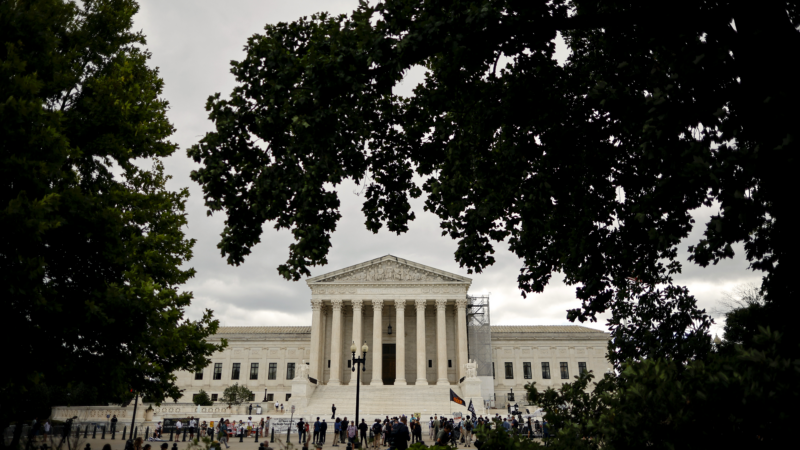
The U.S. Supreme Court granted for now the Trump administration’s emergency request to fire the heads of two independent agencies, the National Labor Relations Board and the Merit Systems Protection Board.
The vote was 6-3 with the liberals in dissent.
At issue is President Trump’s firing of National Labor Relations Board member Gwynne Wilcox, who still has three years left on her term as a member of the Board, and Cathy Harris, who still has four years left on her term as a member of the Merit Systems Protection Board, which handles employment challenges brought by federal workers.
Shortly after taking office for a second time, Trump began making sweeping personnel changes throughout the federal government, and firing the heads of several administrative agencies, including Wilcox and Harris, both Biden appointees.
The firings contradict statutes enacted by Congress that explicitly bar the president from firing members of the NLRB and the Merit Systems Protections Board without cause, meaning bad conduct. These protections exist, in part, thanks to a longstanding Supreme Court decision that for nearly a century has formed the basis for how most independent federal agencies operate, including statutory provisions for many agencies that limit the number of agency members from any one party.
Ironically, the longstanding precedent at issue in the case arose in 1933 when President Franklin Roosevelt fired William Humphrey, one of five members on the Federal Trade Commission. Roosevelt didn’t have a problem with Humphrey’s job performance. The sole reason for the dismissal was that Humphrey had been appointed by the previous president, Republican Herbert Hoover, and was a conservative who disagreed with Roosevelt’s policy views. Because the FTC had oversight over many progressive New Deal policies, Roosevelt wanted Humphrey replaced with his own appointee.
The Supreme Court, however, ruled unanimously in 1935 that the president could not dismiss FTC commissioners the way he could his own Cabinet or other members of his administration, and that he could only fire members of independent agencies for cause, meaning misconduct or other bad behavior.
While the Humphrey precedent is technically still in place, the current Supreme Court, dominated by a 6-to-3 conservative majority, has for years been chipping away at it, without overruling it entirely.
In 2020, the high court narrowed the Humphrey decision when it allowed President Trump, in his first term, to fire the head of the Consumer Financial Protection Bureau, another independent federal agency. In that decision, the Supreme Court distinguished between independent agencies run by a single director, whom the president may fire for any reason, and independent agencies run by a board made up of both Republicans and Democrats who still can only be fired for bad conduct.
In what remains the last vestige of the 90-year-old Humphrey case—which has never been challenged by any other president—multi-member boards of independent agencies, like the NLRB or the MSPB, currently remain protected. However, many of the court’s six conservatives seem to be itching to overturn the Humphrey’s precedent.
Before joining the court, Justice Brett Kavanaugh in particular took issue with the Humphrey decision repeatedly. But he is not alone, Justice Neil Gorsuch believes that the executive has been unconstitutionally weakened by a surplus of independent regulatory agencies and executive branch officials that are beyond the president’s control. Justice Samuel Alito expressed similar views before joining the court, saying of the presidency, “the president has not just some executive powers, but the executive power — the whole thing.”
Although Thursday’s decision was technically temporary, its tone was pretty final — and in exactly the direction the conservative court has been going in recent years. What’s more, the order all but outright reverses the unanimous decision of the court 90 years ago holding that a president cannot fire agency leaders just because he disagrees with their views.
The language of the two-page unsigned opinion clearly forecasts the eventual outcome of the case when it is argued before the court, likely next year. For example, there is a carve out for the Federal Reserve, essentially insulating it from the order. The idea the president could fire members of the Fed has spooked markets. That has been the fly in the ointment of those who want to corral federal agencies and make all the commissions like the SEC and the FTC, subject to firing at will by the president.
In dissent, Justice Elena Kagan quoted Alexander Hamilton as saying: “To avoid an arbitrary discretion in the courts, it is indispensable that they should be bound down by strict rules and precedents. Today’s order favors the president over our precedent.”
And, she added, “it does so unrestrained by the rules of briefing and argument—and the passage of time—needed to discipline our decision-making. I would deny the President’s application. I would do so based on the will of Congress, this Court’s seminal decision approving independent agencies’ for-cause protections, and the ensuing 90 years of this Nation’s history.”
House Dem. Leader Jeffries responds to air strikes on Iran by U.S. and Israel
NPR's Emily Kwong speaks to House Minority Leader Hakeem Jeffries (D-NY), who is still calling for a vote on a war powers resolution following a wave of U.S.- and Israel-led airstrikes on Iran.
Iran’s Ayatollah Ali Khamenei is killed in Israeli strike, ending 36-year iron rule
Khamenei, the Islamic Republic's second supreme leader, has been killed. He had held power since 1989, guiding Iran through difficult times — and overseeing the violent suppression of dissent.

Found: The 19th century silent film that first captured a robot attack
A newly rediscovered 1897 short by famed French filmmaker Georges Méliès is being hailed as the first-ever depiction of a robot in cinema.
‘One year of failure.’ The Lancet slams RFK Jr.’s first year as health chief
In a scathing review, the top US medical journal's editorial board warned that the "destruction that Kennedy has wrought in 1 in office might take generations to repair."
Here’s how world leaders are reacting to the US-Israel strikes on Iran
Several leaders voiced support for the operation – but most, including those who stopped short of condemning it, called for restraint moving forward.

How could the U.S. strikes in Iran affect the world’s oil supply?
Despite sanctions, Iran is one of the world's major oil producers, with much of its crude exported to China.
