
SpaceX launches international crew to space station on 6-month NASA mission

An international crew of four launched into orbit just before noon Friday from Florida on NASA’s Crew-11, a six-month mission to the International Space Station.
SpaceX’s Falcon 9 rocket roared to life on Kennedy Space Center’s Launch Complex 39-A, lofting the company’s Dragon capsule and crew on a nine-minute trip from the Earth’s surface into orbit.
The capsule is carrying NASA astronauts Zena Cardman and Mike Fincke, along with Japan Aerospace Exploration Agency astronaut Kimiya Yui and Russian cosmonaut Oleg Platonov.
It will take the crew about 15 hours to reach the ISS, with a docking planned Saturday around 3 a.m. ET. Once there, they’ll remain aboard the station for about six months, living and working on the orbiting lab, conducting dozens of science experiments.
Those include studying plant cell division and microgravity’s effects on bacterial-killing viruses. They’ll also perform experiments to produce a “higher volume of human stem cells and general on-demand nutrients.”
The Crew-11 mission marks the 12th time SpaceX is launching NASA astronauts to the ISS. In 2020, the private company began ferrying astronauts to the station as part of the agency’s Commercial Crew Program, ending a reliance on Russia for rides to the station after the retirement of the Space Shuttle program in 2011.

It is the first trip to space for mission commander Cardman. The 37-year-old geobiologist was selected by NASA in 2017 to join the astronaut corps. Her first flight was scheduled last year on SpaceX’s Crew-9 mission, but her assignment was bumped to make room for astronauts Butch Wilmore and Suni Williams.
Wilmore and Williams had arrived at the space station in Boeing’s Starliner capsule on the spacecraft’s first human test flight in June 2024. But hardware issues uncovered during that mission prompted NASA to select a new ride home for the crew — leaving the Starliner with no one aboard for its trip back to Earth. NASA and SpaceX flew Crew-9 to the station with two empty seats for Wilmore and Williams to use for their return in March.
“It was an unexpected change. But space flight is not about me or about any individual. It’s about what we can do together,” said Cardman. “Now I have the opportunity to train with this wonderful, amazing crew. Life is a journey. It takes many turns, and I’m just grateful to be here.”
For Crew-11 pilot Mike Fincke, it will be his fourth trip to the space station. His first two flights in 2004 and 2008 were aboard Russia’s Soyuz capsule. In 2011, he flew to the station on Space Shuttle Endeavour — the last launch of that vehicle.
There has been a continual human presence on the space station since its first crew arrived on October 31, 2000. But the orbiting outpost is set to retire by the end of the decade.
“We have a beautiful space station. I’m very proud of our space station,” said Fincke ahead of his launch. “This is something that I think that humans should just really remember of all the cool things we can do when we work together constructively.”
The mission marks the second trip to the station for Japan’s Yui Kimiya. It is the first spaceflight for Russia’s Oleg Platonov.

China sets a lower economic growth target of 4.5% to 5% for 2026 as challenges loom
China has signaled continuity rather than change for its economy, setting a slightly lower target for growth this year in the midst of a property slump and other headwinds at home and growing uncertainty abroad.
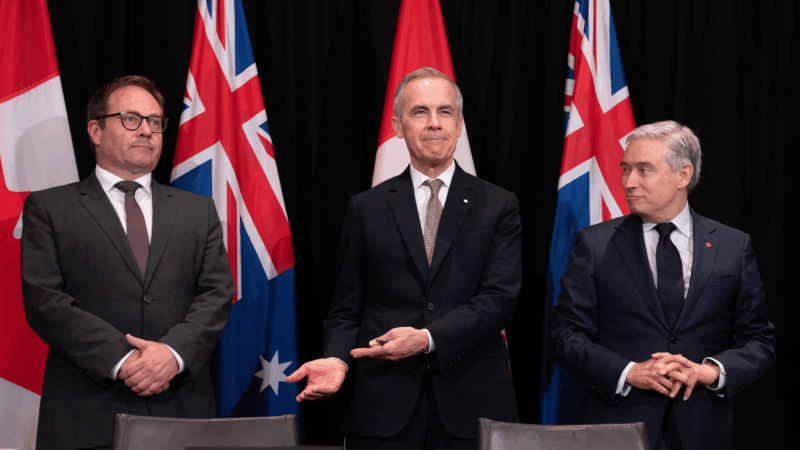
Carney says he backs strikes on Iran ‘with some regret’ as world order frays
Canadian Prime Minister Mark Carney says he supports the strikes on Iran "with some regret" as they represent an extreme example of a rupturing world order.
Iranian civilians are now fleeing the relentless bombing for neighboring Turkey
As the U.S. military broadens its strikes in Iran, traumatized Iranians are reaching the border with Turkey.

A split Senate votes against measure to constrain Trump’s authorities in Iran
Democrats in the Senate were facing an uphill climb Wednesday in their push to restrain President Trump's ability to wage war against Iran.
WATCH: How traffic dried up in the Strait of Hormuz since the Iran war began
The effective closure of the Strait of Hormuz is "about as wrong as things could go" for global oil markets. Iran achieved it not with a naval blockade, but with cheap drones.

As Mississippi waits to spend opioid settlement funds, children and families suffer
Mississippi will receive more than $400M to fight the opioid epidemic. So far, officials haven't directed it toward programs that support addiction recovery.
